
Free Options Snapshot API
Compare current option quotes, Greeks, implied volatility, open interest, freshness, quotas, and licensing before you build.
TL;DR
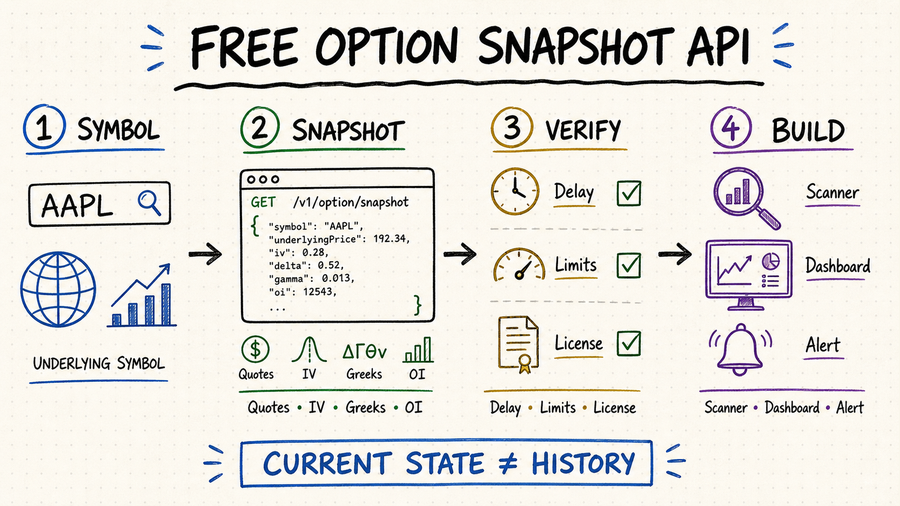
One current-state response for an option contract or chain, usually combining quotes, trades, IV, Greeks, volume, and open interest.
Free tiers fit prototypes, scanners, notebooks, dashboards, and low-frequency alerts that tolerate capped or delayed data.
A current snapshot endpoint does not automatically provide historical point-in-time snapshots for backtesting.
Request one liquid underlying, inspect timestamps and null fields, then calculate how many complete chains your quota supports.
Fields to expect in an option snapshot
A useful option snapshot joins contract identity with time-sensitive market state. Providers package the fields differently, so verify the response at contract level rather than relying on a feature-list checkmark.
Underlying, contract symbol, expiration, strike, call or put, exchange, and exercise style tell you exactly what the row represents.
Bid, ask, sizes, midpoint, last trade, volume, and open interest need their own source timestamps and market-status context.
Implied volatility and Greeks should include the provider's calculation timestamp and, where available, assumptions such as the underlying price, interest rate, dividend input, and pricing model.
The underlying quote, session status, and timestamp let you judge whether option and stock values were observed close enough together for comparison.
A snapshot is a bundle of clocks, not one timestamp
The bid and ask may be current, the last trade older, open interest from the previous clearing cycle, and Greeks newly calculated from a provider model. Store each source time separately. The HTTP response time only tells you when your application received the bundle; it does not make every field equally fresh.
Where free option snapshot access comes from
| Source type | Typical free access | Best for | Watch for |
|---|---|---|---|
| Broker API | Account-linked snapshots or streaming quotes. | Personal trading tools and order workflows. | Market-data subscriptions, entitlements, and snapshot fees. |
| Market data vendor | Capped or delayed contract and chain snapshots. | Structured prototypes, scanners, and evaluation. | Plan-specific endpoint access, credits, and exchange licensing. |
| Exchange or regulator | Reference files, delayed summaries, or reports. | Validation and official definitions. | Often not a developer-ready full chain API. |
| Community library | Convenient wrappers around public endpoints. | Exploration, education, and notebooks. | Unofficial endpoints and breaking changes. |
Free option snapshot API selection checklist
A provider can advertise a free account while reserving its unified snapshot or chain endpoint for a paid options tier.
Compare provider, exchange, quote, trade, and receipt times. “Snapshot” describes response shape, not guaranteed recency.
One underlying may span hundreds or thousands of contracts. Include pagination, expiration filters, retry traffic, and refresh frequency when converting a quota into usable chain snapshots.
Decide whether to retain, flag, or exclude crossed quotes, zero bids, absent Greeks, stale last trades, and contracts without open interest before downstream code sees them.
API access does not automatically grant historical storage, derived redistribution, public display, or use by multiple end users. Match the license to the product.
Run a contract-level acceptance test
Choose a liquid underlying, one near expiration, one longer-dated expiration, an at-the-money contract, and two wings. Capture the raw payload while the market is open and again after the close. Verify pagination, symbol normalization, quote ages, null semantics, underlying alignment, and whether the same request is reproducible.
Use QVeris to discover option snapshot capabilities
The exact QVeris Options Chain Tool is the closest verified match: its capability record includes calls and puts by expiration and strike with bid, ask, volume, open interest, and related chain fields. It is suitable for inspecting a current chain-shaped result, but its public record does not prove every market, entitlement, history window, or timestamp guarantee.
- Open one known symbol and expiration in the QVeris Playground before writing integration code.
- Inspect whether the result is contract-level or chain-level and whether pagination is required.
- Save the tool ID, parameters, raw response, retrieval time, and validation outcome for reproducibility.
FAQ
Not necessarily. Free access may be delayed, limited to certain markets, or exclude the snapshot endpoint even when a free account exists.
It depends on the endpoint. Some return one contract, some paginate contracts for one underlying, and others return a unified chain response.
Only if you captured or licensed point-in-time history. Repeatedly calling a current endpoint cannot reconstruct quotes and model values that were visible in the past.
They may use different underlying prices, rates, dividend assumptions, models, timestamps, or smoothing rules. Treat Greeks as calculated values, not exchange facts.
References and next steps
Massive unified snapshot
Tradier option chains
Alpha Vantage options documentation