
Free Open Interest API
for Options Research
Learn what free open interest data really includes, which limits matter, and how to turn raw option-chain fields into useful signals.
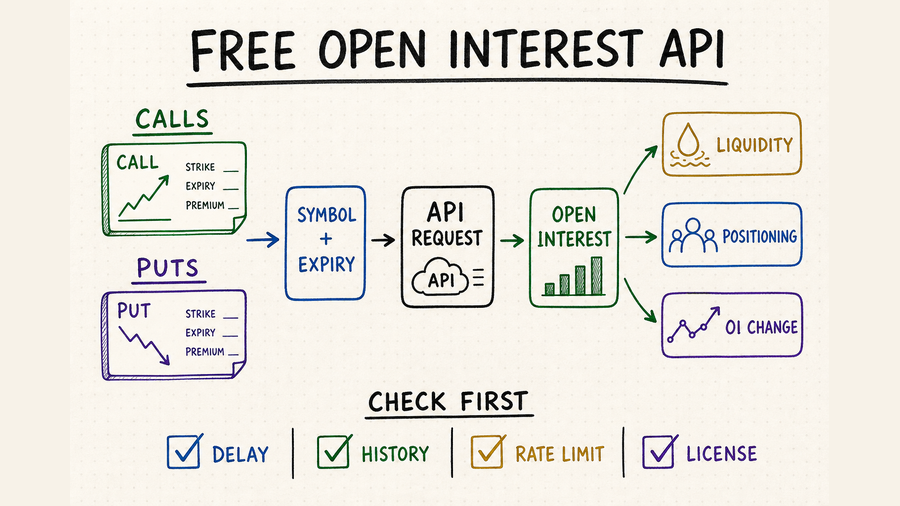
TL;DR
Open interest is the number of outstanding option contracts, usually reported by contract, strike, expiry, and call or put side.
Free access often comes with delayed updates, narrow market coverage, short history, or strict daily request limits.
It is useful for screening liquidity, mapping positioning, and tracking changes—not for proving whether traders are bullish or bearish by itself.
Verify timestamps, update frequency, historical depth, contract identifiers, licensing, and whether zero values mean zero or missing.
Fields a useful open interest API should return
A usable response needs enough identity and timing data to distinguish contracts and compare observations safely. Open interest without an as-of date, expiry, strike, and option type is difficult to trust.
Underlying symbol, standardized contract symbol, expiration date, strike price, and call/put type prevent accidental joins between different contracts.
An explicit as-of date and market timezone tell you whether the value is current, delayed, or the previous session’s official figure.
Volume, bid, ask, last price, implied volatility, and underlying price help separate active contracts from stale or illiquid listings.
Store daily snapshots yourself when the API does not return open-interest change. Compare like-for-like contract identifiers across sessions.
Treat open interest as a dated clearing snapshot
A quote can update throughout the session while its open-interest field still describes the previous clearing cycle. Keep separate fields for quote time and open-interest as-of date; never substitute the API retrieval time for either one. A value of zero must also remain distinct from null, unavailable, and not-yet-published.
Preserve contract identity through adjustments
Store the full standardized contract symbol plus underlying, expiration, strike, call/put side, multiplier, root, and adjustment status. Splits, mergers, and special distributions can create adjusted contracts whose deliverable is no longer a simple 100-share lot. Joining only on strike and expiration can silently combine different instruments.
Free open interest API access options
“Free” should be evaluated endpoint by endpoint, not by provider name. A supplier may offer a free API key while reserving current options chains, full history, or exchange-entitled fields for a paid plan. Check the live plan and documentation before designing around a request allowance.
| Access type | Typical benefit | Common free-tier limit | Best for |
|---|---|---|---|
| Broker API | Option chains alongside trading accounts and quotes. | Account required; redistribution may be restricted. | Personal tools and execution workflows. |
| Market-data API | Cleaner symbols, broader endpoints, and easier automation. | Delayed data, low request caps, or limited history. | Research prototypes and scheduled screens. |
| Exchange files | Authoritative definitions and official aggregate statistics. | Bulk formats; contract-level history may be paid. | Validation and market-level analysis. |
| QVeris | Discover and inspect suitable financial-data capabilities. | Provider entitlements and limits still apply. | Agents that need auditable capability selection. |
Compare suppliers with one controlled request
Useful when a brokerage-oriented option-chain endpoint fits the application. Confirm account requirements, market-data status, expiration filters, and whether the returned open interest is delayed or prior-session data.
Useful for a market-data workflow that also needs contract reference data, quotes, trades, snapshots, or aggregates. Verify the subscribed options tier and the timestamp attached to each field.
Useful for prototyping historical US options requests with an API key. Its documentation distinguishes historical and realtime functions, so do not infer realtime access from a historical response.
Useful as an exchange source for market statistics, product definitions, and commercial datasets. Public market totals are not a substitute for contract-level historical open interest.
Build a reliable open-interest pipeline
1. Define the research clock
Decide whether the screen runs after the official daily update, before the next open, or intraday with prior-session open interest. Document that choice beside the signal so later readers do not mistake a slow-moving clearing measure for live positioning.
2. Save immutable daily snapshots
Partition raw responses by supplier, market date, underlying, and retrieval time. Retain the original payload before normalization. Calculate change in open interest only after matching the same contract identity across two valid as-of dates; a single snapshot cannot reveal whether positions were opened or closed.
3. Validate before ranking contracts
- Reject duplicate contract-and-date keys and impossible negative values.
- Flag missing expirations, malformed standardized symbols, and unexplained multiplier changes.
- Measure chain coverage against the contract master rather than assuming a short response is complete.
- Keep volume, open interest, quote freshness, and spread as separate screening dimensions.
4. Separate concentration from direction
Large open interest can identify strikes where many contracts remain outstanding, but it does not disclose which side initiated each trade or whether positions are hedged elsewhere. Put/call ratios and changes in open interest are descriptive inputs; combine them with price, volatility, volume, and an explicit hypothesis rather than labeling them automatically bullish or bearish.
Where QVeris fits in open interest research
The exact QVeris Options Chain Tool is strongly relevant because its public capability record includes calls and puts by expiration and strike together with volume and open interest. Use that record to inspect inputs and response shape, but still verify market coverage, as-of semantics, history, and entitlements with a small test.
- Run one known underlying and expiration in the QVeris Playground before automating a full chain.
- Confirm that open interest, volume, strike, expiration, and option side are present and correctly typed.
- Record the tool ID, parameters, raw response, retrieval time, and validation result with the analysis.
FAQ
Usually not. Many markets publish official open interest after clearing, so an API can have live quotes while open interest reflects the prior session.
No. Volume counts contracts traded during a period; open interest counts contracts that remain outstanding.
No. You need matched observations from at least two clearing dates, and even the change does not identify trader direction or intent.
Correct contract identity, an explicit as-of date, stable coverage, enough request capacity, and terms that permit the intended storage and display.
References and next steps
Tradier option chains
Polygon options API
Alpha Vantage options documentation
Cboe options statistics