
Free 1-Minute Stock Data API
Compare 1-minute OHLCV fields, delays, sessions, history depth, rate limits, licensing, and integration tradeoffs.
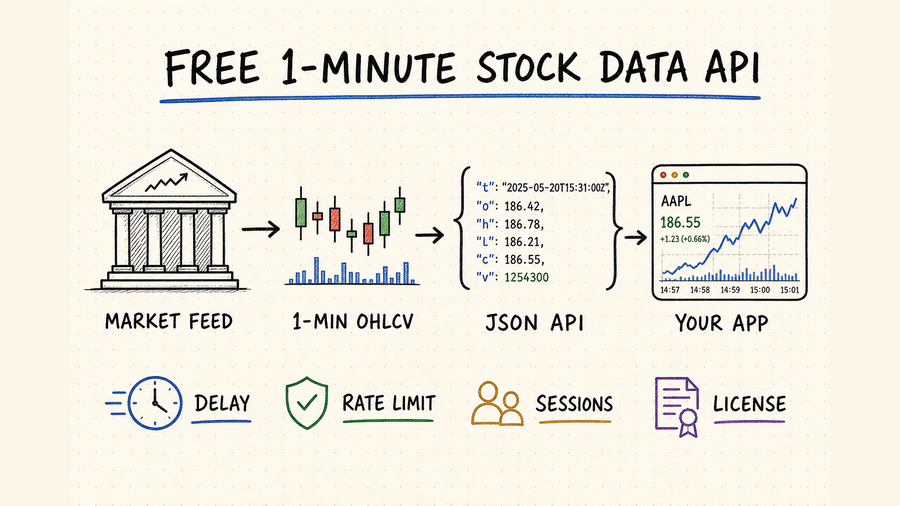
What a free minute stock data API must prove
A usable 1-minute feed must return completed and in-progress OHLCV bars with unambiguous timestamps, session rules, adjustment policy, market coverage, and freshness. “One minute” describes aggregation length, not real-time entitlement. Before choosing a free API, replay known trading sessions, compare bars with the provider's own interface or another licensed source, and calculate whether the quota supports your symbol count and refresh pattern.
For a 1-minute chart, request timestamped OHLCV bars. A latest-price endpoint cannot reliably reconstruct each minute’s open, high, low, close, and volume.
Confirm timezone, interval boundaries, regular versus extended sessions, delayed delivery, and whether the current bar is partial or complete.
Calculate symbols × requests per symbol × refreshes × users, then add retries and backfills. Daily allowance alone does not reveal burst constraints.
Personal research, internal analytics, public display, redistribution, and automated trading can carry different exchange and vendor permissions.
Fields a 1-minute stock data API should return
A usable minute bar needs more than a price. Store the provider's raw response beside your normalized record during evaluation so timestamp, adjustment, and correction problems remain diagnosable.
| Data | Fields to expect | Use | Common trap |
|---|---|---|---|
| OHLCV | Open, high, low, close, volume | Candles, indicators, alerts | Building bars from sparse quotes |
| Bar time | Start or end timestamp, timezone, interval | Align bars and fill gaps | Mixing UTC and exchange time |
| Session | Venue, regular/extended flag, status | Separate premarket and after-hours | Treating overnight gaps as missing data |
| Adjustments | Raw/adjusted flag, splits, dividends | Research and backtesting | Combining raw and adjusted series |
Define the interval boundary precisely
Decide whether a timestamp marks the bar start or end. For a start-stamped series, a U.S. regular-session bar at 09:30 represents trades from 09:30:00 up to—but not including—09:31:00 in the exchange timezone. Do not infer this convention from array order. Document it in the normalized schema and convert to UTC only after interpreting the provider timestamp correctly.
| Semantic check | Question to answer | Failure if ignored |
|---|---|---|
| Partial bar | Can the latest bar change until the interval closes? | Indicators repaint and alerts trigger on unfinished data. |
| Empty minute | Does the API omit no-trade intervals or emit zero-volume bars? | Forward filling may create fictitious liquidity. |
| Corrections | Can completed bars be revised after late or corrected trades? | Cached history diverges from the provider's final record. |
| Corporate actions | Are OHLC and volume raw, split-adjusted, or dividend-adjusted? | Returns, indicators, and backtests contain artificial jumps. |
What “free” means for minute stock data
Convert the advertised quota into your own workload: symbols × refreshes × users. A generous daily allowance can still fail if the provider enforces a tight per-minute burst limit.
Free feeds may be delayed, end-of-day only, or limited outside regular sessions. Label the timestamp and delay in the UI instead of implying live execution quality.
A provider may expose daily data for free while reserving 1-minute history, adjusted bars, extended hours, or larger output windows for paid plans. Confirm the exact endpoint—not the platform's broad “free data” claim.
Free access may be limited to personal or non-display use. Confirm whether you may cache, derive, display, redistribute, or use the data in a commercial product before implementation.
Representative supplier paths
Availability, free plans, delays, and commercial terms change. The table describes where to investigate, not a promise that every listed endpoint is free for your use case.
| Supplier | Minute-data route | Verify before choosing |
|---|---|---|
| Alpha Vantage | TIME_SERIES_INTRADAY supports 1-minute OHLCV plus adjustment and extended-hours controls. | Current premium status, entitlement, output window, rate and license. |
| Twelve Data | The time_series endpoint supports a 1min interval across plan-dependent instruments and markets. | Exchange coverage, credits per request, delay, history, commercial rights. |
| Alpaca | Historical stock bars and streaming market data integrate naturally with brokerage workflows. | Feed selection, SIP versus IEX coverage, subscription, rate, account requirements. |
| Polygon | Stock aggregate APIs and minute flat files serve historical and market-data workflows. | Plan access, freshness, source feed, flat-file versus REST cost, display rights. |
A resilient 1-minute bar integration pattern
Map provider-specific responses into your own Quote, Bar, and Instrument models. Keep raw payloads for debugging, but do not spread vendor field names through product code.
Cache completed historical minute bars much longer than the bar currently forming. Use explicit freshness rules and coalesce identical requests to protect the free quota.
Reject impossible timestamps, negative prices, inconsistent currencies, duplicate bars, and unexpected timezone shifts. Record the provider and retrieval time.
Use bounded historical requests to fill completed bars, then poll or stream only the live edge. Do not repeatedly download the full intraday window for every screen refresh.
After the session, re-fetch a small overlap and upsert by instrument, interval, and bar start. This captures vendor corrections without duplicating records.
Normalized bar contract: retain instrument_id, venue, interval, bar_start_utc, OHLCV, is_complete, session, adjustment, currency, provider, source_timestamp, and retrieved_at. Never mix raw and adjusted bars in one series.
Test the feed before trusting a chart
- Replay a normal session, an early close, a daylight-saving transition, a split date, and a low-liquidity symbol.
- Assert monotonic timestamps, fixed interval alignment, nonnegative prices and volume, OHLC relationships, currency, and duplicate policy.
- Simulate quota errors, timeouts, empty responses, malformed payloads, late bars, and corrections; verify retries do not invent or duplicate data.
- Display the source timestamp and delay separately from the application's retrieval time.
Find minute stock data capabilities with QVeris
A live catalog check did not surface one exact public QVeris Tool or Provider page that can be guaranteed to deliver 1-minute stock bars under every requested entitlement. The page therefore links to QVeris Docs and the QVeris Playground rather than inventing a match. Use discovery to find candidates, then inspect the selected capability's schema and cost signals before calling it.
- Search for quote, OHLCV, historical price, symbol lookup, and corporate-action capabilities.
- Inspect inputs and outputs before calling a tool from your code or agent.
- Keep provider selection separate from your normalized application model.
- Use the live market data provider comparison as a shortlist, then verify official supplier terms.
After discovery, compare interval boundaries, session coverage, adjustment policy, timestamps, quotas, and licensing before choosing the minute-bar capability your application will call.
FAQ
Yes for prototypes and limited research, but providers often restrict symbols, intraday history, request frequency, exchange coverage, or commercial display.
Not necessarily. One-minute is the bar interval, not a freshness guarantee. Check the source timestamp and documented delay.
Not reliably from occasional snapshots. Accurate bars require the relevant trade stream or provider-built aggregates with defined venue and correction rules.
Use one explicit convention for the research question. Adjusted history supports continuity; raw bars reflect traded prices. Never merge them silently.
Charts may need days; indicators need warm-up; research and validation may require months or years. Check the endpoint's actual intraday depth.
Do not assume so. Verify freshness, source feed, reliability, exchange entitlement, automation rights, and the consequences of delay or outage.
References and next steps
Alpha Vantage intraday documentation
Twelve Data API documentation
Alpaca stock market data
Polygon stock data documentation
QVeris market data comparison
QVeris Docs
QVeris Playground