
Free Market Sentiment API
Compare market-wide, news-derived, and market-implied sentiment signals, then validate coverage, history, limits, and JSON fields before integration.
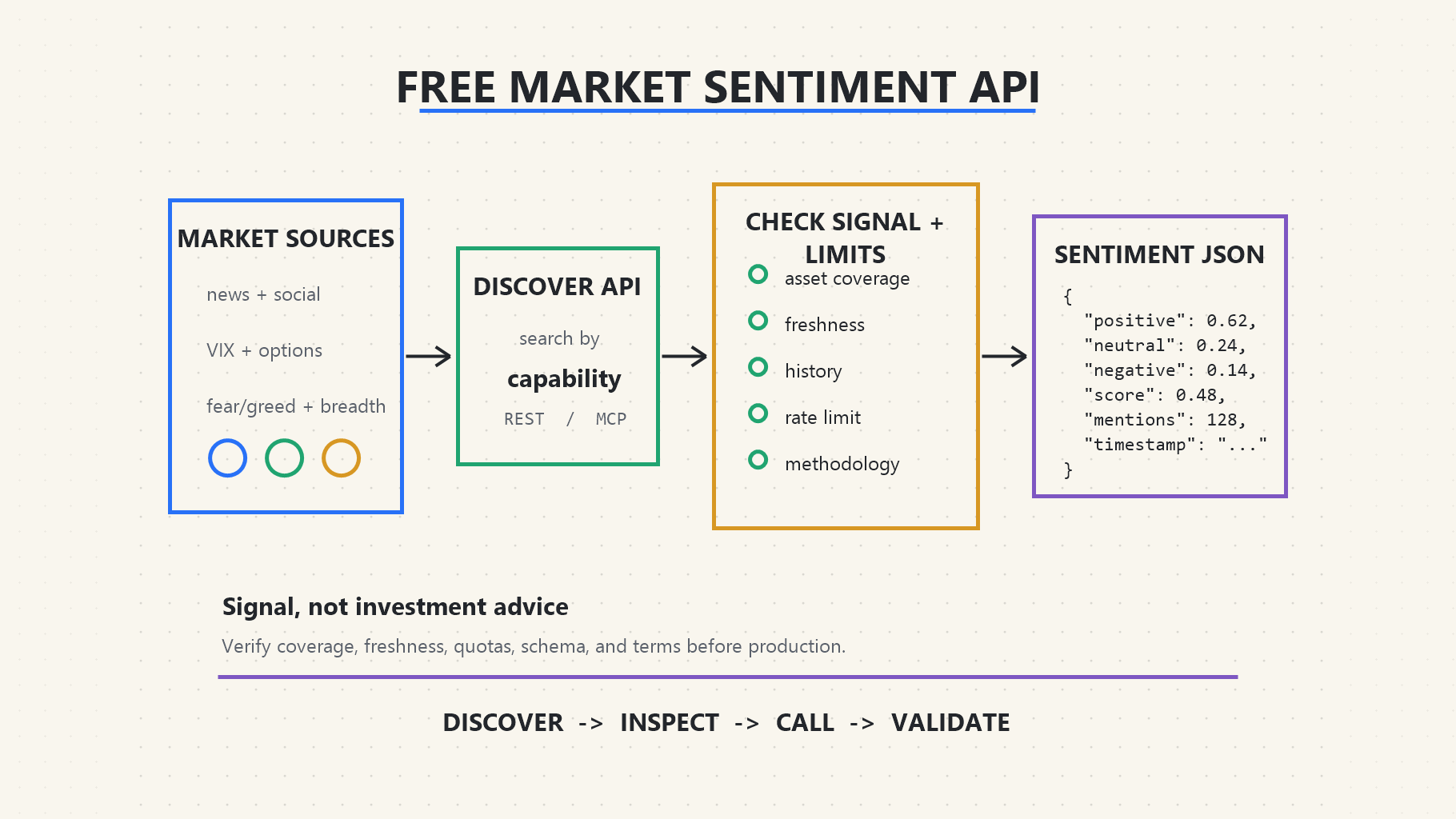
Signals a free market sentiment API should explain
Market sentiment is not one universal number. An endpoint may summarize investor mood across an index, score news about one symbol, or infer risk appetite from options and price behavior. The first selection task is to identify what the score measures and which assets it covers.
Composite fear and greed scores
A composite score combines several inputs into a bounded scale such as 0–100. Record every component, weighting rule, update time, and interpretation band. Two providers can use the same label while measuring different markets.
Financial news sentiment by symbol
News endpoints usually attach bullish, neutral, or bearish scores to articles, tickers, sectors, or topics. Check entity resolution, language coverage, duplicate handling, source timestamps, and whether the response includes the underlying article identifiers.
Market-implied risk appetite
VIX, put/call ratios, volatility term structure, price momentum, safe-haven demand, and advance-decline breadth can describe different parts of risk appetite. They are inputs to interpretation, not interchangeable sentiment labels.
Important: market sentiment describes a measured state or model output. It is not a guaranteed forecast, buy signal, or substitute for price, liquidity, and risk data.
Practical free starting points for market sentiment data
There is no single free endpoint that represents sentiment for every market. The most useful starting points fall into three groups: a published composite for one asset class, news-derived sentiment for named assets, or public component series used to build an internal index. Choose by the decision you need to support, not by which response happens to contain a field called score.
| Starting point | What it measures | Useful when | Main boundary |
|---|---|---|---|
| Alternative.me Fear & Greed API | A published crypto-market composite with value, classification, timestamp, and optional historical results. | A prototype needs a simple crypto regime indicator through a public GET endpoint. | It represents crypto sentiment, not stocks or a named token. Attribution is required, and the published index methodology must remain part of the interpretation. |
| Alpha Vantage News & Sentiment | Live and historical news with sentiment for ticker and topic filters across stocks, crypto, forex, and market themes. | The application needs asset-linked narrative sentiment and the underlying article metadata in one response. | An API key is required and the current free service is limited to 25 requests per day. Article-level or ticker-level news sentiment is not a market-wide fear-and-greed index. |
| FRED and ALFRED component series | Public economic and financial time series, including observations, release metadata, updates, and vintage dates that can support an internal regime model. | A research team wants transparent components such as volatility or macro conditions and is prepared to define normalization and weights. | FRED supplies component data, not a ready-made sentiment conclusion. Series frequency, release lag, revisions, licenses, and real-time vintages must be handled explicitly. |
Do not merge these scores directly: a crypto composite, a ticker-news score, and a volatility observation describe different populations and timescales. Preserve each source signal first; create a combined index only under a documented methodology.
How to compare free market sentiment API endpoints
A useful comparison separates signal quality from commercial access. “Free” may mean a no-key public endpoint, a monthly credit allowance, a trial, delayed observations, or a restricted historical window.
| Check | What to verify | Why it changes the result |
|---|---|---|
| Asset scope | Whole market, index, sector, stock, ETF, crypto, or multi-asset | A broad market score cannot replace symbol-level sentiment. |
| Methodology | Components, weights, model version, score range, and null rules | The same numeric value can have different meanings across APIs. |
| Freshness | Observation time, publication time, ingestion time, cache, and delay | A current response can still contain stale source data. |
| History | Start date, interval, timezone, revisions, and retention | Backtests require consistent historical definitions. |
| Free access | API key, requests per minute, monthly credits, fields, and commercial use | A prototype allowance may not support production traffic. |
| Response contract | Symbol, market, score, label, components, timestamp, confidence, and source | Stable fields make validation and provider changes safer. |
Free market sentiment API Python integration pattern
Request one market and time window
Begin with one documented symbol or market aggregate such as a broad index proxy. Request only the fields needed for validation and use a finite network timeout.
Validate the sentiment JSON contract
Require the asset identifier, score, label, observation timestamp, update timestamp, and component metadata. Reject unknown score ranges instead of guessing how to normalize them.
Preserve raw values before normalization
Store the provider response and methodology version. Convert scores into an internal scale only after documenting the original range and handling missing components explicitly.
import os
import requests

response = requests.get(
    "https://provider.example/v1/market/sentiment",
    headers={"Authorization": f"Bearer {os.environ['API_KEY']}"},
    params={"symbol": "SPY", "window": "1d"},
    timeout=20,
)
response.raise_for_status()
payload = response.json()

required = {"symbol", "score", "label", "observed_at", "updated_at"}
if not required.issubset(payload):
    raise ValueError("Unexpected market sentiment response schema")

score = float(payload["score"])
if not 0 <= score <= 100:
    raise ValueError("Unsupported sentiment score range")
The hostname and field names are illustrative. Replace them with the selected provider’s documented endpoint and schema; never send an example hostname to production.
Turn market sentiment data into a testable workflow
Build a market regime dashboard
Display the composite score beside its components, timestamps, and historical range. A chart without methodology or freshness can make unlike observations look comparable.
Use sentiment as a risk filter
A bot can pause, reduce, or flag an action when sentiment conflicts with another rule, but the decision should also inspect price, volatility, liquidity, and position limits.
Backtest without look-ahead leakage
Use the timestamp when the sentiment value became available, not merely the date of the underlying article or market observation. Preserve revisions and missing periods.
Validate regime meaning, not just score direction
Build a dated sample across calm, selloff, rebound, earnings-heavy, and low-liquidity periods. For every observation, retain components, methodology version, availability time, and subsequent market context. Test stability when one component is missing and compare the score with volatility, breadth, and returns without treating correlation as causation.
Design a market sentiment composite without hiding the inputs
If no published score matches the target market, an internal composite can combine volatility, breadth, momentum, options, funding, safe-haven demand, or news measures. The hard part is not averaging numbers; it is making observations with different units, frequencies, publication lags, and missing-value behavior comparable without introducing future information.
Define the population and decision horizon
State whether the index describes US equities, a global portfolio, large-cap crypto, or another universe. Match input windows to the intended decision—intraday risk control, daily market regime, or weekly allocation—and do not combine horizons merely because the latest values are available.
Normalize with information available at the time
Transform each component using fixed thresholds or rolling statistics calculated only from earlier observations. Record the lookback, clipping rule, direction, and whether a high value means fear or risk appetite. A full-history z-score computed after the test period leaks future distribution information.
Version weights and component membership
Publish the formula, component weights, effective date, and change reason. If a series becomes unavailable, do not silently redistribute its weight. Either hold the last valid observation for a documented period, calculate a partial score with a quality flag, or suspend the composite.
Keep observation time separate from availability time
A value may describe Friday but become available on Monday. Store both timestamps and use availability time in backtests and alerts. For revised macro series, retain the vintage originally available rather than substituting the newest history.
Return quality context beside the score
Include the composite value, interpretation band, component values, missing-component count, methodology version, observed-through time, calculated time, and next expected update. A single 0–100 number without those fields is difficult to monitor or reproduce.
Acceptance test: reconstruct ten historical dates using only the source vintages available on each date. The calculated value and quality flags should match the stored output exactly. Then remove one component at a time to test whether a single input dominates the classification.
How QVeris helps find market sentiment data capabilities
QVeris is a capability routing network. It helps agents discover relevant financial data capabilities, inspect accepted inputs and returned fields, and call a selected capability through a consistent workflow. It does not guarantee that a provider is free, real time, suitable for trading, or licensed for every use.
- Open the QVeris News Sentiment tool details to inspect the exact inputs and output.
- Inspect the current provider documentation for authentication, quota, history, timestamps, and licensing.
- Use the QVeris REST API reference to connect the chosen capability to an auditable agent workflow.
Free market sentiment API questions
Yes. Some providers expose a free tier, trial, or no-key endpoint for fear and greed, news sentiment, volatility, breadth, or composite market mood. Coverage and limits vary.
Typical responses include an asset or market identifier, bullish or bearish label, normalized score, component values, observation time, update time, and sometimes confidence.
Not reliably by itself. Sentiment can support a dashboard, regime model, or risk filter, but it should be tested with price, volatility, liquidity, and explicit risk rules.
Request one documented symbol or market, verify status and timestamps, validate the JSON schema and score range, then preserve the raw response before normalization.
Not always. A free endpoint may be delayed, cached, sampled, or updated hourly or daily. Check both the response timestamp and the source observation timestamp.
Compare asset scope, methodology, components, freshness, history, score range, rate limits, authentication, null behavior, licensing, and commercial-use terms.