
Free Market Movers API
Build trustworthy gainers, losers, and most-active lists by defining the session, comparison price, ranking formula, liquidity floor, security universe, timestamp, and market-data entitlement—not merely by accepting a provider’s top-20 response.
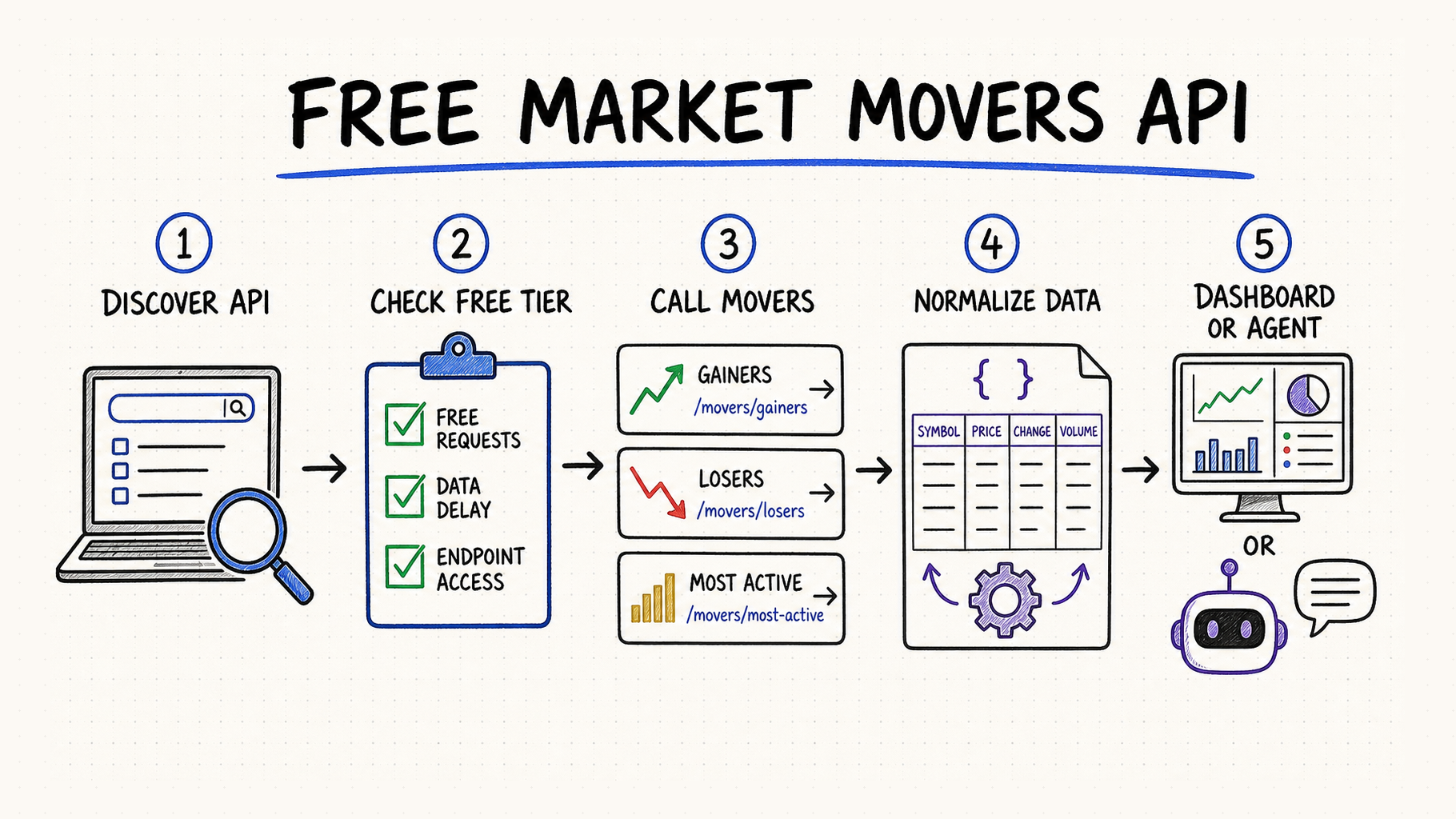
TL;DR
Gainers may rank percent or absolute change; “active” may mean shares, dollar volume, trade count, or unusual volume. Store the exact sort field.
Premarket, regular hours, after-hours, and completed-day lists use different liquidity and reference prices. Label the session and timezone.
Price floors, volume or dollar-volume minimums, security type, exchange, halted status, and corporate actions materially change the leaderboard.
A free key may expose delayed, historical, or end-of-day values. Return provider timestamp and freshness state with every result.
What to check in a free market movers API
A useful market-movers API should answer operational questions clearly: which leaderboards exist, what the free plan returns, how delayed the observations are, and whether the result is suitable for a scanner, dashboard, alert, or AI agent.
A leaderboard is a derived dataset. Its rank depends on the eligible universe, snapshot time, reference close, corporate-action adjustment, stale-quote rules, and tie handling. Two APIs can use the same quotes and still return different movers without either response being mechanically wrong. A production contract must expose enough metadata to explain the difference.
Top gainers and losers API coverage
Confirm whether the endpoint returns both directions and how it ranks change: percentage, absolute price move, or another field.
Most active stocks API fields
Check whether activity means share volume, dollar volume, trade count, or provider-specific logic.
Real-time market movers API entitlement
Read the documentation carefully. A free key can coexist with delayed or end-of-day market data because exchange entitlements are separate.
Market and session coverage
Verify US exchanges, premarket and after-hours support, minimum-volume filters, pagination, timestamps, and reset times.
Reference price and corporate actions
Confirm whether percent change uses previous regular-session close, adjusted close, session open, or another baseline. Splits and special distributions can create false movers if the baseline is not adjusted consistently.
Universe and quality filters
Check common shares versus ETFs, ADRs, warrants, units, OTC securities, halted symbols, stale quotes, price floors, and minimum dollar volume. A broad unfiltered universe often promotes illiquid noise.
Worked example: one snapshot, four valid leaderboards
Assume the following regular-session snapshot uses adjusted prior closes and contains only eligible common stocks. Percent change is (current ÷ prior close − 1) × 100; dollar volume is current × shares traded.
| Symbol | Prior / current | Change | Share volume | Dollar volume |
|---|---|---|---|---|
| A | $10 / $12 | +20% | 100,000 | $1.2M |
| B | $50 / $51 | +2% | 2,000,000 | $102M |
| C | $5 / $4 | −20% | 5,000,000 | $20M |
The result depends on the named metric. A leads the gainers list; C leads the losers list and the share-volume list; B leads by dollar volume. Calling all four outputs “most active” or sorting a mixed list by an undocumented field makes the ranking impossible to reproduce. Store the formula, filters, snapshot timestamp, and tie rule with every list.
Free stock market movers API comparison
| Provider | Mover coverage | Free-access caveat | Useful for |
|---|---|---|---|
| Alpha Vantage | Top 20 gainers, losers, and most active US tickers. | Documentation says default output is historical; delayed and real-time access depend on entitlement. | Simple three-list prototypes. |
| Massive | Top 20 US stock gainers or losers with snapshot fields. | Plan access and data entitlement must be checked on the current pricing/docs page. | Snapshot-driven scanners. |
| Webull | Gainers/losers with premarket, after-hours, intraday, and longer ranking periods. | OpenAPI onboarding and market-data permissions apply; do not assume every tier is anonymous or free. | Session-aware ranking. |
| QVeris | Discovers and calls suitable financial-data capabilities rather than inventing a separate exchange feed. | The selected provider's limits, licensing, and freshness still govern the returned data. | Agents that need inspectable tool access. |
How to integrate a market movers API
Choose gainers, losers, most active, or premarket movers first. Record the market, timezone, session, sort field, and minimum-liquidity rule.
Check request quotas, endpoint access, authentication, attribution, commercial-use terms, and whether the free response is delayed.
Map provider fields to symbol, price, change, percentChange, volume, timestamp, and marketSession. Preserve the provider timestamp.
Market-mover snapshots may repopulate after daily clearing. Treat empty lists, holidays, pre-open periods, rate limits, and stale timestamps as explicit states.
When price, reference price, and volume are present, recalculate change and percent change, then verify ordering after applying your liquidity filters. Flag stale quotes, zero or invalid reference prices, split discontinuities, and ranks inconsistent with the documented field.
Key cached results by market, session, universe, filters, sort field, entitlement, and snapshot time. Do not serve a premarket list as a regular-session list or retain a “live” label after the provider timestamp becomes stale.
Use QVeris to find and call market movers data
QVeris can help an agent discover and inspect gainers, losers, volume leaders, dollar-volume leaders, or session-specific mover capabilities. Before calling one, the agent should state the market, eligible security types, session, sort formula, liquidity floor, result count, data entitlement, and freshness tolerance. It should cite the provider timestamp and must not compare ranks built from incompatible universes or sessions.
- Open the QVeris Market Movers tool details for the required list and session.
- Inspect parameters and returned fields before calling a provider-backed capability.
- Keep provider licensing, free-tier limits, and timestamps visible in the application.
FAQ
Some providers offer a free key or limited plan. Verify which lists are included, whether results are current or historical, exchange entitlement, request quota, eligible securities, attribution, and commercial-use terms.
Sometimes, but never assume it from a free API key. Check exchange entitlement, provider timestamp, refresh schedule, session, and any delay label. A frequently refreshed endpoint can still contain delayed underlying quotes.
Usually by percent change from a documented reference price, with absolute change as a separate field. Define the session, adjusted baseline, eligible universe, price and liquidity floors, stale-quote rule, and tie handling.
It can mean share volume, dollar volume, trade count, turnover, or unusual volume relative to history. The API should name the metric and window; these rankings are not interchangeable.
Use an endpoint with explicit extended-hours support, select the premarket session, verify the comparison baseline and snapshot timestamp, and enforce stronger liquidity filters because extended-hours trading can be thin.
They may differ in universe, entitlement, snapshot time, session, reference price, corporate-action adjustment, filters, or sort field. Compare those contracts before treating either list as incorrect.