
Use a Free Live Stock Data API
Without Hidden SurprisesFree Live Stock Data API
Verify quote freshness, exchange feeds, entitlements, streaming support, limits, and fallback behavior before you ship.
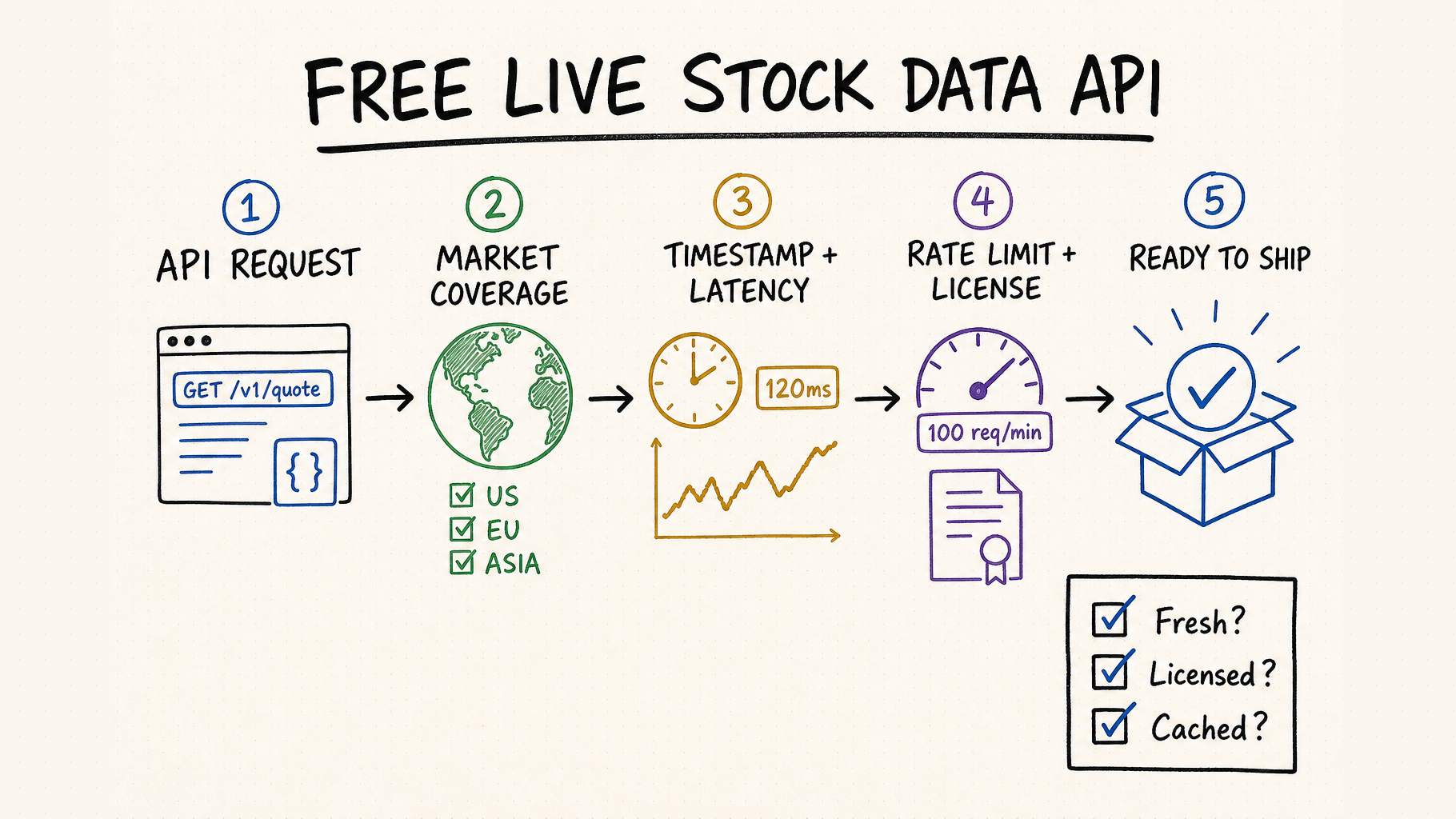
TL;DR
A free live stock data API can support demos, watchlists, paper trading, and low-traffic research tools when its feed and license match your use case.
“Real time” is not universal. Verify exchange, quote timestamp, session, and whether the response is delayed.
Use REST snapshots for light refreshes and a documented WebSocket stream only when your product truly needs continuous updates.
Cache repeated requests, batch symbols when allowed, and keep a provider adapter so you can switch later.
For a watchlist or portfolio page, delayed consolidated quotes or periodic snapshots may be enough if the UI labels them honestly. For alerts, compare the provider’s source timestamp with application arrival time and define a stale threshold. For execution-adjacent workflows, confirm whether the feed represents SIP/NBBO, one exchange, an alternative venue, or the provider’s own aggregation; a fast single-venue quote is not the same as the best displayed market-wide price.
How to verify real-time stock data
A “real-time” label is not enough.
| Data | Fields to expect | Use | Common trap |
|---|---|---|---|
| Latest quote | Price, timestamp, currency, exchange, session | Watchlists and snapshots | Treating delayed data as live |
| Freshness | Exchange time, received time, timezone, delay | Measure end-to-end latency | Comparing server time to local time |
| Market feed | Exchange, venue, feed type, session | Understand quote scope | Assuming one feed represents the full market |
| Delivery | REST cadence, WebSocket events, reconnect rules | Snapshots or streaming | Polling faster than the source updates |
| Bid and ask | Bid, ask, sizes, source venue, conditions, event time | Spreads, alerts, and executable context | Using last trade as a current two-sided quote |
| Consolidation | SIP, NBBO, exchange-only, alternative venue, or provider aggregate | Interpret market-wide price scope | Comparing unlike feeds as if coverage were identical |
| Market status | Regular, pre-market, after-hours, halt, auction, correction | Explain why a quote is absent or unusual | Treating a halt or closed session as feed failure |
| Instrument identity | Stable ID, ticker, exchange, share class, currency, effective dates | Resolve symbols before subscribing | Mixing listings or reusing an obsolete ticker |
What “free” means for real-time stock data
Convert the advertised quota into your own workload: symbols × refreshes × users. A generous daily allowance can still fail if the provider enforces a tight per-minute burst limit.
Free feeds may be delayed, end-of-day only, or limited outside regular sessions. Label the timestamp and delay in the UI instead of implying live execution quality.
Separate API access from upstream market-data rights. A free endpoint may cover one venue, delayed SIP data, or real-time data only for users who sign agreements or qualify as nonprofessional.
Check symbols per request, simultaneous subscriptions, connection count, message rate, reconnect cooldown, and whether changing a watchlist consumes additional quota.
Confirm whether quotes may be shown publicly, delivered to multiple users, cached, stored, used by an automated agent, or redistributed. Attribution alone does not grant these rights.
Free tiers may omit uptime commitments, support, correction notices, replay, or incident status. Define how long the product can serve stale data and when it must show unavailable state.
A resilient real-time stock data integration
Map provider-specific responses into your own Quote, Bar, and Instrument models. Keep raw payloads for debugging, but do not spread vendor field names through product code.
Cache end-of-day history much longer than an active quote. Use explicit freshness rules and coalesce identical requests to protect the free quota.
Map user input to stable listing IDs with exchange, share class, currency, and effective dates. Reject ambiguous symbols rather than silently choosing a venue.
Initialize from a timestamped snapshot, apply ordered events, monitor heartbeat and sequence gaps, deduplicate updates, and request a fresh snapshot whenever continuity cannot be proven.
Store source event time, provider receipt time when available, and application arrival time. Calculate age by symbol and show delay or stale status to downstream users.
Use session calendars, halts, auction status, quote conditions, and last-update time to distinguish an inactive security from a disconnected or incomplete feed.
Test disconnects, rate limits, expired credentials, schema changes, and provider outages. Decide whether to serve a labelled cached value, switch source, degrade features, or stop the workflow.
Find real-time stock data capabilities with QVeris
QVeris helps developers and agents discover and inspect callable financial-data capabilities. Compare what a tool can return before wiring it into your application.
- Search for quote, OHLCV, historical price, symbol lookup, and corporate-action capabilities.
- Inspect inputs and outputs before calling a tool from your code or agent.
- Keep provider selection separate from your normalized application model.
After discovery, compare timestamp semantics, SIP or venue coverage, delivery mode, instrument identifiers, authentication, quotas, and licensing before choosing the real-time stock capability to call. Use the official Nasdaq symbol directory definitions to verify listed-symbol fields rather than inferring them. QVeris can simplify discovery and routing; the application still owns entitlement checks, state recovery, freshness policy, consolidated-feed interpretation, fallback behavior, and downstream display rights.
FAQ
Sometimes, but coverage, exchanges, entitlements, and delays vary. Verify the timestamp and license instead of relying on a “real-time” label.
Use time-series OHLCV bars with a documented interval, timezone, session policy, and adjusted-price option.
It is the price of the most recent eligible trade, which may be old or from one venue. For current tradable context, inspect bid, ask, sizes, venue, conditions, and timestamps.
SIP consolidates eligible US equity information across participating venues; exchange-only feeds show activity from a narrower source. Coverage, speed, entitlements, and displayed best prices can differ.
Define it by workflow and session. A portfolio page may tolerate minutes, an alert may allow seconds, and execution-adjacent logic may require much tighter bounds. Expose age rather than hiding it.
Do not assume continuity. Detect the gap, obtain a new timestamped snapshot or replay supported events, reset sequence state, and mark data unavailable until the state is coherent.