
Free Live Market Data API
for DevelopersFree Live Market Data API
Evaluate live quotes, streaming, coverage, rate limits, licensing, and reliability before integration.
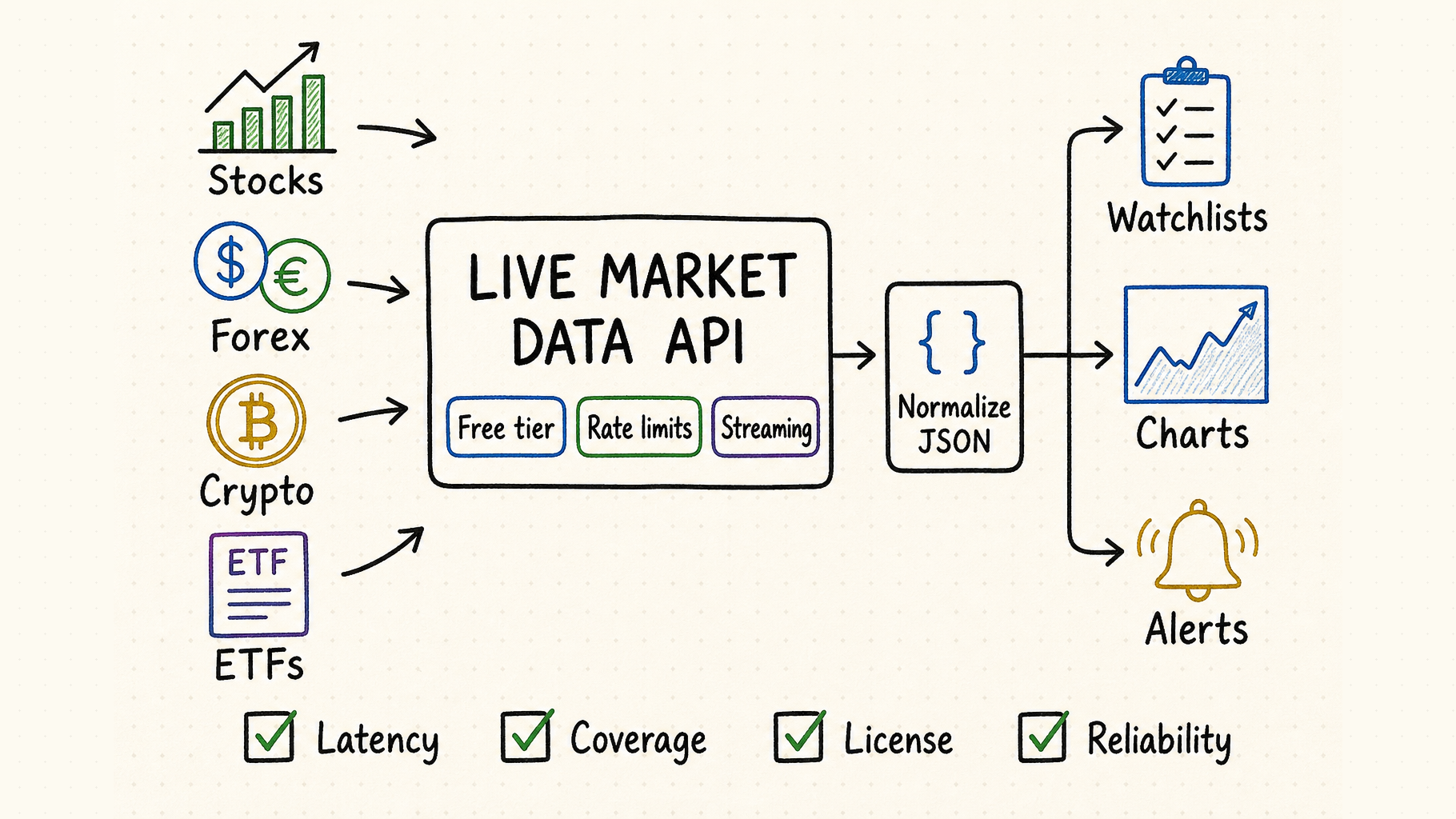
Free market data API: the short answer
Expect limits on requests, delayed quotes, historical depth, exchanges, endpoints, or commercial usage.
A watchlist, chart, backtest, and trading workflow need different latency, bar intervals, and reliability.
Check timestamps, adjustments, missing values, pagination, errors, and symbol conventions with real requests.
Normalize provider responses behind your own interface so quotas or terms do not lock the application in.
For a portfolio dashboard, delayed or low-frequency snapshots may be acceptable. For alerts and live charts, measure quote age and update continuity. For automated execution, a “free live” label is not enough: the feed needs entitlement-correct venue coverage, event timestamps, deterministic gap recovery, and an operational fallback. Decide the maximum acceptable age and loss behavior before comparing providers.
What can a free market data API cover?
“Market data” usually means quotes, trades, candles, order-book snapshots, reference data, and corporate actions across stocks, ETFs, indices, forex, crypto, options, or futures. Start with the exact instruments, venues, frequency, and history your product needs.
Access models vary by asset and venue. Compare the official Alpha Vantage API documentation, Nasdaq real-time and delayed data guidance, and Coinbase Exchange market data documentation against your latency, licensing, and recovery requirements.
Verify whether bid, ask, last price, size, and trade conditions are available, whether updates are live or delayed, and which venues contribute data.
Check supported intervals, session boundaries, timezone, OHLCV definitions, split adjustments, historical depth, and treatment of missing bars.
For WebSocket feeds, require subscription acknowledgements, heartbeats, sequence or gap signals, reconnect guidance, and a snapshot method that can rebuild state after missed events.
Keep stable IDs, ticker effective dates, venue, currency, asset type, session calendar, tick size, contract multiplier, and active status. The same symbol can mean different instruments across markets.
Clarify whether the API returns top of book, aggregated levels, or venue-level depth; identify price and size units, update type, sequence, market-by-price versus market-by-order, and snapshot consistency.
Stocks, forex, crypto, options, and futures do not share one clock or quote model. Document trading sessions, base and quote currency, consolidated versus venue data, contract expiry, and continuous-market conventions.
Capture source venue, event time, provider receipt time, application arrival time, delay class, halt or market status, correction flag, and provider identity with every observation.
During evaluation, interrupt the stream, exceed a short burst limit, rotate a subscription, and cross a session boundary. Verify heartbeat timeout, reconnect backoff, resubscription, sequence-gap detection, snapshot recovery, duplicate suppression, and ordering. Measure how long the application state remains incomplete; a successful WebSocket connection alone does not establish production reliability.
The criteria that separate a demo API from a dependable one
| Criterion | What to verify | Common free-tier trade-off | Test |
|---|---|---|---|
| Coverage | Assets, exchanges, regions, fields, and history. | Narrow universe or short history. | Query representative and delisted symbols. |
| Freshness | Timestamps, delays, update schedule, and revisions. | Delayed or end-of-day data. | Compare several updates with a primary source. |
| Limits | Per-minute, daily, concurrent, and endpoint quotas. | Low burst capacity or hard daily caps. | Exercise 429 responses and retry headers. |
| Rights | Commercial use, storage, attribution, and redistribution. | Personal or non-commercial use only. | Read both API terms and upstream data rights. |
| Latency | Event, provider-receipt, and application-arrival timestamps. | “Live” without a measurable age guarantee. | Measure p50, p95, p99, jitter, and stale-event rate. |
| Recovery | Heartbeats, sequence gaps, reconnect, replay, and snapshots. | Silent data loss after a disconnect. | Drop the connection and prove state can be rebuilt. |
| Consistency | Identifiers, units, sessions, nulls, corrections, and schema versions. | Fields change meaning across endpoints. | Reconcile quote, trade, candle, and reference responses. |
Use a synchronized acceptance run rather than isolated sample calls. Subscribe to a small but diverse universe across quiet and volatile periods, record every timestamp, deliberately disconnect, trigger rate limits, rotate symbols, and compare snapshots with streams. Report coverage, age, gaps, duplicates, out-of-order events, crossed quotes, reconnect time, and quota consumption. This converts “live” from a marketing term into an evidence-based service level.
Plan request capacity and stream recovery before integration
A free quota can look generous until it is translated into symbols, refresh intervals, trading hours, and retry traffic. Calculate both the short burst and the full-day budget. A design that stays below a per-second limit can still exhaust a daily allowance before the opening hour ends.
Worked polling example. A watchlist contains 200 symbols and needs a refresh every five seconds. If the endpoint accepts one symbol per request, the application needs 200 ÷ 5 × 60 = 2,400 requests per minute. If a batch endpoint accepts 50 symbols, the same target becomes 4 requests every five seconds, or 48 requests per minute. That is still 18,720 requests during a 6.5-hour US equity session before retries, startup snapshots, or after-hours monitoring. Compare all three numbers—burst rate, requests per minute, and session total—with the provider’s separate endpoint and daily limits.
Fetch a documented snapshot, record its sequence or as-of time, and validate that every subscribed instrument has a known starting state. Do not display a partially initialized book as if it were complete.
Subscribe before or immediately around the snapshot according to the provider’s protocol, buffer overlapping events, discard those already represented by the snapshot, and apply the remainder in sequence. The exact handshake must come from provider documentation rather than assumption.
If a sequence jumps, a heartbeat expires, or an update cannot be reconciled, mark the affected state stale. Reconnect with backoff and rebuild from a fresh snapshot. Continuing from an incomplete order book can be worse than showing no value.
Decide whether each product should freeze the last value with an age label, fall back to delayed data, reduce the symbol universe, or suspend an automated action. Never mix feeds silently when their venues, adjustment rules, or timestamps differ.
Use QVeris to discover market data capabilities
Provider lists go stale and every API describes itself differently. QVeris helps developers and agents discover, inspect, and call relevant capabilities while keeping the evaluation criteria explicit.
QVeris can simplify capability discovery and routing; the application still owns exchange entitlements, asset-specific normalization, timestamp measurement, stream state, data-loss recovery, quality gates, fallback behavior, and permitted downstream use.
- Search by the capability you need—quotes, trades, candles, order books, exchange reference data, forex, or crypto—not only by a vendor name.
- Inspect inputs, outputs, authentication, and constraints before wiring a capability into an automated workflow.
- Keep provider adapters and provenance in your application even when discovery and calling are streamlined.
FAQ
Yes, several providers offer free tiers, but most limit requests, freshness, history, exchanges, asset classes, endpoints, or commercial usage.
Test representative symbols, timestamps, adjustments, missing values, pagination, error responses, and actual rate-limit behavior.
Sometimes. Confirm licensing, attribution, redistribution rights, quotas, reliability expectations, and an upgrade or fallback path.
Not necessarily. It may mean recently updated, delayed, or real time only for entitled users and selected venues. Require source and arrival timestamps plus a documented delay class.
Polling can fit occasional dashboards. Streaming fits continuously changing quotes and trades, but it requires state, heartbeat, gap detection, reconnect, and snapshot recovery.
Compare exchange event time, provider receipt time when available, and application arrival time. Report distributions and stale-event rates by venue, asset, session, and network region.
It can offer one interface, but applications must retain asset-specific semantics such as sessions, quote currency, contract expiry, multipliers, venue consolidation, and corporate actions.