
Free Institutional Holdings API
13F Data & Integration
Use a free institutional holdings API to query SEC 13F portfolios or stock holders, preserve filing versions, compare point-in-time changes, and verify scope, identifiers, dates, limits, and licensing.
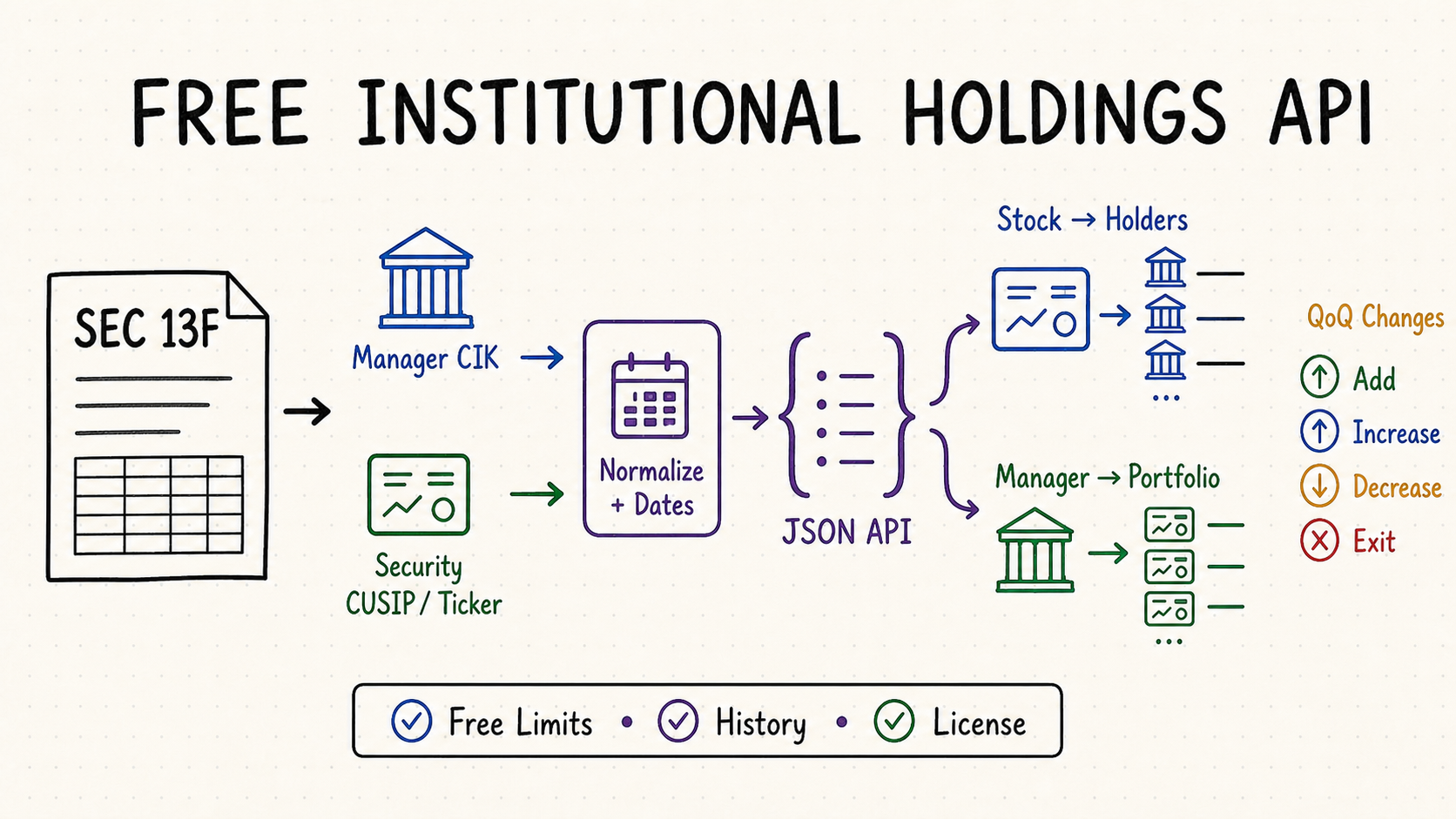
Free institutional holdings API: what users need
Most U.S. institutional-holdings APIs normalize Form 13F filings. Under the SEC framework, institutional investment managers that exercise investment discretion over at least the applicable $100 million threshold in Section 13(f) securities file quarterly reports. The information table reports specified securities held at quarter end; it is not a live transaction feed, acquisition-cost ledger, short-position report, or complete view of every asset managed.
A production-quality API must preserve the distinction between report period, filing timestamp, provider processing time, and amendment time. It should also expose whether a filing is a holdings report, notice, combination report, or amendment. Without that context, a portfolio can appear empty, duplicated, or newly changed when the filing structure—not the manager’s economics—caused the difference.
Look up reporting managers for one mapped security, or retrieve one manager’s disclosed portfolio by CIK and filing period.
Results describe reportable positions at quarter end. They are not real-time trades or a complete view of every asset class.
Reliable APIs connect manager CIK, issuer, CUSIP, ticker, filing accession, and report period without hiding the source record.
Confirm whether “free” is a lasting plan or trial, which quarters are accessible, and whether commercial use, caching, or redistribution is allowed.
13F institutional holdings data API fields and timing
A useful API preserves the form type, report period, filing and amendment timestamps, accession number, manager CIK and file number, issuer, security class, CUSIP, optional FIGI when filed, shares or principal amount, reported fair value and units, investment discretion, voting authority, and put/call indication where present. It should retain the original information-table row and source link rather than exposing only a ticker and derived percentage.
Query institutional holders by stock ticker or CUSIP
Ticker search is convenient, but the filing identifies an issuer, class, and CUSIP; FIGI may appear in addition to, not instead of, CUSIP. Check effective-dated ticker mapping, multiple share classes, options, amended filings, shared reporting managers, pagination, and the difference between quarter-end reported value and a value repriced with today’s market data.
Retrieve an institution's 13F portfolio by CIK
For manager-level analysis, retain the filing identity and period, resolve holdings or combination-report structure, and apply amendments before comparing adjacent quarters. Derive new, increased, reduced, and exited labels only after adjusting for identifier changes and corporate actions. These are filing-to-filing differences, not observed trades or trade timestamps.
Understand what is excluded or delayed
Only securities on the applicable Section 13(f) list are reportable in the information table; many other assets are outside its scope. Confidential-treatment requests can also affect what appears publicly and when. An API should not label a missing row as zero ownership unless it has distinguished scope, filing structure, mapping failure, and unavailable or confidential data.
How to evaluate a free 13F holdings API
| Check | Verify | Why it matters |
|---|---|---|
| Coverage | Managers, issuers, quarters, amendments, historical depth. | Avoids silent gaps. |
| Lookup | Ticker, CUSIP, manager name, CIK, pagination. | Supports both ownership views. |
| Provenance | Accession, filing URL, report and processed dates. | Makes records auditable. |
| Normalization | CIK and CUSIP mapping, duplicates, amendments, units. | Prevents false changes. |
| Filing structure | Holdings, notice, combination, amendment, other reporting managers. | Prevents an empty notice from being treated as zero assets. |
| Completeness | Source row count and value total, unmapped rows, options, confidential-treatment flag. | Reveals silent drops and partial public views. |
| Point-in-time access | Can the API reproduce what was available on a chosen analysis date? | Avoids look-ahead bias in historical research. |
| Free limits | Quota, recent-quarter restriction, license, caching. | A trial may not fit production. |
Integrate a free institutional holdings API with JSON
Step 1: test stock-holder and manager-portfolio queries
Call one documented endpoint by ticker or CUSIP and another by manager CIK. Inspect authentication, HTTP status, pagination, total count, latest available report period, and rate-limit headers.
Step 2: normalize 13F holdings fields
Map responses into stable fields such as manager_cik, report_period, filing_date, cusip, ticker, shares, reported_value, and accession_number. Keep the raw response and source URL.
Step 3: compare quarterly holdings without look-ahead
Store each filing by report period and filing timestamp, apply amendments, and compare only information available as of the analysis date. Do not overwrite prior snapshots or label delayed disclosure as real-time activity.
Step 4: reconcile the normalized portfolio
Compare normalized row counts and reported-value totals with the source summary, retain unmapped rows, and explain any difference. Treat 13F-NT and combination reports separately, and make amendment processing idempotent so repeated ingestion does not double-count positions.
Step 5: publish dates and limitations with results
Expose report period, filing and amendment time, ingestion time, source accession, mapping version, and whether values are reported or repriced. Label quarter changes as disclosure changes and state that non-reportable assets, shorts, and confidential or delayed rows may be absent.
Use QVeris to find institutional holdings data capabilities
QVeris helps developers and agents discover, inspect, and call available financial-data capabilities. Open the QVeris tool details to inspect 13F manager portfolios or holder-by-security capabilities, then inspect CIK, CUSIP and period inputs, form and amendment metadata, pagination, source links, historical access, quotas, and provider terms. QVeris can route a capability, but it does not turn a delayed filing into a current portfolio.
- Search specifically for 13F holdings or institutional ownership, not ETF constituents or insider trades.
- Inspect query identifiers, historical coverage, pagination, quotas, and licensing before calling.
- Keep provider-specific logic behind a normalized application interface.
FAQ
Is there a free institutional holdings API?
Some providers expose a free tier, evaluation endpoint, or no-cost recent 13F access. Verify request limits, quarters, source links, caching, redistribution, licensing, and commercial use.
What does a 13F holdings API return?
It can return manager and filing identity, issuer, class, CUSIP, shares or principal amount, reported fair value, discretion, voting authority, put/call indication, period, and source accession.
Can I query institutional holders by ticker?
Often, but ticker lookup is a provider mapping layered over filing identifiers. Keep CUSIP, class, manager CIK, mapping date, and source row so ticker changes remain auditable.
Does a 13F API show the manager’s complete portfolio?
No. It covers reportable Section 13(f) securities and may involve notice, combination, amendment, or confidential-treatment context. Other assets and short positions are not a complete part of this view.
How current is 13F data?
It is quarterly disclosure data, generally filed after quarter end under the applicable deadline. Fast API processing reduces filing-to-API delay, not the age of the underlying position.
How should quarterly changes be interpreted?
Call them filing-to-filing changes. Corporate actions, identifier mapping, amendments, reporting structure, and security scope can change the row even without a directly observed trade.
How do I avoid look-ahead bias?
Version filings by report and public filing time, apply only amendments available by the analysis date, and never replace an older research snapshot with today’s normalized latest state.
Authoritative references and next steps
Use the SEC source to understand what Form 13F represents, then confirm any third-party API's current free-plan contract before relying on it.