
Free Insider Transactions API
Form 4 Data & JSON
Use a free insider transactions API to build a queryable Form 4 event stream by issuer, owner, code, date, and filing version—without flattening every ownership change into a buy or sell.
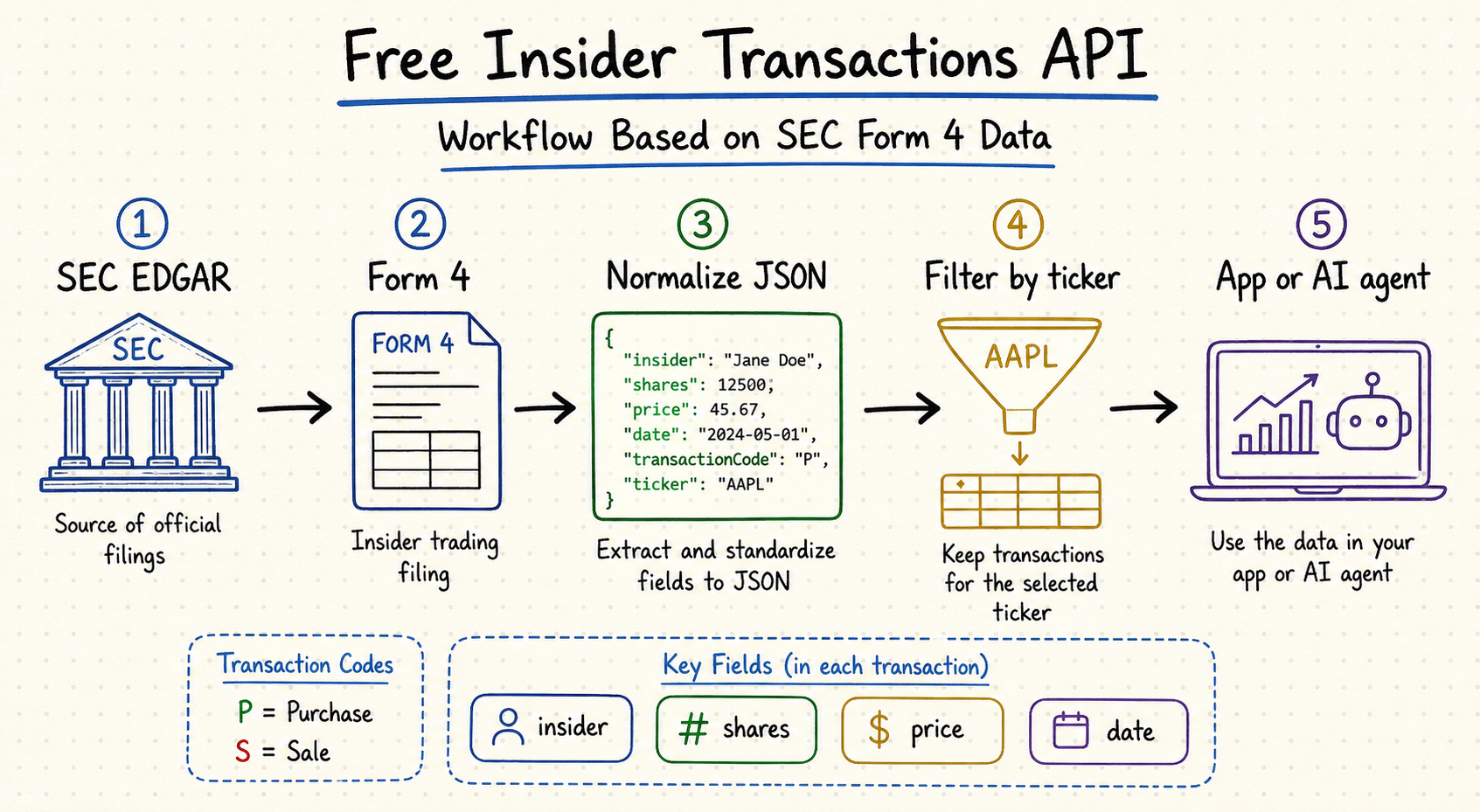
Free insider transactions API: what users need
This page is for applications that need a normalized transaction feed: issuer timelines, owner histories, open-market purchase filters, sale alerts, compensation-event separation, or event clustering. The correct atomic record is a transaction row within a filing—not the filing headline alone. One Form 4 can contain multiple owners, multiple non-derivative or derivative rows, and footnotes that change how a price or ownership path should be understood.
A high-quality API supports both discovery and reconstruction. Discovery filters find transactions by ticker, issuer CIK, owner CIK, role, form, code, security type, acquired/disposed status, and transaction or filing window. Reconstruction fields preserve accession, row identity, amendment lineage, direct or indirect ownership, holdings after the event, derivative terms, footnote references, and source timestamps.
Include reportable transactions by directors, officers, and beneficial owners of more than 10% of a registered class, with links back to the SEC filing.
Support practical searches by ticker while retaining issuer and reporting-owner CIK values for verification.
Return filing and row identity, form and amendment, transaction code, security table, dates, shares, price, ownership path, post-event holdings, and source.
Check request quotas, history, delay, amendment handling, permitted use, caching, and whether “free” means a lasting tier or a trial.
SEC Form 4 API fields, transaction codes, and timing
Form 4 reports changes in beneficial ownership for covered corporate insiders and is generally filed after a reportable transaction under the applicable deadline. A transaction API should expose transaction date and deemed execution date separately from SEC acceptance and provider processing time. Sorting by “latest” must state which clock it uses.
Query insider transactions by ticker or issuer CIK
Ticker lookup is convenient, but issuer CIK is the durable SEC identity. Test ticker changes, multiple classes, joint filings, owner aliases, pagination stability, transaction-date versus filing-date filters, and whether every result exposes accession, row identity, filing URL, and mapping provenance. Filtering must not discard non-ticker derivative rows tied to the same filing.
Interpret P, S, grants, exercises, and amendments
P generally identifies a purchase and S a sale, but Form 4 also covers grants, option exercises, gifts, tax withholding, conversions, and other changes. Code alone is not enough: preserve voluntary indicator, acquired/disposed direction, price and footnote, security table, underlying shares, direct or indirect ownership, post-transaction balance, and Form 4/A lineage. If the combination is unfamiliar, classify it as “review required” rather than inventing a market signal.
Forms 3, 4, and 5—and the transaction codes that change the meaning
An insider-data product should not label every ownership filing as a buy or sale. Form 3 commonly establishes an initial ownership position when a person becomes subject to reporting; Form 4 reports many subsequent changes; Form 5 can report certain items on a later annual schedule. Preserve the form, amendment status, reporting period, and source row before building a unified timeline.
| Code or form | Typical meaning | What to inspect | Unsafe shortcut |
|---|---|---|---|
| Form 3 | Initial statement of beneficial ownership. | Reporting-owner status, securities, direct or indirect path. | Treating the opening balance as a purchase. |
| P / S | Open-market or private purchase / sale, subject to filing details. | Price, footnotes, voluntary indicator, security and ownership nature. | Assuming every P or S has the same motivation. |
| M | Exercise or conversion of a derivative security. | Derivative table, exercise price, expiration and underlying shares. | Calling the acquired common shares an open-market purchase. |
| F | Payment of exercise price or tax liability using securities. | Related award or exercise rows, withholding terms and footnotes. | Treating every disposition as a discretionary bearish sale. |
| G | Gift of securities. | Acquired/disposed direction, recipient context and ownership path. | Using a zero or blank price as evidence of a zero-value trade. |
| Form 5 | Certain transactions eligible for later annual reporting. | Fiscal year, transaction date, exemption and prior reporting. | Using filing arrival as the transaction date. |
An officer may exercise options for 20,000 shares under code M, surrender 7,000 shares under code F to cover tax, and sell 3,000 shares under code S. The filing contains 30,000 reported row units, but it does not describe one 30,000-share sale. The officer acquired 20,000 underlying shares, disposed of 10,000 shares through two different mechanisms, and may finish with a net increase of 10,000 shares before considering other rows. Keep each row, security table, code, price, ownership nature, and post-event balance; aggregate only after their economic meanings align.
How to evaluate a free SEC Form 4 API
| Check | Verify | Why it matters |
|---|---|---|
| Coverage | Issuers, reporting owners, non-derivative and derivative rows, Form 4/A. | Prevents silent gaps. |
| Freshness | SEC acceptance time, provider processing delay, polling or webhook behavior. | Separates filing latency from market latency. |
| Provenance | Accession number, filing URL, issuer CIK, owner CIK, filed date. | Makes each record auditable. |
| Normalization | Transaction codes, units, ownership nature, footnotes, amendments, duplicates. | Avoids false buy or sell signals. |
| Query model | Issuer and owner IDs, form, code, role, security table, transaction and filing dates, stable cursor. | Supports alerts and reproducible backfills. |
| Event identity | Accession, owner, table, row, security, transaction date, amendment lineage. | Prevents row loss and duplicate alerts. |
| Footnote fidelity | Weighted-price ranges, indirect ownership, plan context, conversion and tax explanations. | Keeps normalized labels explainable. |
| Free limits | Daily quota, history, rate limit, license, caching, commercial use. | A trial may not support production. |
Integrate a free insider transactions API with JSON
Use one transaction row—not one filing—as the atomic event. The provider-neutral example below keeps filing identity, owner identity, economic direction, ownership path, derivative terms, and evidence in separate fields so downstream filters do not have to infer them from a headline.
{
  "filing": {
    "accession_number": "ACCESSION_PLACEHOLDER",
    "form": "4",
    "accepted_at": "YYYY-MM-DDThh:mm:ss-04:00",
    "source_url": "SEC_FORM_4_URL",
    "amends_accession": null
  },
  "issuer": {"cik": "ISSUER_CIK", "ticker": "TICKER_PLACEHOLDER"},
  "owner": {"cik": "OWNER_CIK", "name": "REPORTING_OWNER", "roles": ["officer"]},
  "transaction": {
    "row_id": "ROW_ID",
    "table": "non_derivative",
    "date": "YYYY-MM-DD",
    "code": "P",
    "acquired_disposed": "A",
    "security_title": "Common stock",
    "shares": "1000",
    "price_per_share": "25.40",
    "ownership_nature": "direct",
    "shares_owned_after": "12500",
    "derivative": null,
    "footnote_ids": ["F1"]
  }
}
Null is not zero and a row is not automatically a trade signal. A blank price can be valid for a gift, grant, conversion, or other non-cash event. Preserve null, then interpret it with the transaction code, table, acquired/disposed direction, derivative terms, and footnotes. Converting a missing price to zero creates a false zero-value transaction.
Step 1: test ticker and issuer-CIK queries
Call a documented endpoint with a known ticker and date range. Record authentication, HTTP status, pagination, rate-limit headers, latest filing time, and links to the matching SEC documents.
Step 2: normalize SEC Form 4 transaction fields
Map the response to stable fields such as issuer_cik, owner_cik, ticker, transaction_date, transaction_code, shares, price, shares_owned_after, and accession_number. Retain the raw response and filing URL.
Step 3: apply amendments without overwriting history
Store filings by accession number, link Form 4/A records to the original filing, and make amendment policy explicit. Do not silently replace the prior record or describe every reported change as an open-market purchase or sale.
Step 4: publish a typed transaction event
Keep source code and fields immutable, then derive a separate category such as open-market purchase, open-market sale, award, exercise, tax-related disposition, gift, transfer, or unresolved. Record the classification version and reasons so rules can be corrected without rewriting evidence.
Step 5: build alerts around filing arrival and deduplication
Poll or consume provider updates by filing timestamp, use an overlap window, and deduplicate with stable event identity. Emit correction alerts for material amendments rather than sending the amended row as a second new trade.
Step 6: validate analytics before ranking activity
When aggregating value, distinguish reported transaction price from null, zero, exercise, or weighted-average values. Do not sum derivative and underlying shares as if they were identical, and keep multi-row execution totals linked to the filing footnote.
Use QVeris to find insider transaction data capabilities
QVeris helps developers and AI agents discover and inspect available financial-data capabilities. Open the QVeris tool details to review issuer timelines, owner histories, Form 4 rows, or broader ownership filings, then inspect supported filters, event identity, code and derivative fields, amendments, footnotes, source links, pagination, history, and provider terms. Keep provider-specific output behind a source-aware event schema.
- Search specifically for Form 4 or corporate insider transactions, not 13F institutional holdings or congressional trades.
- Inspect ticker and CIK inputs, history, amendment handling, pagination, quotas, and source links.
- Keep provider-specific responses behind a normalized application interface.
FAQ
Is there a free API for insider transactions?
Some providers offer a free tier or public endpoint for SEC Form 4 data. Verify quotas, history, processing delay, licensing, amendment handling, and source links before production use.
Does the SEC have a Form 4 API?
The SEC publishes EDGAR filings and downloadable Insider Transactions Data Sets. Those official sources are not the same as a ticker-oriented, normalized REST API.
Can I query insider transactions by ticker?
Many APIs support ticker lookup. Retain issuer and reporting-owner CIK values plus the filing accession number so the match remains auditable.
How quickly are Form 4 filings available?
Most reportable transactions are generally due by the end of the second business day. API availability also depends on SEC acceptance and provider processing time.
What do P and S mean on Form 4?
P generally means a purchase and S a sale. Other codes cover grants, exercises, gifts, tax withholding, and additional transaction types.
Are Form 4 transactions real-time trades?
No. Form 4 is a regulatory disclosure. Preserve transaction and filing timestamps and do not present filing arrival as exchange execution time.
How should multiple Form 4 rows be aggregated?
Group only rows with compatible owner, security, code, direction, date, and economic meaning. Preserve weighted-average price footnotes and never combine derivative units with underlying common shares blindly.
Why is the transaction price sometimes blank or zero?
The event may be a grant, gift, transfer, conversion, tax event, or another non-cash transaction. Use code, derivative terms, acquired/disposed state, and footnotes rather than converting null to zero-value trading.
How can duplicate insider alerts be prevented?
Use accession plus owner, table, security and row-level transaction identity; link amendments to the original filing and emit a correction instead of a second new-trade alert.
Authoritative references and next steps
Use the SEC sources to verify the meaning and timing of Form 4 data, then confirm a third-party API's current free-plan contract before relying on it.