
Free Insider Trading API
for SEC Form 4 Data
Find, evaluate, and implement a free insider trading API for SEC Forms 3, 4, and 5 while preserving transaction codes, ownership paths, filing versions, and source evidence.
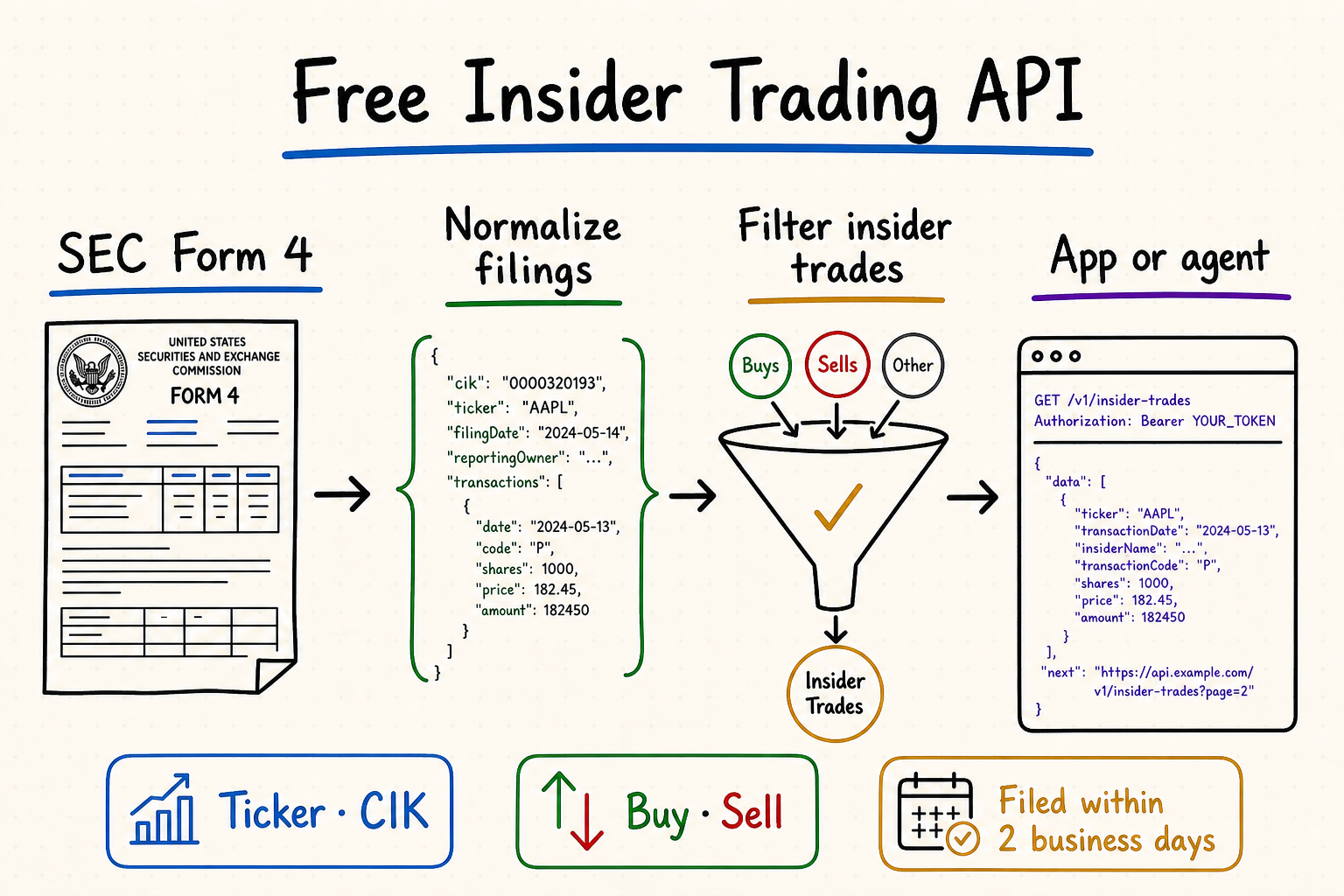
What a free insider trading API actually needs to do
A developer-ready API turns public corporate-insider ownership filings into usable JSON without discarding the filing context. Form 3 establishes an insider’s reported ownership when the reporting obligation begins, Form 4 reports changes in beneficial ownership, and Form 5 is an annual statement for transactions or holdings reportable there. A complete workflow may need all three forms and their amendments, even when the product’s main filter is recent Form 4 activity.
A filing is evidence of a reported ownership event, not a self-explanatory “bullish buy” or “bearish sell.” Transaction code, acquired/disposed flag, security type, direct or indirect ownership, derivative terms, footnotes, and post-transaction holdings must be read together. Grants, option exercises, tax withholding, gifts, transfers, and transactions under a trading plan can produce share changes that should not be grouped blindly with discretionary open-market purchases or sales.
“Insider trading data” here means lawful public disclosures by officers, directors, and certain beneficial owners. It is not nonpublic information or a trading recommendation.
What an SEC Form 4 API should return
A useful API preserves the source filing while normalizing issuer, reporting owner, relationship, non-derivative and derivative tables, transaction, ownership form, post-transaction holdings, footnotes, and amendment state. Always retain accession number, filing URL, original filing date, and provider ingestion time so each normalized event can be verified against the authoritative record.
| Field group | Examples | Why it matters |
|---|---|---|
| Issuer | Ticker, CIK, company name | Company lookup and joins |
| Reporting owner | Name, CIK, officer/director status | Role-aware filtering |
| Transaction | Date, deemed date, code, voluntary flag, shares, price, acquired/disposed | Separate market trades, awards, exercises, gifts, tax and other events |
| Ownership | Direct/indirect, nature of indirect ownership, holdings after transaction | Avoid double-counting entities, trusts, family and controlled holdings |
| Derivative security | Exercise price, exercisable and expiration dates, underlying title and amount | Interpret options, warrants and convertibles separately from common stock |
| Filing context | Form type, amendment, 10b5-1 indicator, footnotes, joint filing | Preserve explanation and filing lineage |
| Provenance | Accession, filedAt, source URL | Audit and freshness checks |
How current is insider trading API data?
The SEC explains that Form 4 is generally filed within two business days of the transaction. API freshness begins only after publication. Track transaction date, deemed execution date when present, SEC filing time, amendment time, and provider ingestion time separately; “real-time insider data” can only describe low processing delay after disclosure, not instantaneous knowledge of the underlying transaction.
Three ways to obtain SEC insider transaction data
The best route depends on whether the application needs authoritative source documents, normalized records, or a callable capability that can switch among providers. These layers can complement each other: use a normalized API for product speed, but retain an EDGAR link and accession number for verification.
| Route | Best fit | Main engineering work |
|---|---|---|
| SEC EDGAR source files | Authoritative evidence, bulk research, custom classification, and independent verification. | Follow SEC access guidance, discover filings, parse ownership XML, resolve issuers and owners, process amendments, and preserve source versions. |
| Normalized provider API | Dashboards, alerts, issuer pages, and prototypes that need JSON quickly. | Verify form and history coverage, code fidelity, footnotes, amendments, pagination, latency, free limits, and licensing. Alpha Vantage and Finnhub document insider-transaction capabilities, but current plan access must be checked. |
| Capability discovery layer | Agents and multi-source applications that need to inspect an input/output contract before routing a call. | Keep provider identity and evidence visible, normalize only documented fields, and apply the same acceptance tests to every routed source. |
Worked classification: share count alone is not a buy or sell signal
Consider three records that all increase an officer's reported shares. A transaction with code P, an acquired indicator, a cash price, and non-derivative common stock is a candidate open-market purchase. Code M may represent an option exercise and should be paired with the derivative table, exercise price, underlying shares, and any same-day disposal. Code A may represent a grant or award rather than a discretionary purchase. The change in holdings is real in each case, but the economic event and its interpretation differ.
A sale record also needs context. Shares withheld for taxes, gifts, transfers among controlled entities, and a sale marked under a Rule 10b5-1 trading arrangement should remain distinguishable from an unplanned open-market disposition. Footnotes may explain weighted-average prices, multiple executions, ownership through a trust, or why a value is blank. If those details are flattened into a single “buy/sell” label, the API has made the data easier to display but less reliable to interpret.
Match the output to the product
Include code, security type, price status, ownership form, 10b5-1 indicator, filing time, and a source link. Alert only after classification rules pass.
Group transactions by filing and owner, show amendments and footnotes, and avoid summing grants, exercises, purchases, and sales into one number.
Keep point-in-time filing versions, stable CIK joins, delisted issuers, raw XML, and reproducible classification logic.
Return the normalized event together with confidence, excluded context, source accession, and a warning that disclosure is not investment advice.
How to choose a free insider trading API
Check whether the stock insider trading API covers all Form 4 filings, amendments, derivative transactions, and source links—not only highlighted open-market buys.
Record requests per day or month, historical depth, rate limits, required API key, credit-card requirement, and permitted commercial use.
Verify ticker-to-CIK joins and distinguish purchase code P, sale code S, grants, exercises, indirect ownership, and amended filings.
Select several records and reconcile shares, price, ownership type, filing time, and accession number against SEC EDGAR before building automation.
Include an amendment, joint filing, indirect holding, weighted-average price, derivative exercise, null price, multiple transactions, and a 10b5-1 indicator. These reveal whether the API preserves meaning or merely flattens rows.
Build categories from documented transaction code, acquired/disposed status, security table, and footnote context. Keep a review queue for unfamiliar combinations instead of forcing every row into “buy” or “sell.”
Insider trading API Python implementation
The exact endpoint and authentication scheme depend on the selected provider. Keep the client configurable, validate HTTP status and schema, and preserve the source filing identifier.
Minimal REST request pattern
import os
import requests

url = os.environ["INSIDER_API_URL"]
headers = {"Authorization": f"Bearer {os.environ['INSIDER_API_KEY']}"}
params = {"ticker": "AAPL", "transaction_code": "P", "limit": 25}

response = requests.get(url, headers=headers, params=params, timeout=20)
response.raise_for_status()
records = response.json()

for item in records.get("data", records):
    print(item.get("ticker"), item.get("transactionDate"),
          item.get("shares"), item.get("accessionNumber"))
Production checks before automation
- Paginate until the provider signals completion; do not assume one response contains every owner, transaction, table, or footnote.
- Store raw XML or source response immutably, then key normalized rows by accession, owner, security table, transaction identity, and amendment version.
- Apply amendments as versioned corrections rather than blindly adding or deleting the original filing.
- Preserve transaction code, voluntary flag, acquired/disposed state, direct/indirect ownership, derivative terms, and footnote references before assigning a human-readable category.
- Treat null or zero price, weighted-average price, gifts, grants, exercises, tax withholding, and indirect transfers explicitly.
- Back off on 429 responses, cache stable source versions, and measure source-to-provider ingestion latency separately from transaction-to-filing delay.
Use QVeris to inspect API capabilities before calling
QVeris helps agents discover and inspect callable financial-data capabilities before execution. Use QVeris tool details to distinguish raw ownership filings, normalized Form 4 transactions, issuer activity, and reporting-owner history. Inspect form coverage, identifier and date inputs, transaction-code fields, derivative and footnote support, amendments, source links, pagination, limits, and provider terms before calling; capability routing does not replace filing interpretation.
FAQ
Is there a free insider trading API?
Yes. SEC EDGAR provides the underlying public filings without charge, and some providers expose free tiers or no-key endpoints. Verify current limits and terms before committing.
How do I get insider trading data from the SEC?
Download and parse Form 4 XML from EDGAR, or use a SEC insider filings API that converts filings into normalized JSON while retaining source references.
What data is included in a Form 4 API?
Typical fields cover issuer, reporting owner, role, security, transaction date and code, shares, price, acquired/disposed status, holdings, and filing provenance.
Do I need an API key or credit card?
It depends on the provider. A no-key endpoint is convenient for testing, while free plans may require registration. Treat authentication and billing requirements as comparison criteria.
Does every Form 4 acquisition mean an insider bought stock?
No. Awards, option exercises, conversions, gifts, transfers, and other events can increase reported holdings. Use the transaction code, security table, acquired/disposed flag, price, and footnotes.
Why can a Form 4 price be blank or differ from the market?
Some events are non-cash, use an exercise or conversion price, or report a weighted-average price explained in a footnote. Null is not automatically zero, and one displayed price may summarize multiple executions.
How should amended Form 4 filings be handled?
Keep the original and amendment under one filing lineage, compare corrected owners, transactions, holdings, and footnotes, and publish a versioned current state without erasing what was previously public.