
Free Index Constituents API
Sources, Weights & Examples
Compare free sources for current and historical index members, weights, formats, and limits—then validate one API response before production use.
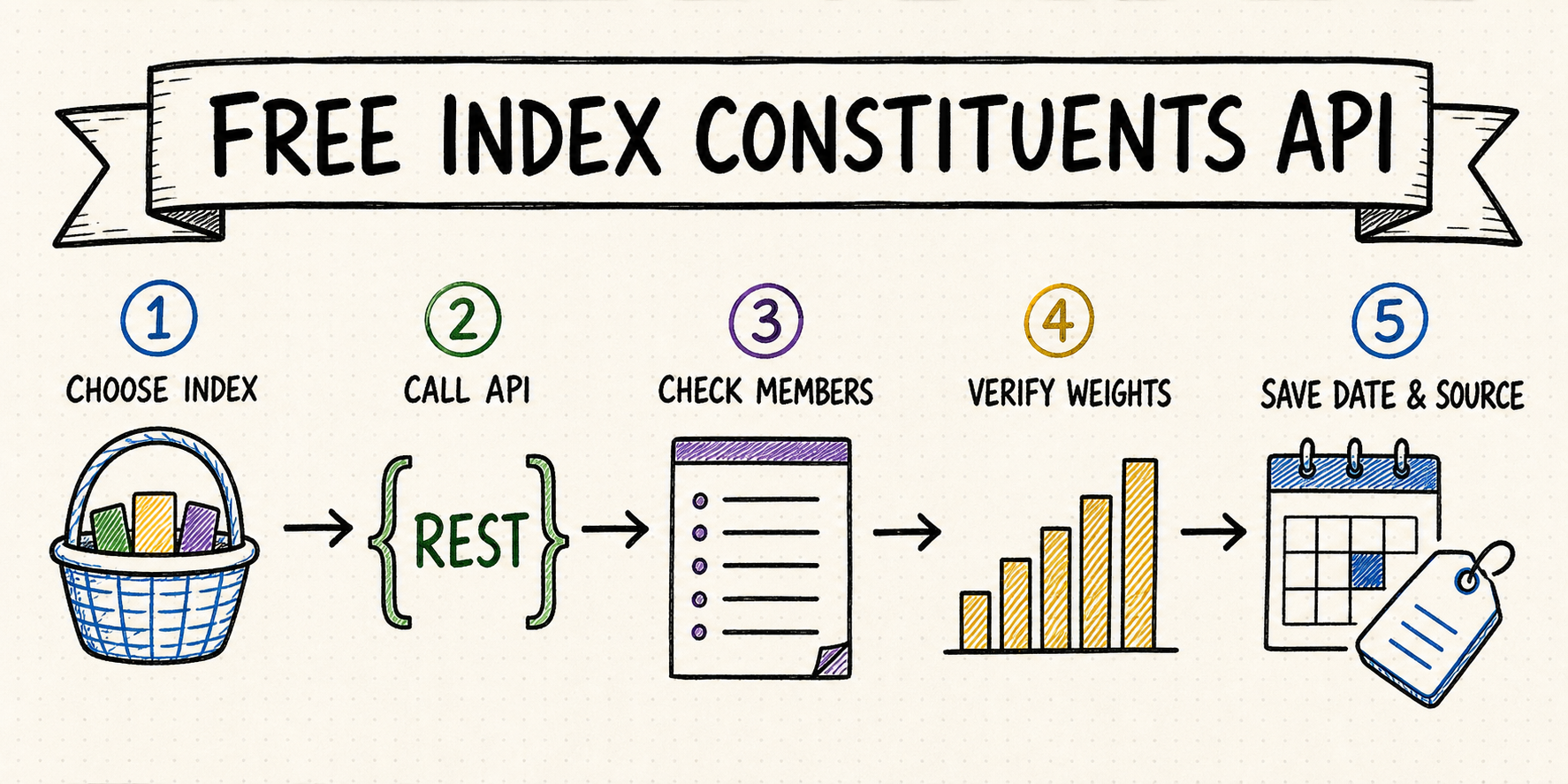
Free index constituents API: what to verify first
A constituent response needs an index version and a membership state. Current members, announced changes, pro-forma composition, and effective post-rebalance members are different datasets. Preserve announcement, reference, pricing, and effective dates so an application does not treat a future addition as if it were already in the index.
A free index constituents API should answer a specific task: given an index identifier and an effective date, return the securities that belonged to the index, ideally with weights and stable identifiers. A usable response must distinguish current membership from announced or pro-forma changes and provide enough evidence to reproduce the snapshot.
Important: “Free” may mean a trial, a limited free tier, view-only access, or an open endpoint. Verify current pricing, permitted use, attribution, redistribution, and point-in-time history before relying on any source.
Coverage a stock index constituents API should provide
Current index constituents and stable identifiers
Look for ticker, exchange, security name, ISIN or another stable identifier, plus the index code used in the request. Tickers alone can change or collide across exchanges.
Index constituents with weights API
Confirm whether weights are included, whether they are decimals or percentages, the weighting methodology, and the effective timestamp. A member list without weights may be insufficient for replication or exposure analysis.
Historical index constituents API
Backtests need point-in-time membership, additions, deletions, and effective dates. Using today’s members for past periods introduces survivorship bias.
Formats, authentication, pagination, and limits
Check JSON or CSV support, API-key requirements, page size, rate limits, update frequency, error shape, and whether one call can return the complete index.
Announcement, reference, and effective dates
Store the lifecycle of each addition, deletion, and weight change. A rebalance can be announced before pricing and implemented at a later close or open; the correct membership depends on the query time.
Corporate actions and security lineage
Track mergers, spin-offs, delistings, ticker and share-class changes, multiple listings, special dividends, and temporary constituents with stable IDs. Name matching cannot preserve historical continuity.
Weight basis and reconciliation
Confirm free-float or full market-cap basis, equal weighting, capping, divisor treatment, currency, units, and residual. Weight snapshots may be indicative before implementation and drift afterward with prices.
Free index constituents API sources to evaluate
Benchmark sources with one ordinary date, one announced but not yet effective change, one rebalance close, and one corporate-action event. Compare index variant IDs, member state, stable security mapping, total row count, weight units and totals, publication time, revisions, historical depth, and license.
Use the table as a verification checklist rather than an endorsement. Test each source with one ordinary date, one announced but not yet effective change, one rebalance close, and one corporate-action event; access and terms can change.
| Source | Useful signal | Verify before use |
|---|---|---|
| FinancialData.net | Documents an index-constituents endpoint, identifier parameter, pagination, and JSON/CSV formats. | Current free allowance, supported indices, weights, history, and license. |
| Profit.com | Documents an index constituents route and says API access is available with a free-plan key. | Rate limits, index universe, response fields, history, and production terms. |
| Ricequant / RQData | Chinese documentation exposes index components by date and separate constituent weights for quantitative workflows. | Account tier, market coverage, quotas, and redistribution rights. |
| Open-source datasets | Projects such as index-constituents publish current or historical files that can help prototypes. | Upstream provenance, update process, completeness, and non-API operational risk. |
Python example for a free index components API
1. Start with a documented index code
Use the provider’s own example identifier and endpoint. For a documented FinancialData.net-style request: requests.get(url, params={"identifier":"^GSPC","format":"json"}, headers={"X-API-Key": api_key}, timeout=20).
2. Validate members, weights, and as-of date
Call raise_for_status(), parse JSON, then assert expected fields, unique identifiers, numeric weight types, an effective date, and a plausible record count. HTTP 200 alone does not prove usable data.
3. Handle pagination and constituent changes
Follow the documented offset or cursor until complete. Store the raw response, retrieval time, provider, index code, and effective date so additions and removals remain auditable.
4. Test historical membership without survivorship bias
If the API accepts a date, compare two known rebalance dates and verify that membership changes. If it only returns current members, do not label the result point-in-time historical data.
5. Reconstruct event-state membership
Represent announced, pro-forma, current, and effective membership separately. Apply changes at the documented implementation time, preserve source announcements, and do not backdate a deletion or addition to the announcement day.
6. Reconcile weights and identifiers
Normalize decimal versus percentage units, sum weights within the stated basis, resolve duplicates by stable ID and listing, and explain cash or residual rows. Test ticker changes and corporate actions without breaking security lineage.
7. Freeze point-in-time snapshots and revisions
Store index version, membership state, as-of and effective times, first publication, correction ID, raw response, parser version, and retrieval time. A backtest must select only the version available at its simulated decision time.
How QVeris helps connect index data capabilities
- Search separately for current constituents, announced changes, historical membership, weights, and index reference data.
- Require publisher, index variant, membership state, as-of and effective date, weight basis, historical requirement, and revision metadata.
- Preserve raw IDs, source announcements, timestamps, completeness checks, and licensing with every normalized snapshot.
QVeris does not manufacture index constituents, grant an index license, or guarantee a provider’s data. It helps developers and agents discover available capabilities, inspect interfaces, and connect the selected external tool through a consistent workflow.
- Open the QVeris provider details for relevant financial-data capabilities.
- Inspect inputs, outputs, authentication, provider documentation, and supported index identifiers before connecting.
- Keep provider, effective date, retrieval time, and license notes with each result; QVeris connectivity is not investment advice.
Free index constituents API FAQ
Is there a free API for index constituents?
Yes. Some providers expose a limited free tier or open endpoint. Confirm index coverage, weights, historical depth, rate limits, and license before production use.
How do I get S&P 500 constituents via API?
Pass the provider’s documented S&P 500 identifier, then validate the returned symbols, exchange identifiers, effective date, pagination, and optional weights.
Can a free API return historical index constituents?
Some can, but point-in-time history is less common than current membership. Confirm effective dates and test known rebalance changes before backtesting.
Do index constituent APIs include weights?
Some do. Verify whether weights are percentages or decimals, what methodology applies, and whether the weight date matches the member list.
What is the difference between index constituents and ETF holdings?
Index constituents belong to a benchmark under its methodology. ETF holdings are securities actually held by a fund and can differ because of sampling, cash, fees, or implementation timing.
When does an announced index change become effective?
At the implementation time specified by the index publisher, which can differ from announcement, reference, or pricing dates. Applications should keep future changes separate until that moment.
Why do index weights not always sum to exactly 100%?
Rounding, cash or residual rows, capped-weight methods, indicative versus implemented states, and unit errors can cause differences. Verify the published basis before rescaling.
How should ticker changes be handled in constituent history?
Map each listing to a stable security or issuer identifier and preserve effective dates. Do not treat a renamed or relisted security as a new company solely because the display ticker changed.