
Choose a Free Implied Volatility API
Data, Limits & Setup
Find IV data for options research, compare free-tier limits, and validate each value before it enters a screen, model, or backtest.
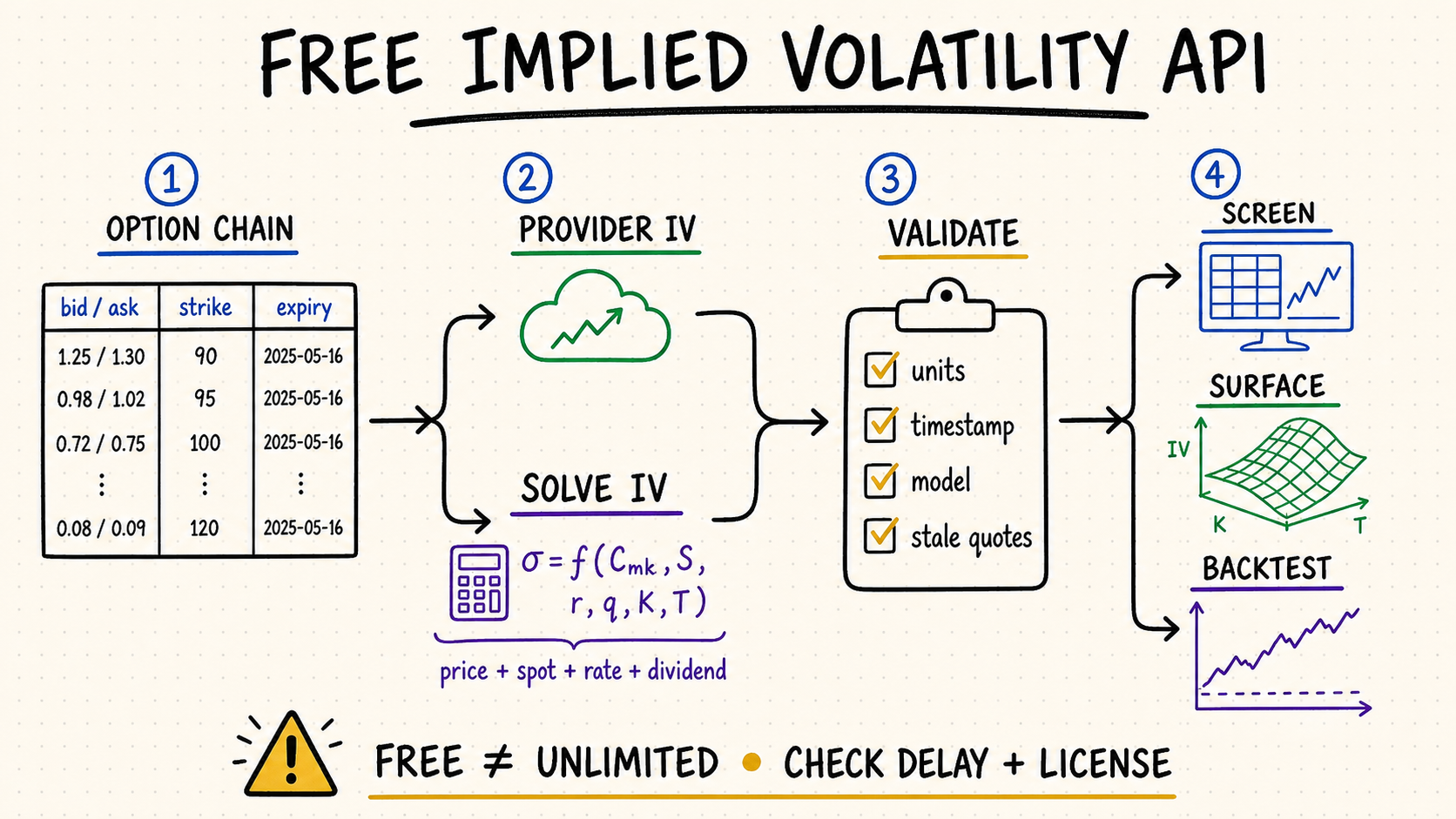
Free implied volatility API: the short answer
A free plan may expose current option-chain IV, a small request quota, delayed values, a calculator endpoint, or a limited symbol universe.
Use a provider-calculated IV field, or retrieve a reliable option price and solve for volatility with a documented pricing model.
Use a provider IV field when speed and broad chain screening matter, but preserve enough inputs to audit it. Use a calculator when the application controls price selection, rates, dividends, time convention, and model. For historical research, require point-in-time quotes and inputs rather than today’s recalculated IV. Implied volatility is an annualized model parameter that reconciles an option price; it does not predict direction and is not directly comparable across contracts without matching expiry, strike or delta, and methodology.
What a useful implied volatility API must return
An IV number without its inputs is hard to audit. Start with the option contract and the market observation used to calculate it. A robust response identifies the underlying, expiration, strike, call or put, contract multiplier, quote or trade price, underlying spot price, calculation time, and whether IV is a decimal or percentage.
Underlying, contract symbol, expiration, strike, call/put flag, exercise style, multiplier, deliverable, venue, and currency.
Bid, ask, midpoint or last price, quote time, underlying spot, market session, delay status, and provider delivery time.
Specify decimal or percent, annualization factor, calendar or trading-day convention, time to expiry, solver tolerance, rounding, and whether the value represents bid IV, ask IV, mid IV, trade IV, or a fitted surface.
Record Black-Scholes, Black-76, binomial, or another model; European versus American exercise; cash or physical settlement; rates, borrow, dividends, forward price, and early-exercise treatment.
Identify the selected option price and filtering rule. Zero bids, one-sided or crossed markets, stale quotes, wide spreads, auction prints, and old last trades can produce unstable or meaningless IV.
Return convergence status, arbitrage-bound checks, iteration or tolerance information, null reason, and any clipping or fallback. A numeric value should not hide an invalid input or failed solve.
Keep expiry, strike, moneyness or delta, forward reference, source contract, raw versus smoothed flag, fit time, data version, and provider identity so smile and term-structure comparisons remain reproducible.
Worked example: one quote can imply an IV range
Consider a 30-calendar-day European call with spot 100, strike 100, a continuously compounded risk-free rate of 4.5%, no dividend, and a contemporaneous market quote of 3.00 bid / 3.40 ask. Under Black–Scholes, using 30/365 years, the bid implies approximately 24.63% IV, the 3.20 midpoint implies 26.39%, and the ask implies 28.14%. The useful output is therefore not just “26.39%”; it is the selected price, the 24.63%–28.14% quote-implied range, every model input, and the calculation timestamp.
Return null when the inputs do not support a defensible solve. For a European call, reject a selected price below max(0, S·e−qT − K·e−rT) or above S·e−qT. Also return a reason code when the market is crossed, the quote is stale, the solver does not converge, or vega is so small that a tiny price change produces an extreme IV change. Near expiry and far from the money, a wide IV interval is often more honest than a precise-looking point estimate.
Ways to get free implied volatility data
Raw market-data APIs, provider-calculated analytics, broker-entitled feeds, and standalone IV calculators solve different problems. Compare them with the same contract set and do not assume a field named iv has the same source or methodology everywhere.
| Source type | Typical output | Best for | Watch for |
|---|---|---|---|
| Options analytics API | Pre-calculated IV, Greeks, skew, term structure, or volatility surface. | Fast prototypes and scanners. | Free tier may omit full chains, history, or methodology. |
| Options market-data API | Chain quotes and sometimes vendor IV and Greeks. | Apps that also need quotes and liquidity. | Delay, exchange coverage, rate limits, and display rights. |
| Broker API | Account-entitled option chains, quotes, Greeks, and positions. | Personal analysis and execution workflows. | Account requirements and redistribution restrictions. |
| IV calculator API | IV solved from supplied option price and model inputs. | Transparent, reproducible calculations. | You must source clean prices, rates, dividends, and exercise assumptions. |
Validate every candidate on the same contracts and observation time. Include liquid at-the-money options, wide-spread wings, zero-bid contracts, short and long expiries, dividend-paying stocks, index options, and an adjusted contract. Compare selected option price, spot or forward, rate, dividend input, time to expiry, model, convergence, and IV output. Differences are useful only after the input and methodology differences are visible.
Compare the same expiry and strike for contract-level checks, or the same expiry and delta or forward moneyness for smile analysis. A raw strike comparison across changing spot prices can mislead.
Store quote-derived IV, filters, excluded contracts, interpolation method, smoothing parameters, and fitted surface values as separate layers. Never overwrite observed contract analytics with the smooth result.
Freeze quotes, underlying or forward, rates, dividends, calendars, model code, and corrections at each observation time. Recomputing history with today’s curve creates a different dataset.
Reject impossible prices, nonconvergence, stale or crossed inputs, excessive spread, arbitrage violations, discontinuous units, and curves built from too few valid contracts.
Alert when provider fields, annualization, input price, smoothing, rate source, dividend treatment, or null behavior changes, even if the schema name remains iv.
Use QVeris to discover IV-capable APIs
QVeris helps agents discover and inspect financial-data capabilities before calling them. Search by the outcome you need—option chain, implied volatility, Greeks, volatility surface, or historical options—then review each provider's schema and terms.
- Search capabilities by required output instead of relying on a provider name.
- Inspect parameters, response fields, freshness, access requirements, and limits before a call.
- Keep provider identity and timestamps attached to every IV value used by an agent.
QVeris can simplify discovery and routing across IV, Greeks, option-chain, and historical-options capabilities. The application still owns price selection, model assumptions, solver validation, surface construction, historical input versions, licensing, and how uncertainty or failed calculations are presented.
FAQ
Yes. Some options-data and analytics providers offer free quotas, trials, calculators, or limited IV fields. Coverage, history, delay, and usage rights vary.
Yes, if the quote is reliable and you also have spot, strike, expiration, rate, dividend assumptions, option type, and an appropriate pricing model.
There is no universal choice. Midpoint is common for liquid two-sided markets; bid and ask produce a range; last trade may be stale. Store the selected price and quote state with the result.
They may use different quotes, underlying or forward prices, rates, dividends, calendars, exercise models, solvers, filters, or smoothing. Compare inputs before treating either value as wrong.
Definitions vary. IV rank commonly scales current IV within a historical minimum and maximum; percentile measures the share of observations below it. Record lookback, IV series, sampling, and formula.
A conventional volatility input cannot be negative. Values above 100% can be valid for highly volatile contracts because 100% is 1.0 annualized volatility, not a probability ceiling. Always verify units.