
Choose a Free Historical Options Data API
for Reliable Backtests
Compare chain history, Greeks, implied volatility, timestamps, rate limits, formats, and licensing before you build.
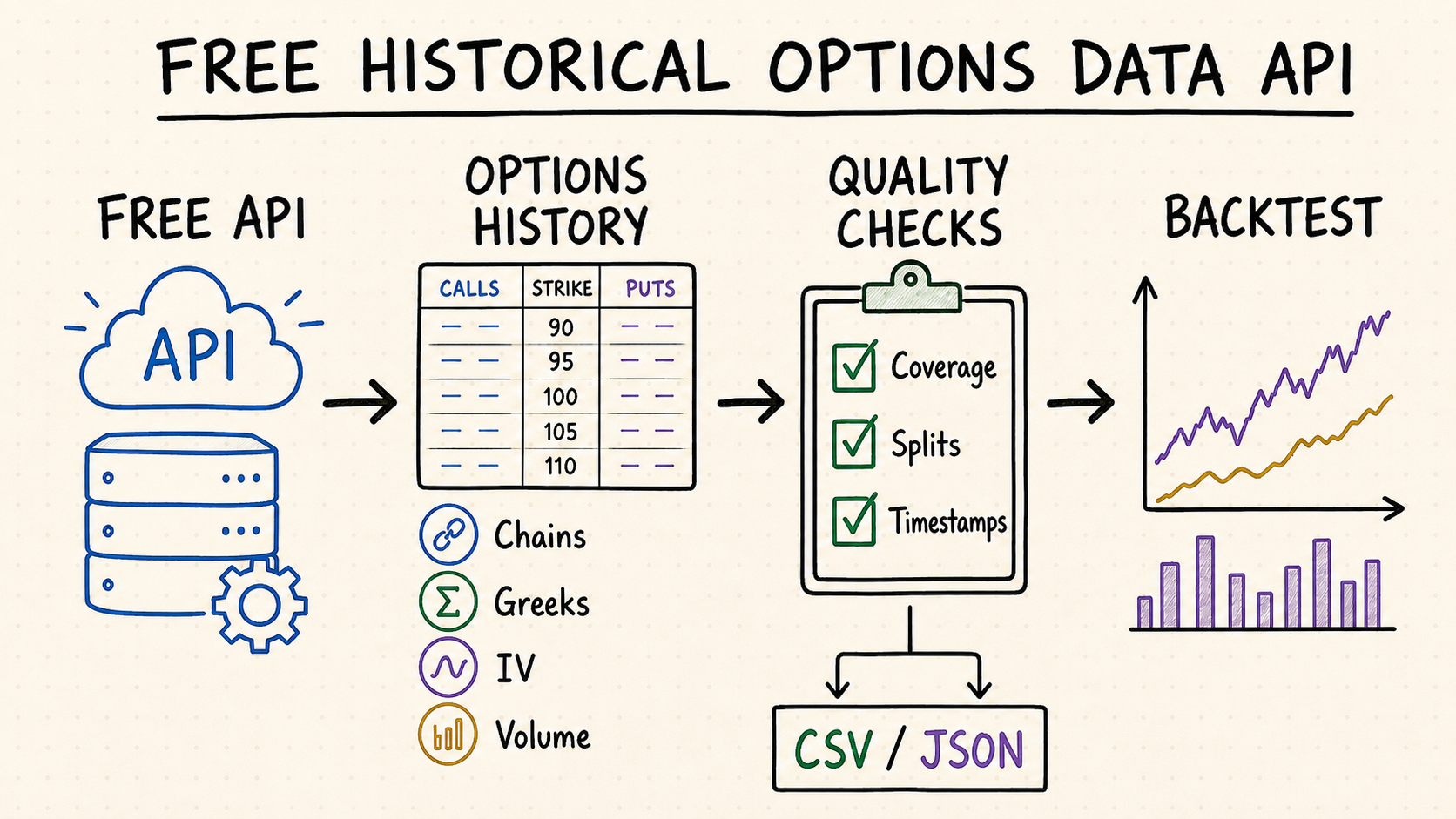
Quick answer: what a free historical options data API provides
A historical options data API retrieves past contracts and chains by underlying, expiration, strike, and observation time. A useful free tier clearly documents whether quotes, trades, open interest, Greeks, and implied volatility are included, plus its retention and request limits.
Strategy research, volatility studies, educational notebooks, and small backtests that do not require a complete institutional feed.
End-of-day chains cannot reproduce intraday entries. Confirm snapshot frequency and whether expired contracts remain queryable.
Expect caps on retention, underlyings, expirations, bulk downloads, Greeks, redistribution, or commercial use.
Use a free API when the job is repeatable retrieval rather than a one-off dataset download: screening a defined universe, refreshing a research notebook, testing a parser, or running a small scheduled backfill. Before choosing it, verify that the same query can be replayed, pagination is stable, expired contracts remain addressable, and corrections do not silently change earlier results. If the strategy depends on full-market tick history or commercial redistribution, a free tier is usually an evaluation environment rather than the final production source.
What a historical options data response should include
| Field | What it tells you | What to verify |
|---|---|---|
| Contract identity | Underlying, call or put, strike, expiration, and contract symbol. | Symbology changes and adjusted contracts. |
| Quotes and trades | Bid, ask, sizes, last price, volume, and open interest. | Snapshot frequency, crossed markets, and stale quotes. |
| Greeks and IV | Delta, gamma, theta, vega, rho, and implied volatility. | Model, interest-rate input, dividend assumptions, and calculation time. |
| Timestamps | Observation time, trade time, and quote update time. | Timezone, market session, and end-of-day cutoff. |
| Contract lifecycle | Listing date, last trade date, settlement, multiplier, exercise style, and deliverable. | Expired, adjusted, nonstandard, and delisted contracts remain traceable. |
| API provenance | Provider, dataset version, retrieval time, request parameters, and correction status. | The same backtest can be reproduced after a backfill or schema change. |
| Pagination and completeness | Cursor, page size, total count, sort order, and next-page behavior. | Large chains do not lose or duplicate contracts between pages. |
How to evaluate a free historical options data API
Check supported underlyings, exchanges, expirations, strike ranges, expired contracts, and the earliest observation date.
Quotes and trades are observations; Greeks and IV are model outputs. Record the provider’s model and assumptions before comparing feeds.
One chain can contain hundreds of contracts. Translate per-minute limits into underlyings, expirations, snapshots, retries, and backfill depth.
Free access may permit personal research but restrict redistribution, display, caching, or commercial products.
Repeat the same underlying, expiration, and observation-time request. Record ordering, pagination tokens, null behavior, corrections, and whether later backfills alter the response.
Compare expected and returned expirations, strikes, calls and puts, then flag duplicate IDs, missing pages, one-sided quotes, zero values, and contracts with inconsistent multipliers.
Use immutable raw responses, request fingerprints, bounded retries, quota-aware scheduling, and checkpoints. A failed page in a long backfill should resume without downloading or overwriting the entire run.
Define a replayable historical options API request
A request such as “give me SPY options for 2025-03-21?is not precise enough for research. It does not say whether the date is an expiration, an observation date, or a trading session; whether the response should contain the full chain or one contract; or which quote should represent the requested time. Write the request contract before comparing providers so that every candidate is tested against the same observable result.
| Request dimension | Make this explicit | Failure signal |
|---|---|---|
| Underlying identity | Stable security ID, exchange, share class, and symbol as of the observation date. | A renamed, delisted, or cross-listed security resolves to the wrong chain. |
| Observation instant | Timestamp, timezone, market session, selection rule, and maximum quote age. | The API silently returns the latest daily row or a later corrected snapshot. |
| Contract universe | Expiration range, call or put, strike or moneyness range, listing status, and adjusted-contract policy. | Only liquid survivors or today's listed contracts appear in a historical query. |
| Snapshot semantics | Last quote before the cutoff, interval bar, official close, settlement, or every trade and quote. | One field called “close?changes meaning across dates or endpoints. |
| Paging and order | Stable sort key, page size, cursor scope, final-page condition, and total-count behavior. | Retrying page three duplicates or skips contracts because the result set moved. |
| Version and entitlement | Dataset version, correction policy, requested fields, account entitlement, and license state. | The same request later returns fewer fields or rewritten history without explanation. |
Turn that contract into one acceptance query and save its expected shape. For example: return every SPY call and put that was listed at 15:55 America/New_York on a selected session, across two expirations, with bid, ask, sizes, trade, underlying reference price, multiplier, deliverable, open-interest as-of date, and the source timestamp. Run it on a quiet day, a volatility spike, a split-adjusted contract, and an expired chain. A provider that cannot state why a contract is absent has not passed the test, even when the HTTP response is successful.
Store historical chains without losing evidence
A single wide table is convenient for notebooks but unsafe as the system of record. Contract terms change, vendor analytics can be recalculated, pages can arrive at different times, and corrections can replace individual fields. Separate immutable source evidence from normalized and derived data so a later model change does not rewrite what the API originally returned.
Store a request fingerprint, normalized parameters, account entitlement, start and finish times, response headers, page tokens, status, retry count, byte count, and payload checksum. A completed batch needs a manifest of every expected and received page.
Use an effective-dated contract table for underlying, expiration, strike, right, multiplier, exercise style, settlement, and deliverable. Store quotes, trades, volume, and open interest as timestamped facts linked to that contract version.
Keep vendor IV and Greeks beside the provider model label and calculation time. Store locally recalculated values in a separate version with rate curve, dividend assumption, underlying price, time convention, and code version.
For every underlying-date-expiration batch, record expected and returned calls, puts, strikes, pages, missing fields, stale quotes, duplicate IDs, adjusted contracts, and permanent failures. Downstream research should reject or flag incomplete partitions instead of treating absence as zero.
Commit raw pages before advancing the cursor. On restart, replay the last safe page idempotently, verify its checksum and key range, then continue. Never mark a date complete merely because the final HTTP request returned an empty page.
A reliable historical options backtesting workflow
- Write the observation contract: define the strategy’s decision timestamp, venue calendar, session, required fields, maximum quote age, and eligible contract universe.
- Discover contracts point in time: retrieve the expirations and strikes that existed then instead of beginning with today’s surviving symbols.
- Persist the request and raw response: store parameters, retrieval time, page tokens, status, headers, provider version, and untouched payload under a request fingerprint.
- Normalize without destroying evidence: map identifiers, timestamps, multipliers, and nulls in separate tables while keeping original contract symbols and provider-calculated analytics.
- Run quality gates: test chain completeness, duplicate IDs, bid–ask logic, timestamp skew, corporate-action deliverables, and historical availability before generating signals.
- Model execution conservatively: use contemporaneous bid and ask, quote size, spread, latency, slippage, and no-fill outcomes rather than assuming every trade occurs at midpoint.
- Freeze a research version: record the source snapshot, normalization code, model assumptions, corrections, and license state so the result can be reproduced.
Use QVeris to discover options data capabilities
QVeris helps agents discover and inspect callable historical options capabilities without hardcoding a single provider first. Compare the input schema, observation-time support, contract coverage, response fields, access requirements, and documented limits before routing a request. The application still owns pagination recovery, point-in-time contract discovery, normalization, quality gates, execution assumptions, data versioning, and licensing.
FAQ
Some providers offer free tiers, but history depth, exchanges, request caps, and permitted use vary.
Not always. Some APIs calculate them only for current chains, omit historical values, or reserve them for paid plans.
An API supports parameterized, repeatable retrieval and scheduled backfills. A sample file mainly reveals schema and example quality. Neither guarantees full history, but only the API can be tested for pagination, quotas, and replay behavior.
Some can, but many current-chain endpoints cannot. Test a known past expiration directly and confirm contract metadata, adjusted deliverables, quotes, and paging rather than relying on a general history claim.
Discover contracts and retrieve values using the historical observation time, retain source publication times, exclude later corrections from the original run, and never derive the universe from today’s surviving contracts.
Classify authentication, entitlement, rate-limit, transient, and permanent data errors. Retry only safe failures with bounds, preserve failed request fingerprints, checkpoint pages, and report incomplete coverage explicitly.