
Free Historical
Options Data
Compare genuinely free options datasets, samples, APIs, and research platforms—then validate every field before backtesting.
TL;DR
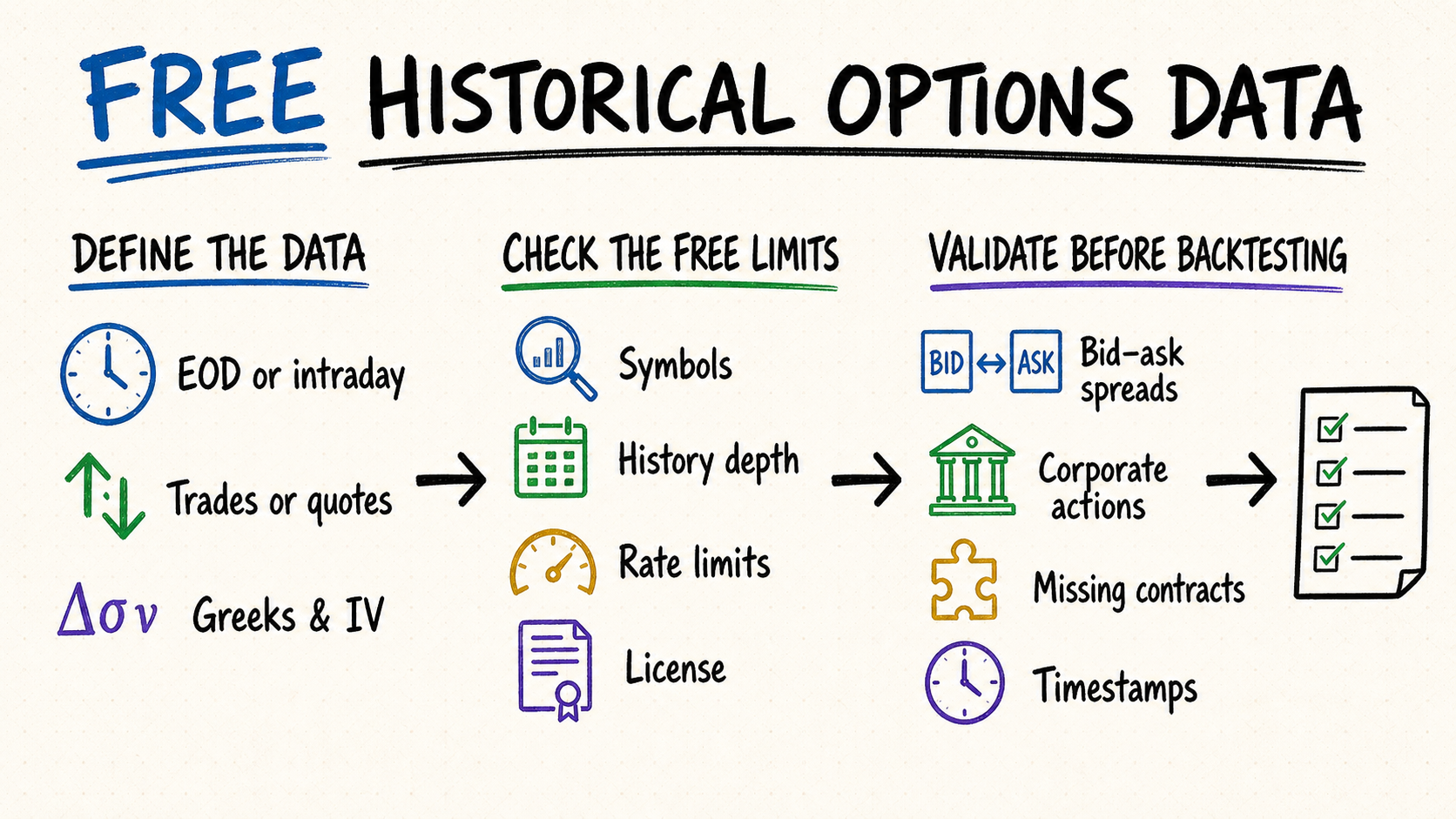
Most no-cost sources provide delayed chains, end-of-day snapshots, a few symbols, sample files, or platform-only backtests—not a full OPRA-quality archive.
Specify trades or quotes, EOD or intraday frequency, option chain coverage, expired contracts, open interest, implied volatility, and Greeks.
A downloadable CSV can still prohibit redistribution or commercial use. Record the source, terms, retrieval date, and permitted workflow.
Validate timestamps, bid–ask spreads, missing strikes, stale quotes, contract identifiers, and corporate actions before trusting simulated results.
The practical answer is to choose the smallest historical dataset that can reproduce the decision your strategy would have made at that moment. An end-of-day volatility study may need complete chains, reliable closing quotes, open interest, and corporate-action handling; an intraday execution study needs timestamped bid and ask updates, sizes, condition codes, and a realistic view of latency. Paying for more rows does not repair missing contract history or ambiguous field definitions.
What historical options data should include
“Options history?can mean one contract’s settlement price, an end-of-day chain, or every trade and quote across thousands of contracts. Those datasets are not interchangeable.
Keep underlying, expiration, strike, call/put flag, multiplier, style, and a stable contract identifier. Confirm whether expired and delisted contracts remain available.
Decide whether OHLC bars are enough or whether you need bid, ask, sizes, trades, exchange timestamps, and quote condition codes. Record timezone and session rules.
Track listing date, last trade date, expiration, exercise style, settlement type, and deliverable changes. Adjusted options can represent shares plus cash or a nonstandard multiplier, so the displayed strike alone does not describe the economic contract.
Record whether implied volatility, delta, gamma, theta, vega, and rho came from the venue, provider, or your own model. Preserve the option-pricing model, interest-rate input, dividend assumption, underlying price, calculation time, and any smoothing rule.
Daily volume and open interest answer different questions. Open interest is usually published on a delayed daily cycle rather than updated with every trade; label its as-of date and do not treat it as an intraday position count.
A backtest needs what was observable then, not a cleaned chain assembled later. Keep ingestion time, vendor revision, missing-contract state, corrections, and the exact data version used for each research run.
For sampled underlyings and expirations, compare expected contracts with returned contracts by strike, call or put, listing date, and moneyness. Track missing quotes, crossed markets, zero bids, stale timestamps, absent open interest, and adjusted deliverables separately. “Ten years of history?has limited value when only the most liquid surviving contracts are complete.
Where to find free historical options data
| Option | Strength | Check first | Best fit |
|---|---|---|---|
| Exchange or academic datasets | Clear provenance and documented methodology. | Sample-only access, delayed releases, research license. | Teaching, replication, and narrow studies. |
| Broker or market-data API | Convenient JSON and active-contract lookup. | Expired contracts, lookback window, entitlement, quotas. | Prototypes and targeted contract research. |
| Vendor sample CSV | Real schema and data-quality preview. | A sample is not a reusable historical archive. | Schema tests and vendor evaluation. |
| Backtesting platform | Data can be free inside hosted research. | Export restrictions, fill model, survivorship rules. | Testing strategy logic before buying data. |
Before selecting a source, write one acceptance query: for example, “return every SPY put and call listed at 15:55 New York time on a chosen date, including expired contracts, bid, ask, sizes, volume, open interest as of its actual publication date, and the underlying reference price.?Then measure chain completeness, timestamp consistency, crossed or zero quotes, duplicate contracts, and reproducibility on several quiet and volatile sessions. This exposes coverage gaps faster than comparing headline retention periods.
Reconstruct a point-in-time options chain without look-ahead
A historical chain is not simply every contract that appears in today’s database with an old date attached. It is the set of contracts, reference data, quotes, and market conditions that were available to the strategy at the decision timestamp. Build the reconstruction from versioned events and state the eligibility and freshness rules before viewing the outcome.
Use listing and effective dates to include only contracts already available at the decision time. Preserve adjusted deliverables and expired contracts; do not infer the universe from contracts that survive in a current endpoint.
For each contract, choose the latest valid quote whose source timestamp is not later than the decision time. Apply exchange condition filters and a documented maximum quote age. A later correction may be stored, but it cannot replace the information set used by the original decision.
Report expected and returned calls and puts by strike and expiration, stale or crossed quotes, zero bids, missing sizes, and the oldest-to-newest timestamp skew. Calculate volatility surfaces or spreads only after the chain passes the workload’s completeness threshold.
Join the underlying price, interest-rate curve, dividend assumption, session state, and contract metadata as they were known at that time. If Greeks or IV are recomputed, version the formula, conventions, and every input.
Use side-specific quotes, displayed size, latency, fees, and a no-fill outcome. Do not let a later trade validate an earlier midpoint fill, and do not carry an expired or stale quote forward without a documented rule.
Worked fill example. At the 14:00:00 decision time, a call is quoted $1.80 bid and $2.20 ask with displayed size 10 × 5 contracts. A backtest that buys 8 contracts at the $2.00 midpoint records a fill the market never offered. A defensible model can fill up to 5 contracts at the $2.20 ask, then apply a documented depth or slippage rule to the remaining 3—or return a partial fill. A quote arriving at 14:00:00.400 cannot be used unless the strategy’s decision and latency model explicitly makes it observable before order arrival.
Use QVeris to discover options data capabilities
Free plans, sample files, and API entitlements change. QVeris helps agents discover and inspect financial-data capabilities by asset class, interval, contract inputs, returned fields, and provider boundary before routing a request. Discovery does not make two datasets equivalent: the application must still validate chain completeness, timestamp semantics, adjustments, model-derived Greeks, licensing, and the fill assumptions used in research.
- Search by asset class, historical interval, contract fields, format, and intended action.
- Inspect tool inputs, outputs, and provider boundaries before making a data call.
- Keep discovery and execution auditable when research spans several financial sources.
FAQ
Usually not. Full tick or quote history is extremely large and licensed. Free access more often means samples, limited symbols, EOD snapshots, short lookbacks, or platform-only research.
It can help inspect current chains, but it is not a reliable complete archive of expired option chains, historical quotes, and point-in-time Greeks for serious backtests.
At minimum, retain the full eligible chain at the decision time, stable contract IDs, bid and ask or a documented settlement field, the underlying price, expiration, strike, right, multiplier, and corporate-action adjustments. Add volume, open interest, and volatility inputs when the strategy uses them.
The midpoint is a reference, not a guaranteed execution price. Test bid, ask, spread-aware slippage, quote size, stale-quote filters, and a no-fill outcome. Thin or far-out-of-the-money contracts make midpoint assumptions especially optimistic.
Yes, if you have point-in-time option quotes, underlying prices, rates, dividends, time conventions, and a documented model. Recomputed values may still differ from vendor Greeks, so label the method and preserve inputs.
It appears when expired contracts, delisted underlyings, adjusted deliverables, or contracts that were missing at the time disappear from the research universe. A present-day reconstructed chain can therefore overstate historical data availability.