
Free FX Data API
Selection and Integration Guide
Find a free FX data API, compare the limits and data semantics that matter, test a JSON request, and validate the result before your app depends on it.
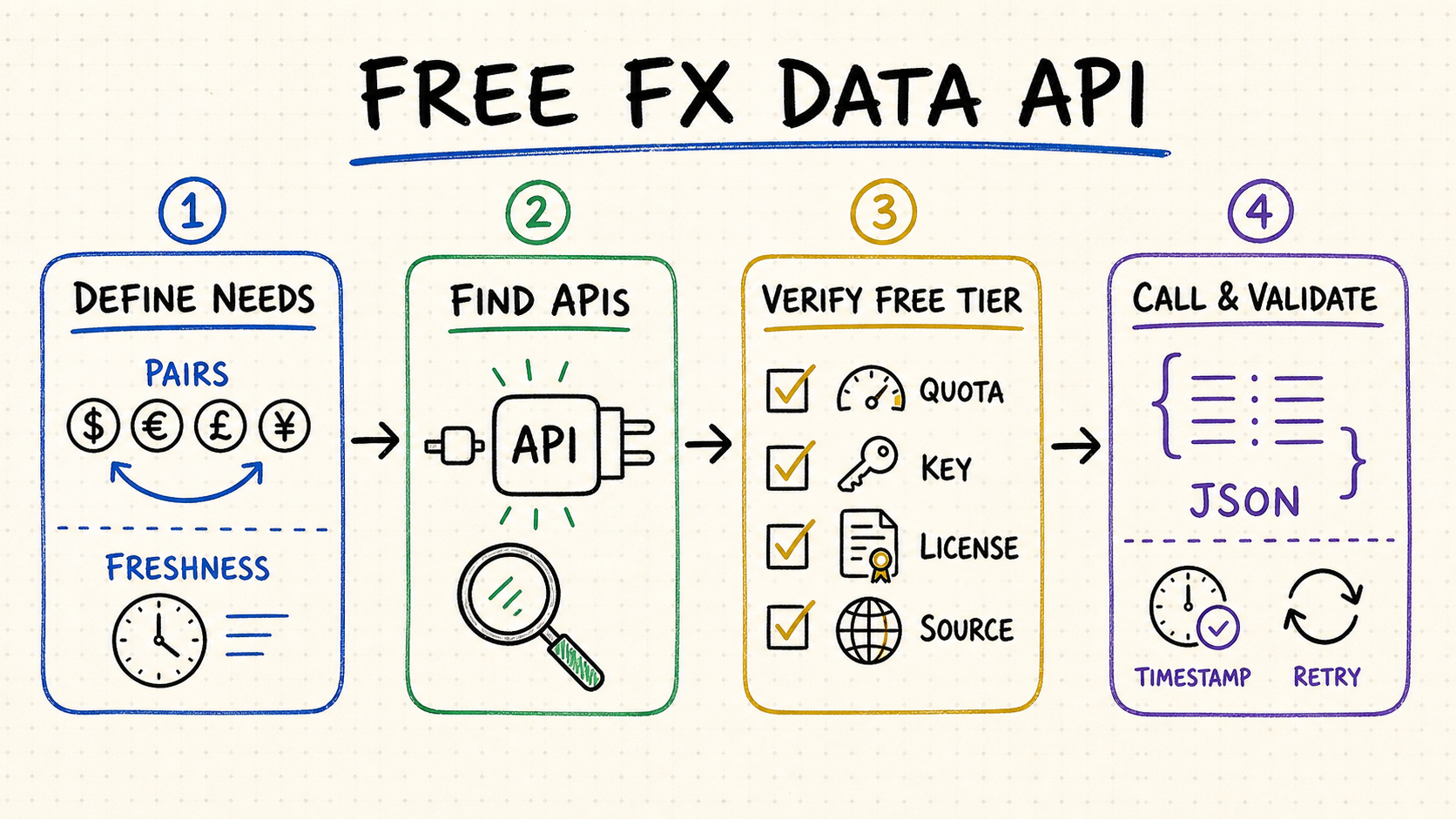
Free FX data API: what to look for first
A useful free FX API exposes a documented HTTPS endpoint, identifies the base and quote currencies, returns a source timestamp, and explains its source, update frequency, quota, authentication, license, and error behavior. “Free” can mean a public endpoint, a limited plan, or a trial, so verify the current documentation before building a dependency.
| Need | Verify | Common mismatch |
|---|---|---|
| Current conversion | Latest timestamp and base rules | Daily reference rate presented as live |
| App or dashboard | Quota, CORS, caching, status page | Trial mistaken for a permanent free tier |
| Trading use | Bid/ask, latency, venue, license | Midpoint used as an executable quote |
Define the job before choosing a free currency exchange API
Current exchange rates or live forex data?
“Latest” may mean a daily central-bank reference, an hourly aggregate, a delayed market snapshot, or an intraday quote. For accounting, display, checkout, alerts, or trading research, document the maximum acceptable data age and whether you need a midpoint or bid and ask.
Currency pairs, base currency, and ISO 4217 codes
Confirm supported fiat currencies, restricted base currencies, direct versus derived crosses, decimal precision, and pair direction. Use the ISO 4217 currency code standard when normalizing identifiers.
Latest, conversion, and historical endpoints
The dominant SERP pages repeatedly expose latest rates, pair conversion, supported-currency lists, and historical endpoints. This page targets current and general FX API selection; browse the QVeris Guides Hub for separate date-range and historical-data guidance.
How to compare free forex API options
| Criterion | Question | Evidence to keep |
|---|---|---|
| Freshness | How often is the source updated? | Source timestamp and retrieval time |
| Free access | Keyless, quota, trial, or attribution? | Plan page and terms date |
| Provenance | Central bank, market feed, or aggregate? | Methodology and provider field |
| Operations | Timeouts, limits, status, versioning? | Headers, errors, and status URL |
| Rights | Caching, commercial use, redistribution? | License and attribution rules |
A free exchange rate API without an API key
Keyless access reduces setup, but it does not imply unlimited calls, guaranteed availability, unrestricted commercial use, or permission to redistribute data. Check rate-limit headers, attribution, acceptable use, and a recovery plan.
Choose the right FX data source and rate type
API features are only useful when the underlying rate matches the job. Before comparing request limits or SDKs, identify whether the provider returns an official reference series, an aggregated midpoint, a delayed market snapshot, or venue-specific bid and ask prices. Two valid APIs can disagree because they observe different markets, fixing times, contributors, and calculation rules.
| Source type | What it represents | Suitable uses | Watch for |
|---|---|---|---|
| Central-bank reference | A scheduled official fixing or reference value | Reporting, statistics, reconciliation | Business-day schedule and limited intraday freshness |
| Aggregated midpoint | A calculated value from one or more contributors | Displays, estimates, general conversion | Methodology, source disclosure, and delay |
| Market bid and ask | Observable quotes at a stated venue or feed | Trading analysis and valuation | Latency, entitlement, spread, and redistribution |
| Derived cross rate | A pair calculated through an intermediate currency | Broad pair coverage | Rounding, path choice, and source consistency |
Midpoint, bid, ask, open, high, low, and close
A single rate field is ambiguous unless the documentation defines it. A trading-oriented feed may provide bid, ask, midpoint, and OHLC values for an interval, while a conversion API may expose one reference value. Store the rate type with every observation so downstream code does not treat a midpoint as an executable price.
Base currency restrictions and cross-rate calculations
Some free plans allow only one base currency. Converting through that base can expand coverage, but it introduces two observations, extra rounding, and a dependency on consistent timestamps. Record whether a pair was supplied directly or derived, the calculation path, and the precision used.
Test a free FX data API JSON response
Provider-neutral latest-rates request
GET /latest?base=USD&symbols=EUR,JPY
Accept: application/json

{
  "base": "USD",
  "timestamp": "SOURCE_TIMESTAMP",
  "rates": {
    "EUR": "RATE_VALUE",
    "JPY": "RATE_VALUE"
  }
}
The endpoint and values are placeholders, not claims about a provider or current market rates. Replace them with the selected API documentation, then verify direction, timestamp, numeric type, missing symbols, and error behavior.
Fields a production response should make unambiguous
| Field | Validation |
|---|---|
base / quote | Valid currency identifiers with an explicit pair direction |
rate / rates | Positive decimal values with a documented rate type and precision |
timestamp | Source observation time, timezone, and freshness—not only server response time |
source | Provider or methodology identifier sufficient for provenance |
success / error | Machine-readable error code, message, and retry classification |
Integration checklist for a free currency API
- Validate base and quote codes before sending the request.
- Set an explicit timeout and handle 4xx, 5xx, and rate-limit responses separately.
- Store the source timestamp, retrieval time, provider, and raw response checksum.
- Use decimal arithmetic and make cache or database writes idempotent.
- Alert on stale timestamps, schema changes, missing pairs, and quota exhaustion.
Validate FX data before production use
Reference rates are not executable prices
A midpoint or official reference rate does not include a bank spread, card fee, slippage, or a venue-specific bid and ask. Label the data accurately and do not present it as an execution guarantee.
Freshness, continuity, and outlier checks
Reject non-positive or malformed rates, detect stale source timestamps, compare reciprocal pairs within a defined tolerance, and classify missing observations. A second source can trigger review, but should not silently manufacture a replacement value.
Quota-aware caching and refresh design
Match cache duration to the provider’s actual update schedule. Calling a daily reference endpoint every minute wastes quota without improving freshness. Keep a short-lived stale-on-error window for non-critical displays, but expose the observation timestamp so users and downstream services can distinguish cached data from a fresh response.
Retries, circuit breakers, and provider fallback
Retry only transient failures with exponential backoff and jitter. Do not retry invalid currencies, authentication failures, or exhausted monthly quotas as if they were network timeouts. A fallback provider must be normalized to the same pair direction, timestamp rules, and rate type before its values can replace the primary source.
Licensing, attribution, and redistribution
Free access to an endpoint does not automatically grant the right to cache indefinitely, publish a bulk download, resell the data, or remove attribution. Keep the terms version and review date with the integration record, and re-check them before changing how the data is displayed or distributed.
How QVeris helps you find a free FX data API
QVeris helps developers and agents discover and inspect callable capabilities. Use the QVeris Tool Finder to find relevant capabilities, inspect their inputs and outputs, then follow the QVeris documentation to connect them. QVeris can reduce discovery and schema-inspection work; it does not change a provider’s rates, license, quota, or service level.
Free FX API questions
Yes. Public endpoints and free plans exist, but freshness, coverage, source, attribution, and quotas differ.
Yes, for reference rates and some market data. Verify whether the response is daily, delayed, intraday, midpoint, or bid/ask.
There is no universal best option. Match the provider to required pairs, freshness, source, quota, rights, and reliability.
Some endpoints are keyless, but they may require attribution, enforce limits, or restrict redistribution.
Do not treat a search converter as an official supported API. Choose a documented endpoint with explicit terms.
Not necessarily. “Latest” may be daily, hourly, delayed, or intraday; inspect the source timestamp and methodology.