
Free Forex Quotes API
Selection and Integration Guide
Use a free forex quotes API to retrieve current bid and ask prices, then verify timestamps, sources, limits, and delivery before your app relies on the feed.
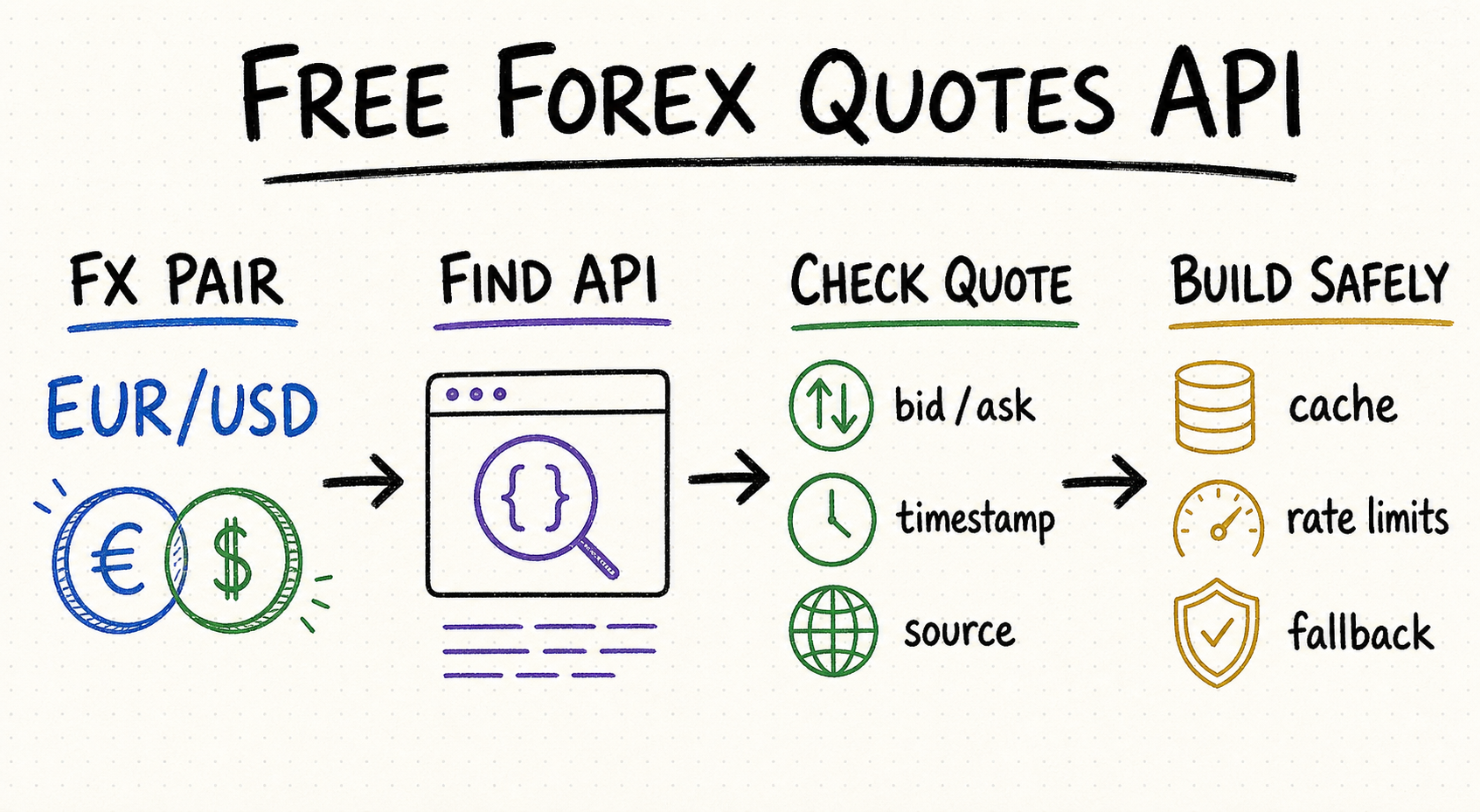
Free forex quotes API: what to look for first
A useful free FX API exposes a documented HTTPS endpoint, identifies the base and quote currencies, returns a source timestamp, and explains its source, update frequency, quota, authentication, license, and error behavior. “Free” can mean a public endpoint, a limited plan, or a trial, so verify the current documentation before building a dependency.
| Need | Verify | Common mismatch |
|---|---|---|
| Current conversion | Latest timestamp and base rules | Daily reference rate presented as live |
| App or dashboard | Quota, CORS, caching, status page | Trial mistaken for a permanent free tier |
| Trading use | Bid/ask, latency, venue, license | Midpoint used as an executable quote |
Define the quote contract before comparing forex APIs
Do you need bid and ask, or only a reference rate?
A forex quote is not merely a currency conversion number. Trading, spread monitoring, valuation, and best-execution research require an explicit bid, ask, quote timestamp, and source or venue. A single midpoint can support display and rough valuation, but it cannot show the cost of crossing the spread. Write this distinction into the acceptance test before comparing providers.
Pair direction, quote precision, and market convention
For EUR/USD, the bid normally describes how many dollars a dealer pays for one euro and the ask how many dollars it charges. An inverted response changes both the numerical value and which side is bid or ask. Preserve the provider symbol, normalized base and quote currencies, displayed precision, pip size, and any direct-versus-derived flag rather than storing an unlabeled rate.
Snapshot quotes versus an ongoing quote stream
This page is about the meaning and validation of a quote, regardless of transport. A REST endpoint may be enough for periodic spread checks; a WebSocket feed is better for stateful monitoring. If your main question is reconnect logic, subscriptions, heartbeat messages, or tick latency, use the dedicated live-forex-data guide instead of treating those operational concerns as quote semantics.
Compare forex quote APIs by market meaning, not endpoint count
| Criterion | Question | Evidence to keep |
|---|---|---|
| Quote sides | Are bid and ask native fields or reconstructed from a midpoint? | Raw payload and field definitions |
| Spread | Is the spread plausible for the pair, venue, and session? | Bid, ask, midpoint, and calculated spread |
| Provenance | Which contributor, broker, venue, or aggregation method produced it? | Provider, venue, contributor, methodology |
| Quote age | How old was the market observation when your service received it? | Source, receipt, and processing timestamps |
| Entitlement | May quotes be displayed, cached, or redistributed to customers? | Market-data agreement and display terms |
Why a free midpoint API is not automatically a forex quote API
Many free endpoints return one indicative rate per pair and call it a quote. That can be useful, but it cannot support spread analysis unless the provider documents how bid and ask are formed. Classify those endpoints as reference-rate services and reserve “quote feed” for responses with enough provenance and side information to explain what a buyer and seller would observe.
Understand how a forex quote is formed
Unlike an exchange-traded stock, spot FX has no single consolidated tape. A bank, broker, electronic venue, retail platform, and multi-source aggregator can all publish valid but different prices at the same instant. The difference may reflect contributor inventory, client tier, session liquidity, aggregation rules, or delay rather than a bad API. A production comparison therefore evaluates quote lineage before numerical closeness.
| Source type | What it represents | Suitable uses | Watch for |
|---|---|---|---|
| Single-dealer quote | Prices offered by one bank or broker | Client-specific execution analysis | Customer tier and non-transferable rights |
| Venue quote | Best visible prices within one venue | Venue monitoring and microstructure research | Depth, participant access, and venue hours |
| Composite quote | A normalized bid and ask across contributors | Cross-provider monitoring and valuation | Contributor set and stale-source handling |
| Indicative quote | A non-binding market indication | Dashboards and directional context | Not executable and may omit the spread |
Store both sides and derive the midpoint explicitly
When bid and ask are available, store both unchanged and calculate (bid + ask) / 2 as a derived field. Also record absolute spread and spread in pips or basis points. This makes later analysis reproducible and prevents a transformed midpoint from being confused with the provider’s original observation.
Worked inversion example: reciprocal values must swap sides
Assume a source quotes EUR/USD at 1.08492 bid and 1.08496 ask. To express the same market as USD/EUR, the inverse bid is 1 ÷ 1.08496 = 0.921693 and the inverse ask is 1 ÷ 1.08492 = 0.921727. The original ask becomes the denominator of the inverse bid because someone selling USD and receiving EUR crosses the opposite side of the original market. Taking 1 ÷ bid as the new bid and 1 ÷ ask as the new ask would produce 0.921727 × 0.921693—a crossed, impossible quote.
Preserve the original pair and sides, perform the inversion with decimal arithmetic at higher precision than the display format, and round only at the final presentation boundary. Record the derived flag and source timestamp so the inverse cannot be mistaken for a separately observed USD/EUR market. The same discipline applies when composing cross rates: bid and ask must be derived side by side from time-aligned source quotes, not from one rounded midpoint.
Detect crossed, locked, stale, and one-sided quotes
Reject or quarantine a quote when bid exceeds ask unless the feed documents an auction or special state. Flag zero spreads, missing sides, timestamps that move backward, and values unchanged beyond a pair-specific threshold. These checks are more meaningful for a quote API than simply asking whether the JSON parsed successfully.
Test a free forex quotes API JSON response
Provider-neutral latest-rates request
GET /latest?base=USD&symbols=EUR,JPY
Accept: application/json

{
  "base": "USD",
  "timestamp": "SOURCE_TIMESTAMP",
  "rates": {
    "EUR": "RATE_VALUE",
    "JPY": "RATE_VALUE"
  }
}
The endpoint and values are placeholders, not claims about a provider or current market rates. Replace them with the selected API documentation, then verify direction, timestamp, numeric type, missing symbols, and error behavior.
Fields a production response should make unambiguous
| Field | Validation |
|---|---|
base / quote | Valid currency identifiers with an explicit pair direction |
rate / rates | Positive decimal values with a documented rate type and precision |
timestamp | Source observation time, timezone, and freshness—not only server response time |
source | Provider or methodology identifier sufficient for provenance |
success / error | Machine-readable error code, message, and retry classification |
Integration checklist for a free currency API
- Validate base and quote codes before sending the request.
- Set an explicit timeout and handle 4xx, 5xx, and rate-limit responses separately.
- Store the source timestamp, retrieval time, provider, and raw response checksum.
- Use decimal arithmetic and make cache or database writes idempotent.
- Alert on stale timestamps, schema changes, missing pairs, and quota exhaustion.
Validate FX data before production use
Reference rates are not executable prices
A midpoint or official reference rate does not include a bank spread, card fee, slippage, or a venue-specific bid and ask. Label the data accurately and do not present it as an execution guarantee.
Freshness, continuity, and outlier checks
Reject non-positive or malformed rates, detect stale source timestamps, compare reciprocal pairs within a defined tolerance, and classify missing observations. A second source can trigger review, but should not silently manufacture a replacement value.
Quota-aware caching and refresh design
Match cache duration to the provider’s actual update schedule. Calling a daily reference endpoint every minute wastes quota without improving freshness. Keep a short-lived stale-on-error window for non-critical displays, but expose the observation timestamp so users and downstream services can distinguish cached data from a fresh response.
Retries, circuit breakers, and provider fallback
Retry only transient failures with exponential backoff and jitter. Do not retry invalid currencies, authentication failures, or exhausted monthly quotas as if they were network timeouts. A fallback provider must be normalized to the same pair direction, timestamp rules, and rate type before its values can replace the primary source.
Licensing, attribution, and redistribution
Free access to an endpoint does not automatically grant the right to cache indefinitely, publish a bulk download, resell the data, or remove attribution. Keep the terms version and review date with the integration record, and re-check them before changing how the data is displayed or distributed.
How QVeris helps you find a free forex quotes API
QVeris helps developers and agents discover and inspect callable capabilities. Open the QVeris tool details to inspect its inputs and outputs, then follow the QVeris documentation to connect them. QVeris can reduce discovery and schema-inspection work; it does not change a provider’s rates, license, quota, or service level.
Free forex quotes API questions
Yes. Public endpoints and free plans exist, but freshness, coverage, source, attribution, and quotas differ.
Yes, for reference rates and some market data. Verify whether the response is daily, delayed, intraday, midpoint, or bid/ask.
There is no universal best option. Match the provider to required pairs, freshness, source, quota, rights, and reliability.
Some endpoints are keyless, but they may require attribution, enforce limits, or restrict redistribution.
Do not treat a search converter as an official supported API. Choose a documented endpoint with explicit terms.
Not necessarily. “Latest” may be daily, hourly, delayed, or intraday; inspect the source timestamp and methodology.