
Find a Free Forex Price API
That Fits Your App
Compare live rates, historical coverage, free limits, API keys, and schemas before you connect forex data to an app or agent.
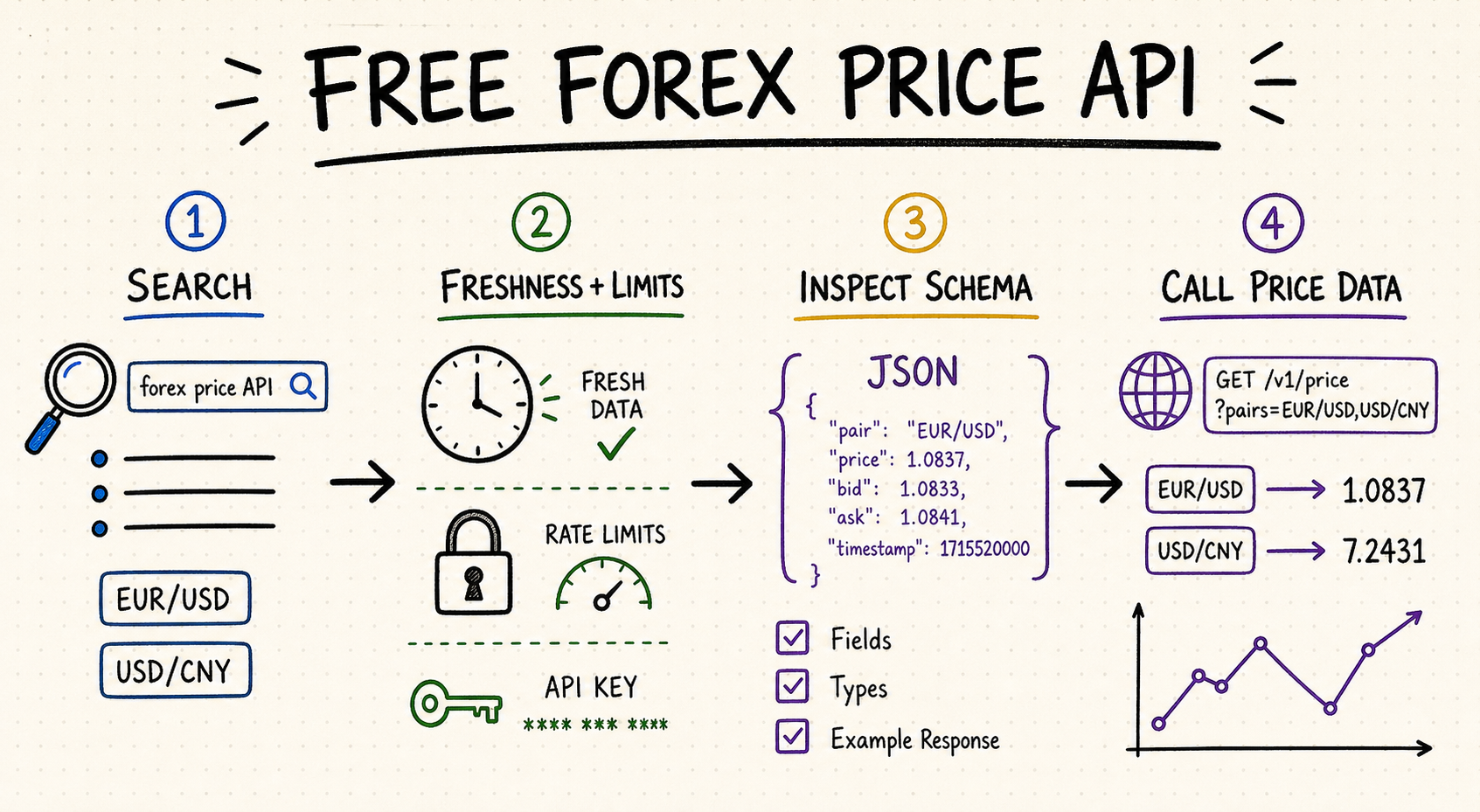
TL;DR
It may mean an open endpoint, a monthly free quota, or a trial. Confirm keys, attribution, commercial-use terms, and limits.
Daily reference rates, delayed mid-market rates, live bid/ask quotes, and OHLC candles serve different jobs.
Check freshness, symbols, history depth, granularity, timestamps, rate limits, schema stability, and data licensing.
QVeris helps developers discover a capability, inspect its parameters, and call it through a documented workflow.
What a free forex price API must provide
A useful free forex API must match the decision your product makes. Currency conversion can use a daily reference rate; a live dashboard needs a recent timestamp; backtesting may require historical forex data with consistent intervals and OHLC fields.
Real-time forex API or reference rates?
Read the provider’s update interval and source. “Latest” does not necessarily mean tick-level or tradable, and a mid-market reference rate is not an executable broker quote.
Historical forex data API coverage
Verify start date, interval, missing periods, daylight-saving handling, weekend behavior, and whether OHLC or only one daily rate is returned.
Free forex API key and limits
Check whether an API key is required, how quotas reset, whether attribution is mandatory, and whether commercial caching or redistribution is allowed.
How to compare free forex APIs
| Criterion | What to inspect | Why it matters | Red flag |
|---|---|---|---|
| Freshness | Timestamp, source, delay, market session. | Separates live use from reference conversion. | “Real-time” without a defined interval. |
| Coverage | Pairs, base currencies, history, OHLC granularity. | Determines whether one endpoint fits the product. | Currency count with no supported-symbol list. |
| Free limits | Calls, burst rate, key, attribution, commercial terms. | Prevents a prototype from failing at launch. | No public quota or licensing terms. |
| Schema quality | JSON types, bid/ask/mid, errors, timezone, versioning. | Reduces integration ambiguity. | Examples do not match documentation. |
Choose forex price data by use case
“Forex price” is not one universal dataset. The correct endpoint depends on whether you are converting an invoice, refreshing a dashboard, researching a strategy, or giving an AI agent current market context. Define the decision first, then choose the data.
Currency conversion and accounting
Daily or periodic reference rates may be sufficient. Prioritize an official source, stable base/quote conventions, historical dates, and clear licensing. Do not label the result as an executable trading price.
Live dashboards and alerts
Require timestamps, a documented update interval, market-session status, and a stale-data rule. Decide how long the last successful quote may remain visible after an upstream failure.
Backtesting and research
Check candle interval, history depth, timezone, daylight-saving transitions, missing bars, weekend policy, and whether “volume” represents real trades or provider-specific tick activity.
AI agents and automated workflows
Expose a strict schema, bounded response size, source metadata, and deterministic errors. The agent should know whether it received a reference rate, midpoint, bid/ask quote, or OHLC candle.
Free forex API Python integration steps
1. Define the data contract
Write down the required pairs, freshness, history, interval, bid/ask or midpoint fields, timezone, error handling, and acceptable request budget.
2. Test one documented request
Use Python’s HTTP client with a timeout, check the status code, and validate the returned timestamp and numeric fields before storing anything.
3. Add caching and limit handling
Cache according to the provider’s terms, respect quota headers, and implement explicit behavior for 429 responses, missing pairs, and stale timestamps.
4. Keep the provider replaceable
Normalize the response into your own internal shape so a free tier can be replaced or supplemented without rewriting every consumer.
Fields a forex API response should explain
A short JSON response can still be ambiguous. Before integration, document the quotation direction, price type, source time, retrieval time, market state, and units. Treat field meaning as part of the API contract—not as an assumption hidden in application code.
| Field | Meaning to confirm | Validation | Common mistake |
|---|---|---|---|
pair | Base and quote order, such as EUR/USD. | Compare with the supported-symbol definition. | Inverting the rate twice. |
price / mid | Reference, midpoint, close, or derived rate. | Read source and methodology notes. | Treating it as an executable quote. |
bid / ask | Provider-side buying and selling prices. | Check that bid ≤ ask and both share a timestamp. | Ignoring spread or quote side. |
timestamp | Source observation time, not always request time. | Parse timezone and calculate age. | Displaying stale data as live. |
import requests

response = requests.get(API_URL, params={"pair": "EUR/USD"}, timeout=10)
response.raise_for_status()
quote = response.json()

required = {"pair", "price", "timestamp"}
missing = required.difference(quote)
if missing:
    raise ValueError(f"Missing fields: {sorted(missing)}")

price = float(quote["price"])
if price <= 0:
    raise ValueError("Price must be positive")
Worked example: invert and cross forex quotes without losing direction
Suppose the feed quotes EUR/USD at 1.0798 / 1.0802 and USD/JPY at 149.98 / 150.02. In both pairs, the first number is the bid for one unit of the base currency and the second is the ask. A synthetic EUR/JPY quote must preserve those sides; multiplying two midpoint values would hide the executable spread.
| Result | Calculation | Interpretation |
|---|---|---|
| EUR/JPY bid | 1.0798 × 149.98 = 161.9484 | The synthetic bid uses both bid sides. |
| EUR/JPY ask | 1.0802 × 150.02 = 162.0516 | The synthetic ask uses both ask sides. |
| USD/EUR reference | 1 ÷ 1.0800 ≈ 0.925926 | This is the inverse of the midpoint only. For a two-sided inverse quote, use 1 / original ask as the new bid and 1 / original bid as the new ask. |
Before composing a cross rate, align the timestamps and sources. Quotes observed in different seconds, from different venue sets, or under different market states do not form a clean synthetic pair. Store the two source timestamps and reject or flag the result when their gap exceeds the application’s tolerance.
Production checklist for a free forex rates API
A successful demo proves only that one request worked. Production readiness requires explicit controls for reliability, licensing, monitoring, and provider changes. Free tiers are valuable for prototypes, but their quotas and product terms can change.
- Freshness: record source timestamps, calculate quote age, and reject data older than the use case allows.
- Reliability: set connect/read timeouts, bounded retries with jitter, circuit breaking, and a defined fallback or fail-closed state.
- Quota: monitor daily and burst limits, cache only when permitted, and alert before exhaustion rather than after HTTP 429 responses begin.
- Data quality: test supported pairs, positive numeric values, bid/ask ordering, timezones, missing candles, and unusual market closures.
- Licensing: save the applicable terms, attribution requirement, commercial-use rule, caching allowance, and redistribution restriction.
- Provider change: version your adapter and contract tests so renamed fields or endpoint changes fail visibly.
How QVeris helps call a forex data capability
QVeris is a capability routing network, not a claim that every forex source is free or real-time. Use its documented Search → Inspect → Call workflow to find relevant capabilities, review parameters and metadata, then execute the selected tool.
- Search in natural language for the required forex price or historical-rate capability.
- Inspect the selected tool’s input schema and examples before sending pair, interval, or date parameters.
- Call the capability and validate freshness, source, quota, and licensing for your production use case.
FAQ
The best option is the one whose freshness, pairs, history, quota, schema, and license match your use case. A daily converter and a trading dashboard need different data.
Some providers offer live or near-real-time data in a free tier, but definitions and quotas vary. Verify the published interval and response timestamp.
Yes, some open endpoints require no key. They may still impose rate limits, attribution, daily updates, or restrictions on redistribution.
Some do, but history depth and granularity vary. Confirm whether the endpoint returns daily rates, time series, or OHLC candles.
Choose a documented endpoint, send an HTTP request with a timeout, validate status and timestamps, then normalize the JSON into your own data model.
Trading-oriented APIs may provide OHLC candles; currency-conversion APIs often return only a current or daily reference rate.