
Free Forex Market Data API
Data Types, Checks & Integration
Understand quotes, OHLC candles, time series, free-tier limits, and the validation steps required before forex market data enters your app.
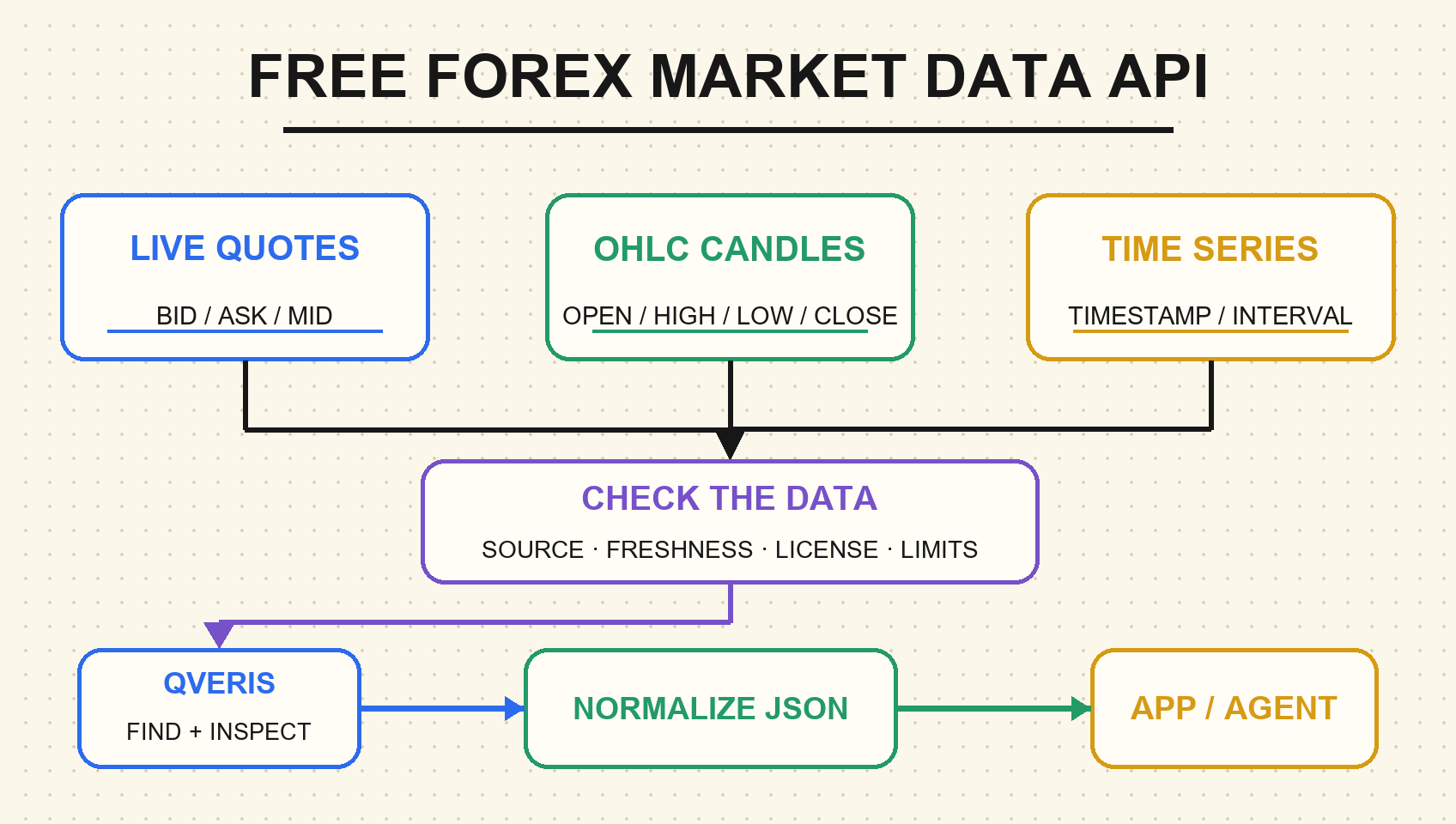
Forex market data types inside an API
“Forex data” can describe several datasets that are not interchangeable. A provider may offer only one of them on its free tier, so inspect the endpoint and sample response rather than relying on the product label.
Live quotes: bid, ask, and midpoint
A quote snapshot should identify the currency pair, price side, source timestamp, and market state. Midpoint data is useful for display and valuation but is not automatically an executable trading price.
OHLC candles for charts and research
Candles aggregate observations into open, high, low, and close fields for a defined interval. Confirm timezone, interval boundaries, missing-bar policy, and whether volume is available or meaningful for OTC FX.
Historical forex time series
A historical endpoint should expose dates or timestamps, start and end limits, supported granularity, pagination, corrections, and consistent pair conventions.
Reference rates and market metadata
Central-bank reference rates suit accounting and conversion workflows. Symbol lists, trading sessions, source labels, and market-status fields provide the metadata needed to interpret them correctly.
Tick volume, contributor depth, and liquidity proxies
OTC FX has no single consolidated exchange volume. A volume field may count quote updates, provider ticks, trades from one venue, or nothing at all. Record its definition before using it as a liquidity or activity signal.
Economic events and session context
Calendar events, session labels, holidays, and market status help explain gaps and volatility. Treat them as contextual datasets with their own publication time rather than embedding them silently into a price record.
Match the dataset to the workload
Use reference rates for accounting and conversion, recent quotes for dashboards, and historical OHLC or tick series for backtests. An agent needs bounded JSON with explicit source and freshness fields. Do not present a daily fixing as live or combine providers before normalizing pair direction, timestamps, and price type.
A valuation or treasury workflow usually values consistency, an approved fixing, and a reproducible business date more than millisecond speed. A monitoring dashboard needs clear source age and market state. A research pipeline needs long history, stable bar construction, and revision evidence. An automated agent additionally needs strict pair and date bounds, explicit units, and a refusal path when the requested data class is unavailable.
Write one acceptance record per workload instead of declaring a provider universally approved. The same source can pass for a daily conversion table and fail for an intraday alert because the required cadence, price side, outage behavior, and usage rights are different.
Free forex data sources: choose by price meaning
The most important difference between free sources is not the response format; it is what the number represents. A central-bank reference rate, a vendor's latest rate, and a broker or venue bid/ask can all be valid while disagreeing at the same timestamp. Select the source class before comparing quotas.
| Starting point | What it provides | Good fit | Do not assume |
|---|---|---|---|
| ECB Data API | Programmatic SDMX access to daily and monthly euro foreign-exchange reference rates, with date filters and revision queries. | Accounting, treasury conversion, reporting, reproducible historical reference series, and official-source validation. | ECB states that the rates are informational averages published on working days around 16:00 CET; they are not necessarily transaction prices or a 24-hour live feed. |
| Alpha Vantage | A free-key path for current currency-pair exchange rates and daily FX OHLC; the documentation also lists JSON and CSV responses. | Small currency converters, recent daily charts, notebooks, and prototypes that make a limited number of pair requests. | The intraday FX time-series function is currently marked Premium. A latest exchange-rate value also does not disclose an executable spread unless bid and ask are explicitly returned. |
| Twelve Data | The free individual plan lists real-time forex market data, and the time-series endpoint supports pairs such as EUR/USD with OHLC history. | Multi-pair dashboards, charting prototypes, and applications that need one API style across forex and other asset classes. | Credits are consumed per symbol, including batched requests. Verify the free plan's current pair coverage, intervals, update cadence, history, and permitted display before production use. |
Map each common search task to the right source
Use a documented reference-rate series with a reproducible business date, base currency, publication calendar, and revision policy. Store the rate identity with the converted value.
Use recent market observations with an event timestamp, receive timestamp, market state, and maximum acceptable age. A daily fixing is unsuitable even if its source is authoritative.
Require a stated bar basis—bid, ask, midpoint, or vendor composite—plus timezone, interval boundaries, missing-bar rules, and a stable historical revision process.
Validate executable bid/ask from the relevant broker or venue, account entitlement, liquidity, and order path. An aggregated free rate can provide context but should not substitute for execution-side market data.
A validation pipeline for free forex market data
1. Define the market-data contract
List pairs, quote side, interval, freshness, history depth, timezone, market-session behavior, and allowed usage before searching for a provider.
2. Inspect the free tier at endpoint level
Check which endpoints, symbols, intervals, date ranges, request credits, streaming features, and commercial rights are actually included.
3. Validate a real response
Test success, empty-market, stale-data, invalid-symbol, 429, and upstream-error cases. Compare timestamps and quotation direction with the documentation.
4. Normalize, cache, and monitor
Map the response into your own schema, cache only as permitted, record source and retrieval time, and alert when freshness or completeness falls outside the contract.
5. Reconcile related datasets
Check that a snapshot falls within the matching candle, inverse pairs agree within tolerance, and derived crosses use synchronized observations. Keep disagreements as quality events rather than overwriting them.
6. Test market transitions
Inspect weekend close and reopen, daylight-saving changes, holidays, major announcements, and a known provider outage. Verify that closed, quiet, delayed, and disconnected states remain distinguishable.
7. Preserve evidence for every downstream use
Store provider, upstream source when known, pair, side, event time, receive time, price basis, entitlement, and raw-response hash so a dashboard, model, or agent answer can be reproduced.
What “free” does and does not guarantee
Free access can suit prototypes, conversion, education, or limited research. It does not guarantee real-time delivery, unrestricted history, redistribution rights, service levels, or stable quotas. Treat plan terms as changeable configuration.
Model the free allowance from actual endpoint credits, pairs, refresh cycles, users, retries, and reconnects. Also record what happens at the boundary: some services return 429, others downgrade data, block an endpoint, or require an upgrade. A production design needs an explicit response for each state rather than silently serving a different dataset.
How QVeris fits the forex market data workflow
QVeris helps an app or agent discover and inspect callable forex data capabilities, review their input and output contract, and call a capability. It does not replace checks for license, freshness, limits, or price meaning.
- Search QVeris capabilities with the required dataset and workload, not only the word “forex.”
- Inspect schema and capability metadata before exposing the call to an automated workflow.
- Keep independent freshness, licensing, and error checks in the consuming application.
FAQ
Yes. Free access may cover daily reference rates, delayed or recent quotes, selected pairs, or limited historical data. Verify the exact endpoint and license.
Sometimes, but “real-time” can mean different update intervals and data sources. Check source timestamps, delay, market status, and whether the values are executable or indicative.
Some trading-oriented APIs expose candles on free plans. Confirm intervals, history depth, timezone, missing bars, and whether the candle is derived from midpoint, bid, or ask observations.
Request a documented endpoint with a timeout, validate status and timestamps, map fields into an internal schema, then add caching, 429 handling, and freshness monitoring.
No. Exchange-rate APIs often focus on periodic reference rates and conversion. Forex market data can also include live bid/ask quotes, OHLC candles, market sessions, and higher-frequency time series.