
Free Forex Live Data API
REST, WebSocket, and Validation Guide
Use a free forex live data API to retrieve current bid and ask prices, then verify timestamps, sources, limits, and delivery before your app relies on the feed.
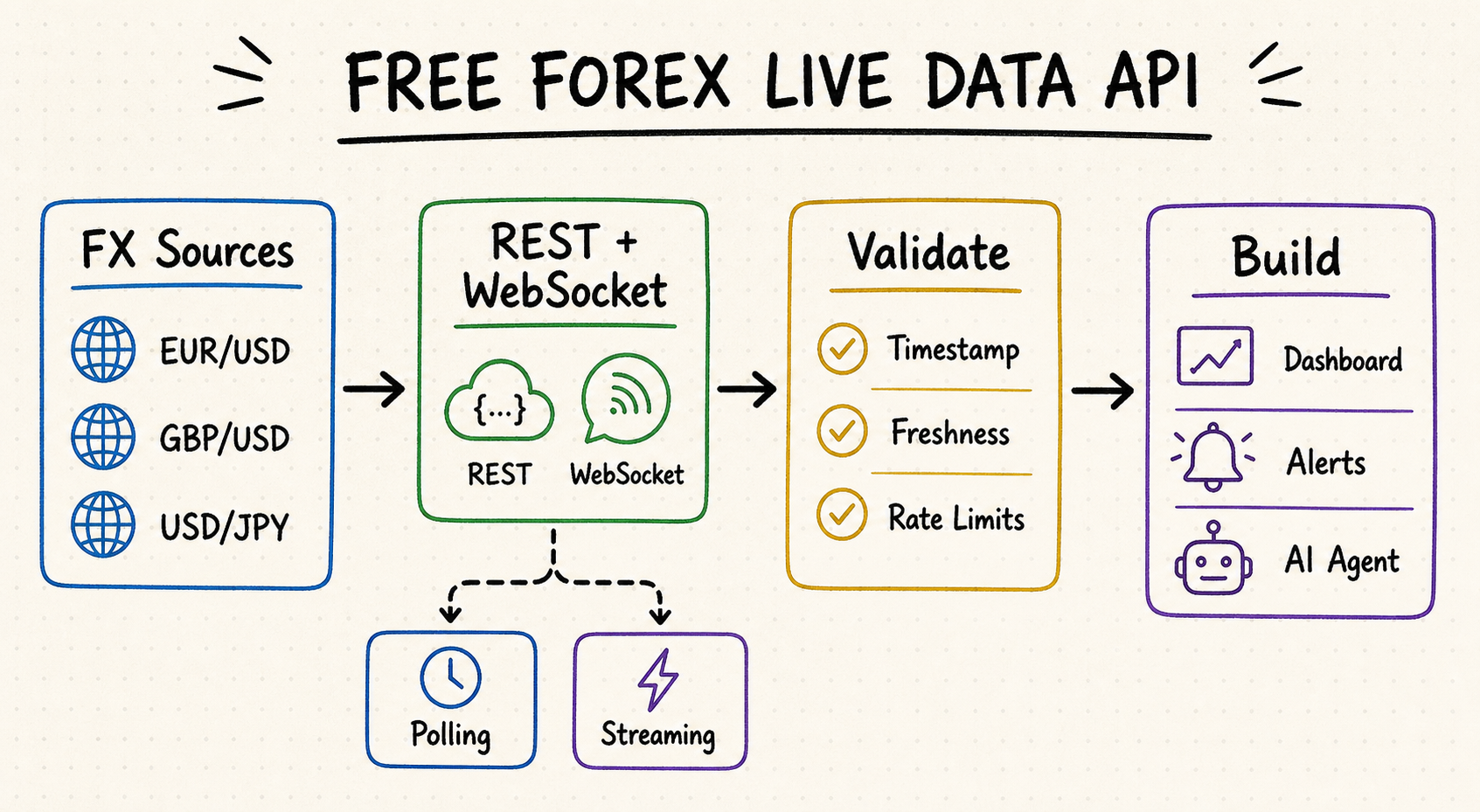
Free forex live data API: what to look for first
A useful free FX API exposes a documented HTTPS endpoint, identifies the base and quote currencies, returns a source timestamp, and explains its source, update frequency, quota, authentication, license, and error behavior. “Free” can mean a public endpoint, a limited plan, or a trial, so verify the current documentation before building a dependency.
| Need | Verify | Common mismatch |
|---|---|---|
| Current conversion | Latest timestamp and base rules | Daily reference rate presented as live |
| App or dashboard | Quota, CORS, caching, status page | Trial mistaken for a permanent free tier |
| Trading use | Bid/ask, latency, venue, license | Midpoint used as an executable quote |
Design the live-feed contract before choosing a provider
REST snapshots or streaming live forex data?
Polling a REST endpoint every few seconds and subscribing to a WebSocket are different architectures. REST is simpler for occasional dashboard refreshes; a stream is appropriate when the application must react to successive quote changes. Define target update frequency, maximum event-to-client latency, simultaneous pair subscriptions, and the acceptable behavior during a disconnect. A feed that is “real time” in marketing copy may still be sampled, delayed, or capped on the free plan.
Subscription lifecycle, heartbeat, and reconnect state
A usable streaming API documents authentication, subscribe and unsubscribe messages, acknowledgement events, heartbeat cadence, sequence numbers, and server-side limits. Your client should distinguish a quiet market from a dead connection, reconnect with backoff, renew every intended subscription, and request a fresh snapshot before processing new deltas. Persist connection state separately from market observations.
Event timestamps, sequence gaps, and market hours
Store the provider event time, your receive time, and an optional processing time. A sequence gap or timestamp reversal should trigger resynchronization rather than silent continuation. FX trades nearly around the clock during the business week, but liquidity changes by session and many feeds pause over the weekend. Market-state metadata prevents a scheduled closure from being mislabeled as stale data.
How to compare free real-time forex data API options
| Criterion | Question | Evidence to keep |
|---|---|---|
| Update model | Every tick, conflated interval, or periodic snapshot? | Captured events over an active session |
| Latency | What are median and tail event-to-client delays? | Event and receive timestamps |
| Capacity | How many pairs, connections, and messages are allowed? | Plan limits and observed disconnects |
| Recovery | Can the client detect gaps and restore a coherent state? | Sequence IDs, snapshots, replay policy |
| Entitlement | Does the free stream permit display or downstream use? | Real-time agreement and redistribution terms |
Free live forex data with or without an API key
Authentication is normal for a persistent stream because providers must enforce connection, pair, and message limits. A keyless demo can prove that your parser works, but a production client also needs revocable credentials, observable usage, documented reconnect rules, and a stable entitlement. Do not expose a reusable streaming token in browser code unless the provider supports short-lived, scoped client tokens.
Choose the live event shape your application can maintain
The best transport is the one that matches downstream state. Full snapshots are larger but easy to recover; deltas are efficient but require an ordered baseline; conflated updates reduce load while hiding intermediate ticks. Before choosing a vendor, prototype the complete session—from authentication and subscription through a forced disconnect and recovery—not merely the first successful message.
| Source type | What it represents | Suitable uses | Watch for |
|---|---|---|---|
| Full snapshot | Complete current state in every update | Simple dashboards and resilient consumers | Bandwidth and redundant values |
| Incremental delta | Only fields changed since the prior state | High-volume stateful services | Ordering, gaps, and snapshot recovery |
| Conflated stream | Latest value emitted at a fixed interval | Monitoring without every tick | Hidden intermediate moves |
| REST refresh | Client requests current state on demand | Low-frequency displays and fallback | Polling quota and synchronized bursts |
Worked stream example: price meaning and sequence recovery
Suppose EUR/USD sequence 8201 carries a bid of 1.08492 and an ask of 1.08496. The spread is 1.08496 − 1.08492 = 0.00004, or 0.4 pip, and the midpoint is 1.08494. A display may show that midpoint when it is labeled as indicative, but a client buying EUR would face the ask: 100,000 EUR costs $108,496 before fees, not the $108,494 implied by the midpoint. Preserve the pair direction, side, size, source timestamp, venue or contributor set, and delay class with the value; a generic rate: 1.08494 is not an executable quote.
If the next received update is sequence 8204, the consumer has missed 8202 and 8203. Do not apply 8204 and keep presenting the pair as current. Mark the local state stale, stop dependent alerts or calculations, request a fresh bounded snapshot, record its sequence or as-of time, and then resume with updates strictly after that baseline. Deduplicate any overlap between the snapshot and buffered stream. This controlled recovery test should be repeated during active markets and after reconnects because a socket that remains open can still deliver incomplete state.
Measure freshness from the source event, not the arrival alone
A message can arrive instantly yet contain an old market observation. Calculate both network/processing delay and total quote age when the source timestamp is available. Report median, p95, and worst-case values over an active session instead of relying on one fast sample.
Backpressure and slow-consumer behavior
Define what happens when events arrive faster than your application can process them: buffer with a hard limit, keep only the latest state, or shed low-priority pairs. Monitor queue depth and processing lag. An unlimited in-memory queue converts a brief market burst into latency growth and eventually an outage.
Test a free forex live data API JSON response
Provider-neutral REST snapshot and streaming model
GET /latest?base=USD&symbols=EUR,JPY
Accept: application/json

{
  "base": "USD",
  "timestamp": "SOURCE_TIMESTAMP",
  "rates": {
    "EUR": "RATE_VALUE",
    "JPY": "RATE_VALUE"
  }
}
The endpoint and values are placeholders, not claims about a provider or current market rates. Replace them with the selected API documentation, then verify direction, timestamp, numeric type, missing symbols, and error behavior.
Timestamp, market state, and freshness fields
| Field | Validation |
|---|---|
base / quote | Valid currency identifiers with an explicit pair direction |
rate / rates | Positive decimal values with a documented rate type and precision |
timestamp | Source observation time, timezone, and freshness—not only server response time |
source | Provider or methodology identifier sufficient for provenance |
success / error | Machine-readable error code, message, and retry classification |
Integration checklist for a live forex data feed
- Validate base and quote codes before sending the request.
- Set an explicit timeout and handle 4xx, 5xx, and rate-limit responses separately.
- Store the source timestamp, retrieval time, provider, and raw response checksum.
- Use decimal arithmetic and make cache or database writes idempotent.
- Alert on stale timestamps, schema changes, missing pairs, and quota exhaustion.
Validate FX data before production use
Reference rates are not executable prices
A midpoint or official reference rate does not include a bank spread, card fee, slippage, or a venue-specific bid and ask. Label the data accurately and do not present it as an execution guarantee.
Freshness, continuity, and outlier checks
Reject non-positive or malformed rates, detect stale source timestamps, compare reciprocal pairs within a defined tolerance, and classify missing observations. A second source can trigger review, but should not silently manufacture a replacement value.
Quota-aware caching and refresh design
Match cache duration to the provider’s actual update schedule. Calling a daily reference endpoint every minute wastes quota without improving freshness. Keep a short-lived stale-on-error window for non-critical displays, but expose the observation timestamp so users and downstream services can distinguish cached data from a fresh response.
Retries, circuit breakers, and provider fallback
Retry only transient failures with exponential backoff and jitter. Do not retry invalid currencies, authentication failures, or exhausted monthly quotas as if they were network timeouts. A fallback provider must be normalized to the same pair direction, timestamp rules, and rate type before its values can replace the primary source.
Licensing, attribution, and redistribution
Free access to an endpoint does not automatically grant the right to cache indefinitely, publish a bulk download, resell the data, or remove attribution. Keep the terms version and review date with the integration record, and re-check them before changing how the data is displayed or distributed.
How QVeris helps you find a free forex live data API
QVeris helps developers and agents discover and inspect callable capabilities. Open the QVeris tool details to inspect its inputs and outputs, then follow the QVeris documentation to connect them. QVeris can reduce discovery and schema-inspection work; it does not change a provider’s rates, license, quota, or service level.
Free forex live data API questions
Yes. Public endpoints and free plans exist, but freshness, coverage, source, attribution, and quotas differ.
Yes, for reference rates and some market data. Verify whether the response is daily, delayed, intraday, midpoint, or bid/ask.
There is no universal best option. Match the provider to required pairs, freshness, source, quota, rights, and reliability.
Some endpoints are keyless, but they may require attribution, enforce limits, or restrict redistribution.
Do not treat a search converter as an official supported API. Choose a documented endpoint with explicit terms.
Not necessarily. “Latest” may be daily, hourly, delayed, or intraday; inspect the source timestamp and methodology.