
Choose a Free Economic News API
Compare economic-news sources, topic filters, freshness, free limits, licensing, and JSON fields before integrating an API.
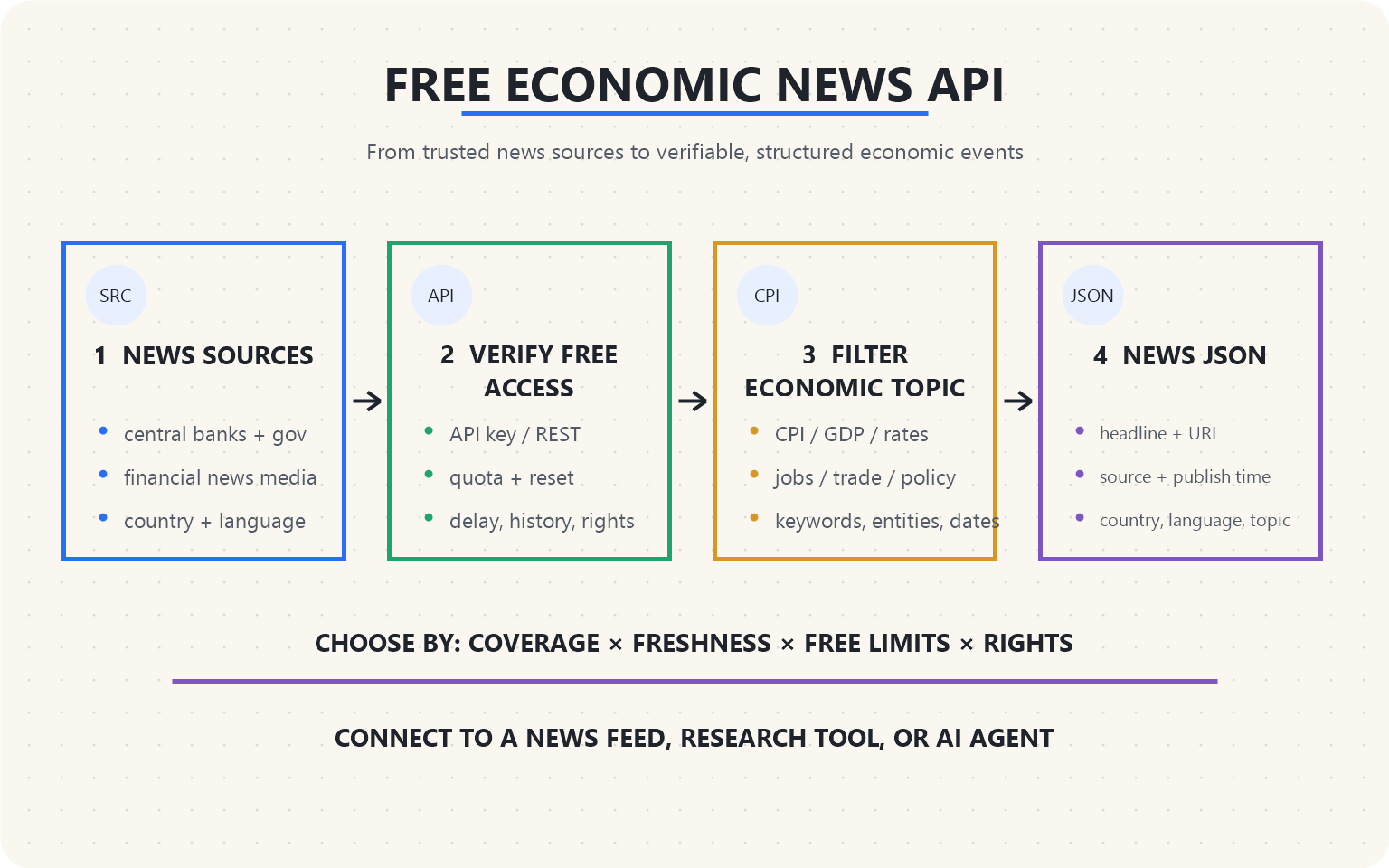
What a free economic news API should help you build
Developers need an API they can test, a clear free-plan boundary, an inspectable response, and enough source evidence to decide whether it fits a news feed, macro monitor, research Agent, or prototype. The first design decision is whether the product needs articles, scheduled events, official indicator values, or a linked combination of all three.
Articles and headlines differ from numeric releases such as GDP, CPI, rates, and employment. Confirm which content the endpoint returns.
A trial or free tier may restrict requests, history, freshness, sources, full text, or production use.
Test timestamps, pagination, empty results, duplicates, rate-limit headers, and attribution fields before selecting a provider.
Economic news API coverage and filter options
Useful coverage includes recent headlines, REST or JSON delivery, named sources, countries, languages, economic categories, entity or ticker tags, sentiment, and date filters. Every coverage claim is provider-specific: confirm it with real queries and current documentation rather than assuming an “economy” category includes official releases, calendars, and explanatory reporting.
Global economic news API coverage
Check countries, languages, publishers, update cadence, and whether sources include central banks, government releases, business media, or blogs.
Economic news API with topic filters
Look for keywords, categories, entities, tickers, country, language, source, and date filters. Test if “economy” includes monetary policy, inflation, jobs, trade, and fiscal policy.
Economic calendar and indicator boundaries
An economic calendar may return a scheduled release time, country, indicator, period, importance, consensus, previous value, actual value, and later revisions rather than journalism. A statistical-series API may return only observations and vintages. Verify timezone and whether “previous” is the originally published or revised value; keep these records separate from articles unless the endpoint explicitly links both.
Release lifecycle and rescheduling
Keep scheduled time, first actual publication time, provider ingestion time, update time, and status as separate fields. Releases can be postponed, canceled, corrected, or published early around holidays and emergencies. A calendar row should not be marked complete merely because the scheduled clock passed.
Consensus, surprise, and unit semantics
Store actual, consensus, prior-original, prior-revised, unit, frequency, seasonal-adjustment status, and transformation such as level, percent, annualized rate, or year-over-year change. Calculate surprise only after units and vintages are aligned; subtracting a percentage from an index level produces a plausible but meaningless number.
Primary releases and explanatory coverage
Central banks, statistical agencies, treasuries, and regulators are primary evidence. News articles explain market interpretation and revisions but should remain linked, separate records. Preserve the official release URL and document version so an agent can cite the number and the analysis appropriately.
Choose the right source for economic news and data
A robust macro product usually combines several source types instead of forcing one endpoint to do everything. Official APIs establish the numeric record, release feeds establish what the institution published, news aggregators add interpretation and cross-source coverage, and calendar services add consensus and scheduled-event structure.
| Source route | Use it for | Do not assume |
|---|---|---|
| Official statistical APIs BLS, BEA, FRED | CPI, employment, GDP, rates, observations, series metadata, and where supported, release or vintage history. | That a series API includes consensus estimates, news summaries, or a complete point-in-time vintage without using the relevant vintage endpoint. |
| Central-bank and agency release feeds | Statements, minutes, press releases, methodology notes, tables, and corrections directly from the publisher. | That every publisher exposes the same schema, timestamp semantics, archive depth, or machine-readable full text. |
| News aggregation APIs GDELT, NewsAPI and financial-news providers | Cross-publisher headlines, country or language discovery, topic filtering, narrative context, and links to reporting. | That the first article is the primary source, full text may be republished, sentiment is factual, or duplicate coverage represents separate events. |
| Economic calendar services For example, Trading Economics | Scheduled times, importance, consensus, prior, actual, event status, and a normalized multi-country calendar. | That consensus is an official statistic, prior means unrevised prior, timestamps share one timezone, or free access permits production redistribution. |
Worked example: a CPI surprise needs units and vintages
Suppose the calendar consensus is 0.3% month over month and the official release reports 0.4% month over month. The surprise is +0.1 percentage point, not “0.1% higher” unless the product explicitly uses a relative calculation. If another feed reports 3.2% year over year, subtracting 0.3 from 3.2 is meaningless because the transformations differ. Store the period, seasonal-adjustment flag, transformation, unit, consensus snapshot time, first released value, and later revision.
Now assume the previous month's value was initially 0.2% and later revised to 0.3%. A live alert should preserve the originally available prior when explaining the immediate reaction, while a current dashboard may show the revised history with an explicit revision marker. Overwriting the prior value erases what market participants actually knew at the release time and contaminates event-study backtests.
Choose by product outcome
Start with an official or calendar event record, then attach one explanatory article. Require actual, consensus, prior vintage, unit, status, and source time.
Use an aggregation API with source diversity, language filters, URL-level deduplication, topic classification, and headline or summary rights.
Keep scheduled, released, ingested, and revised times; freeze consensus snapshots and numeric vintages; link articles without replacing official observations.
Give the Agent separate tools for official values and news context, require citations for both, and surface disagreements or stale data instead of merging them silently.
How to compare free economic news API options
| Check | Why it matters | Evidence to record |
|---|---|---|
| Coverage | Sources, countries, and languages determine blind spots. | Source list and sample queries |
| Freshness | “Live” may still be delayed on a free plan. | Published and indexed timestamps |
| Free limits | Requests, articles, credits, and trial days are different units. | Quota, reset, 429 behavior |
| JSON schema | Apps need stable IDs, URLs, timestamps, source, language, and pagination. | Docs and real response samples |
| Rights | Headline access does not automatically grant full-text republication. | License, attribution, storage terms |
Free economic news API Python integration pattern
Start with a narrow economic news query
Choose one country, language, topic, and recent time window. Keep the key in an environment variable and set a finite timeout.
Validate the economic news JSON response
Require a stable ID, headline, source, URL, publication timestamp, language, and pagination marker. Treat article body, topics, and sentiment as optional.
Handle rate limits and duplicate stories
Respect 429 and Retry-After, deduplicate syndicated URLs or hashes, and record gaps instead of silently assuming no news occurred.
Normalize articles and releases separately
Use an article schema for headlines and a release schema for calendar observations. Link them by country, indicator, period, and official source only when evidence supports the match. Do not force an actual numeric value into a news-summary field or lose revision history in article deduplication.
Preserve point-in-time versions
Append initial and revised observations rather than overwriting them. Record when each version became available so alerts and backtests use the value known at that moment. Recalculate derived surprises only from the corresponding vintage and retain the earlier result for audit.
Monitor scheduled-release completeness
For a fixed country and indicator set, compare expected calendar events with actual arrivals. Track missing releases, reschedules, correction delay, publication-to-ingestion latency, unit changes, null consensus fields, schema drift, and quota headroom around high-volume release windows.
import os, requests

response = requests.get(
    "https://provider.example/v1/news",
    headers={"Authorization": f"Bearer {os.environ['API_KEY']}"},
    params={"topic": "economy", "language": "en", "limit": 25},
    timeout=20,
)
response.raise_for_status()
for item in response.json().get("results", []):
    required = {"id", "title", "source", "url", "published_at"}
    if not required.issubset(item):
        raise ValueError("Unexpected economic news schema")
The hostname is illustrative. Replace it with the documented endpoint from the provider you evaluate.
How QVeris helps discover economic news capabilities
QVeris is a capability routing network. It does not claim that every discoverable provider is free, real time, or licensed for every use. It helps agents find relevant capabilities, inspect inputs and outputs, and route calls through a consistent workflow.
- Open the QVeris tool details to inspect by economic-news capability.
- Review authentication, parameters, response fields, limits, and provider terms before production use.
- Follow the QVeris documentation to connect a discoverable tool to an agent workflow.
Frequently asked questions
Is there a free economic news API?
Yes. Several news and financial-data providers publish a free tier or trial. Free access usually has request, history, delay, attribution, or production-use limits, so verify the current documentation.
What is the difference between an economic news API and an economic data API?
An economic news API returns articles, headlines, summaries, sources, and timestamps. An economic data API returns observations such as CPI, rates, GDP, or employment values. Some providers expose both, but the endpoints and licenses differ.
Can I get real-time economic news for free?
Sometimes, but free does not guarantee real time. Results may be delayed, cached, sampled, or available only in a small quota. Compare publication and ingestion timestamps to measure freshness.
How do I filter economic news by country or topic?
Look for country, language, category, keyword, entity, source, and date parameters. Test whether filters are server-side and whether the response exposes normalized entities or only matching text.
How do I use an economic news API in Python?
Send an authenticated GET request with narrow topic and date parameters, check status and rate-limit headers, validate required JSON fields, follow pagination, and store source and publication timestamps.
What should I check before production use?
Check coverage, latency, quotas, pagination, history, deduplication, full-text rights, attribution, commercial-use terms, error behavior, and whether the free plan permits production traffic.