
Free Dividend Data API
Compare, Test & Integrate
Find a free dividend data API, compare payout semantics and limits, validate historical and upcoming events, and build a source-aware integration.
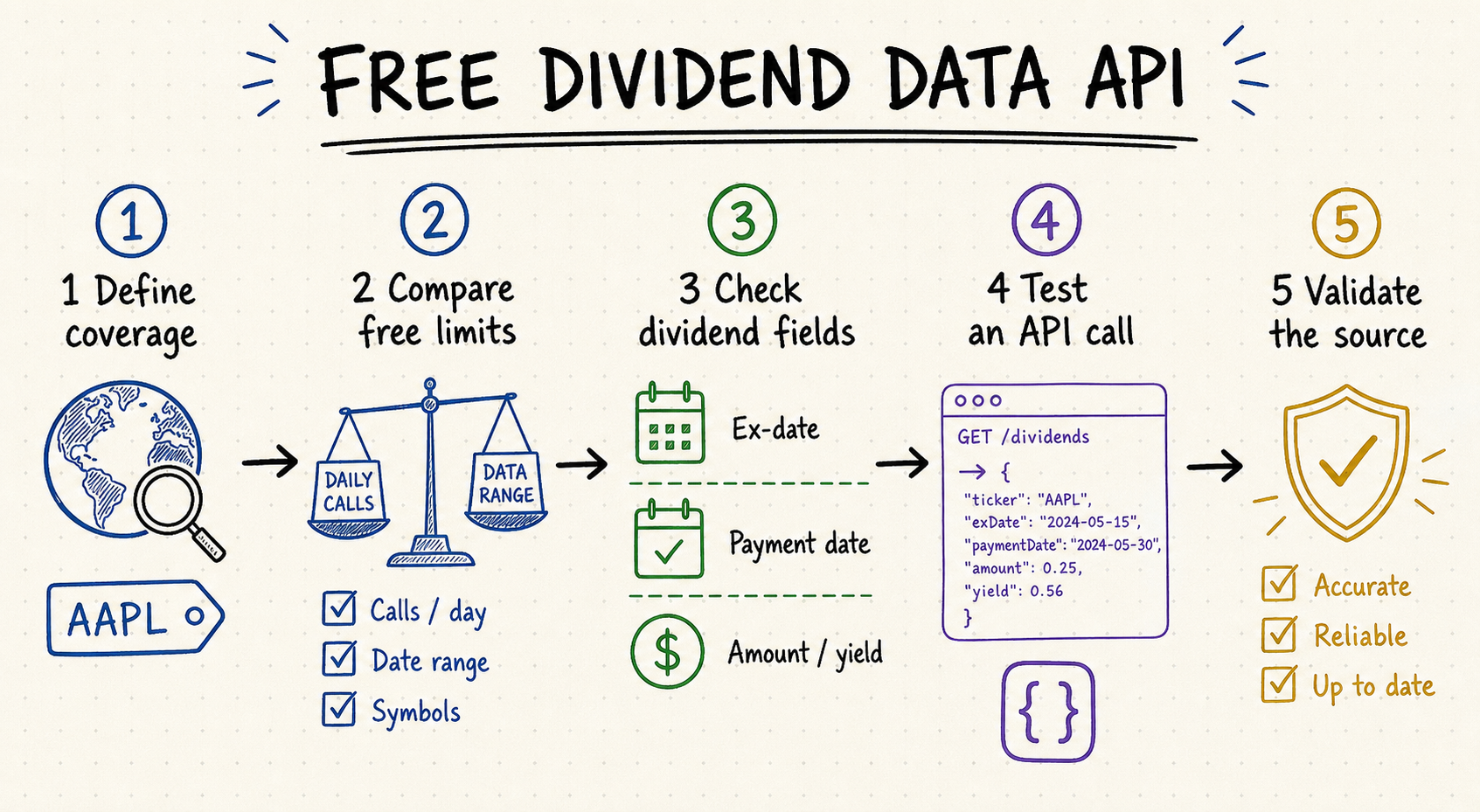
TL;DR
A dividend data API should return structured cash or stock distributions with enough context to answer three different questions: what the issuer declared, when the entitlement changes, and when cash or shares are delivered. For each event, look for a stable security identifier, dividend type, per-share amount or share ratio, currency, declaration date, ex-dividend date, record date, payment date, status, source timestamp, and revision history.
Historical payouts, upcoming dividend calendars, trailing dividend totals, and dividend yield are related but not interchangeable datasets. Yield is a derived metric whose answer changes with the chosen price, payout window, treatment of special dividends, and gross-versus-net amount. Prefer an API that exposes the underlying events so your application can calculate and label the metric consistently.
A working dividend API with enough history, markets, request capacity, and licensing for a prototype or product.
Ex-dividend date, declaration date, record date, payment date, amount, currency, frequency, adjustment status, and yield definition.
Some plans limit calls, symbols, exchanges, history, delayed data, or commercial use. Read the current terms.
QVeris can help agents discover and inspect provider-backed financial capabilities through a consistent workflow; provider coverage and terms still apply.
Dividend data API use cases
Start with the decision the data must support, then confirm that the free allowance covers the required securities, dates, and refresh cadence. A portfolio-income dashboard may need confirmed payment dates and currency; an ex-dividend calendar needs announced future events and revision updates; a total-return backtest needs point-in-time events, delisted securities, and a reproducible adjustment convention.
Historical records versus upcoming events
A historical dividend data API may return completed payments, while a dividend calendar API focuses on declared or upcoming events. Do not assume one endpoint covers both.
Why the date fields matter
Declaration, ex-dividend, record, and payment dates describe different lifecycle events. An ex-dividend date API is not automatically an API for dividend payment dates.
Regular, special, and stock dividends need explicit types
A recurring quarterly cash dividend should not be combined blindly with a one-time special distribution. Stock dividends use a share ratio rather than a cash amount, while fund distributions may include income, capital gains, or return of capital. The API should preserve the provider’s original classification and enough terms for your own taxonomy.
Dividend amount and yield require a declared convention
Confirm whether the amount is per share, gross or net of withholding, in the security’s trading currency or the issuer’s payment currency, and raw or adjusted for later splits. If yield is returned, document whether it is trailing, forward, indicated, or based on the latest payment annualized.
How to compare a free dividend data API
| Check | Why it matters | Test |
|---|---|---|
| Coverage | US-only, global, stocks, ETFs, or funds. | Query known symbols from two markets. |
| History | Free historical dividend data API limits may be shorter than paid coverage. | Request an explicit start and end date. |
| Fields | Dates, amount, currency, frequency, yield, and adjustment flags vary. | Inspect JSON keys and null behavior. |
| Payout semantics | Regular, special, stock, fund distribution; per-share amount; gross or net; cash or share ratio. | Test one regular dividend, one special event, and one non-cash distribution. |
| Lifecycle and revisions | Announcement status, source timestamp, amended amount or date, cancellation. | Re-fetch a known amended event and compare versions. |
| Point-in-time identity | Stable ID, ticker effective dates, delisted symbols, share class and listing venue. | Query a renamed or delisted security across the change date. |
| Free limits | Daily calls, credits, symbols, and commercial rights affect fit. | Read pricing, docs, and license on the same day. |
Dividend API providers to test first
These providers document dividend-related endpoints, but their coverage and free access can change. Treat the table as an evaluation shortlist and verify the current plan, market scope, historical depth, and licensing on the official pages before choosing one.
| Provider | Useful starting point | Best fit | Verify carefully |
|---|---|---|---|
| Alpha Vantage | A documented dividends function for supported equities, suitable for requesting dated payout history through a familiar API pattern. | Notebooks, income dashboards, and prototypes that primarily need historical dividend events. | Date range, symbol and market coverage, raw versus split-adjusted amounts, event status, future events, and current endpoint entitlement. |
| Massive | A structured dividends reference endpoint with filters, identifiers, event dates, cash amounts, and pagination within its stock data platform. | Applications that already use the same provider for market data and need dividend history tied to reference records. | Cash and adjusted amount semantics, frequency labels, status or correction fields, market coverage, plan access, and redistribution terms. |
| Financial Modeling Prep | Dividend history and calendar-style data alongside company profiles, prices, statements, and other financial endpoints. | Products that want dividend events inside a broader company-data schema and may also need upcoming calendars. | Current endpoint path and plan, calendar status, announcement versus ex-date filters, historical depth, source provenance, and revisions. |
| Issuer or exchange notices | Primary event notices and detailed terms for specific issuers or markets. | Verifying special distributions, stock dividends, cancellations, currency, or unusual payment terms. | Publication timestamp, revision chain, document format, automation rights, stable identifiers, and whether a historical archive exists. |
Do not select by “dividend yield” availability alone. A provider that returns reliable event-level amounts and dates lets you calculate trailing, indicated, or portfolio-income metrics transparently. A ready-made yield without its price date, payout window, and special-dividend policy is difficult to verify.
Dividend yield and income-calendar examples
Why one stock can have several correct dividend yields
Assume a stock trades at $50. During the last twelve months it paid four regular dividends of $0.40 per share and one special dividend of $1.00. A trailing yield that includes every cash distribution is $(4 × 0.40 + 1.00) ÷ 50 = 5.2%. Excluding the non-recurring special dividend gives 3.2%. If the latest regular payment has increased to $0.50 and the company is expected to maintain a quarterly schedule, an indicated forward yield is $(4 × 0.50) ÷ 50 = 4.0%.
All three figures can be arithmetically correct, but they answer different questions. Store the payout window, included dividend types, price value and timestamp, currency, annualization rule, and gross-versus-net treatment next to the result. After a stock split, use a consistently adjusted price and dividend series; adjusting only one side creates an artificial yield jump.
Ex-date and payment date answer different portfolio questions
Suppose a dividend is declared on March 1, trades ex-dividend on March 14, has a March 15 record date, and is paid on March 29. Eligibility and price behavior are associated with the ex-date; expected cash flow belongs to the payment date. An income calendar that books cash on March 14 is early, while an ex-dividend alert sent on March 29 is too late. Keep both dates and label the calendar mode.
For a portfolio-income dashboard
Use confirmed payment dates, currency, per-share amount, eligible share count, withholding convention, and payment status. Keep expected and received cash separate so a delayed or amended payment does not silently alter realized income.
For an upcoming ex-dividend calendar
Use announcement status, ex-date, declaration date, source time, and revision time. Refresh announced events until they complete or cancel, and distinguish estimated dates from issuer-confirmed dates.
For total-return research
Use point-in-time event records, delisted securities, regular and special classifications, and one documented adjustment convention. The backtest may not use a corrected amount before that correction was published.
For an AI agent
Return the event type, amount, currency, relevant lifecycle dates, status, source, and revision time. When asked for yield, state the price date, payout window, special-dividend treatment, and whether the figure is trailing or forward.
Test a stock dividend API JSON response
A safe Python request pattern
import requests

response = requests.get(
    "https://provider.example/v1/dividends",
    params={"symbol": "AAPL", "start_date": "2024-01-01"},
    headers={"Authorization": "Bearer YOUR_API_KEY"},
    timeout=20,
)
response.raise_for_status()
records = response.json()
This is a provider-neutral pattern, not a live QVeris endpoint. Replace the URL and authentication with the selected provider's documented values. Never expose an API key in client-side code.
Validate before storing
- Confirm status codes, pagination, rate-limit headers, retry rules, and whether date filters use announcement, ex-dividend, or payment date.
- Store the raw payload, provider event ID, source timestamp, and ingestion timestamp before normalizing fields or calculating yield.
- Validate amount units, currency, dividend type, gross-versus-net treatment, and whether historical amounts are adjusted for later splits.
- Deduplicate by stable event lineage rather than symbol and ex-date alone; two distinct distributions can share an ex-date.
- Recheck announced future events and recently completed payments because dates, amounts, and status can change.
- Build a test fixture containing a regular dividend, special dividend, split-adjusted history, cancellation, null payment date, and a renamed security.
Use QVeris to discover dividend data capabilities
QVeris is a capability routing layer, not the original issuer of every dividend record. Open the QVeris tool details to inspect the matched capability, then review supported markets, identifier inputs, event-date filters, returned fields, pagination, and provider constraints before calling it. Keep source-level validation and licensing controls around the result; similarly named dividend tools can expose different lifecycle stages and adjustment conventions.
For broader vendor selection, see QVeris's financial data API comparison and financial data MCP server guide.
FAQ
Yes, but free access may be a permanent tier, trial, delayed feed, restricted history, or non-commercial license. Test the required market and read current terms before relying on it.
Prefer security and event IDs, dividend type, amount or share ratio, currency, declaration, ex-dividend, record and payment dates, status, source time, and revision time.
Call the documented endpoint with server-side credentials, validate status and pagination, parse the response, and check dates, units, currency, nulls, and event identity before storage.
Some calendar or corporate-action endpoints expose declared future events. Treat them as provisional and refresh them because issuers can amend or cancel an event.
Providers may use different prices, payout windows, annualization rules, special-dividend treatment, currencies, or gross and net amounts. Recalculate from underlying events when consistency matters.
That depends on the analysis. Keep raw declared amounts and adjustment inputs, then derive a separately versioned series so the chosen convention remains reproducible.