
Choose a Free Currency Rate API
That Fits the Job
Match update cadence, request limits, base currencies, data rights, and response semantics to your app before writing integration code.
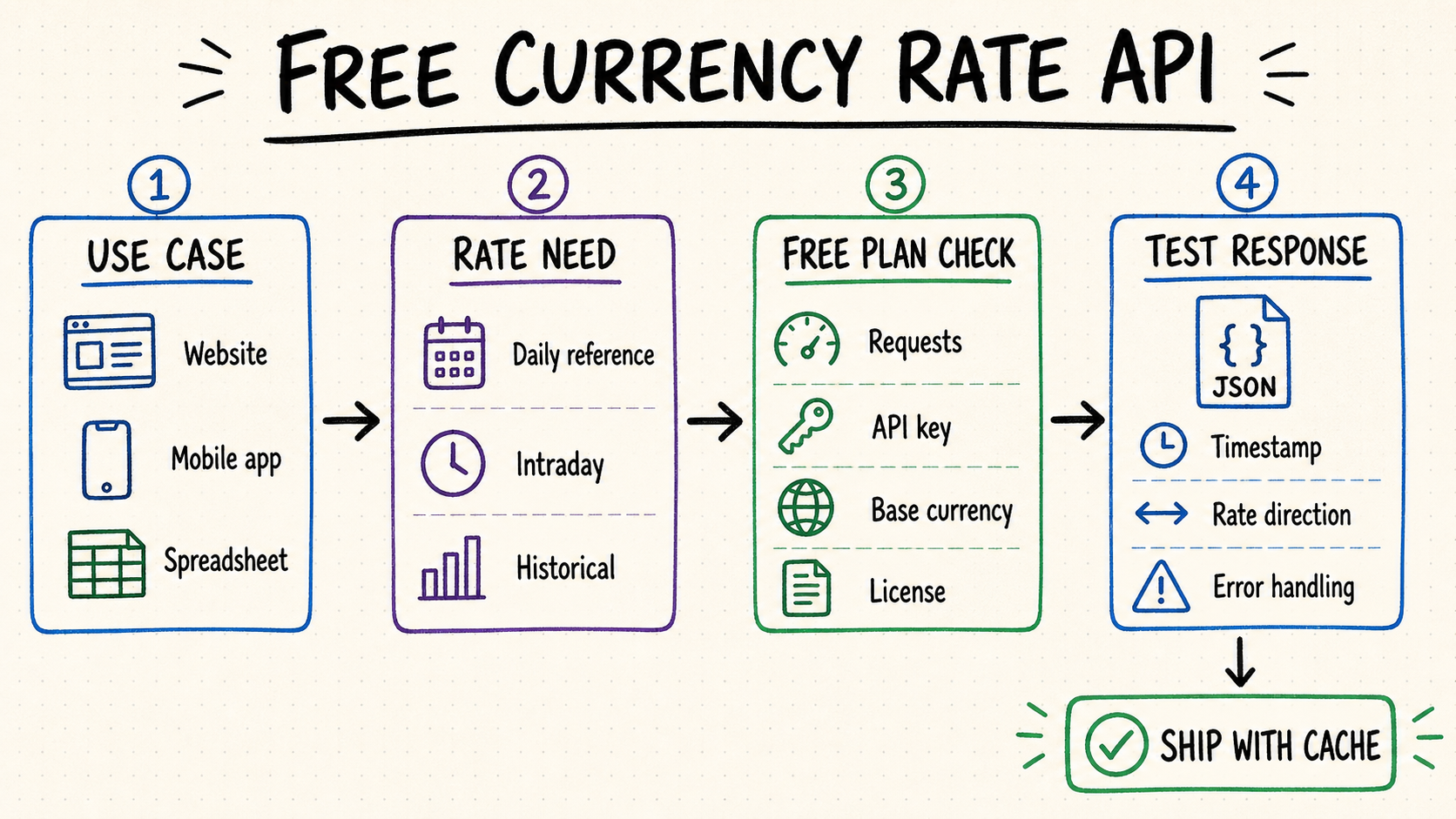
Free currency rate API: the task-first answer
A free currency rate API is useful when its published rate matches the decision your product makes. A travel display may only need a daily reference rate. A checkout system needs a documented timestamp, predictable base-currency behavior, decimal-safe conversion, and a license that permits commercial display. A trading screen needs executable market data rather than a generic currency conversion feed.
Shortlist rule: reject an API as soon as its cadence, rate type, quota, supported currencies, or data rights fail a must-have requirement.
Define what “currency rate” means in your product
Daily reference rate or intraday market rate?
The words current and latest do not guarantee a live quote. Read the provider’s update schedule and inspect the response timestamp. Central-bank reference rates are appropriate for many reports and informational converters, but they are not bid or ask prices available for execution.
Base currency, quote currency, and direction
For a response where USD is the base and EUR is 0.92, one USD equals 0.92 EUR. Converting the other direction requires division, not multiplication. Confirm whether the free plan permits changing the base currency or requires cross-rate calculations.
Worked cross-rate example: suppose one USD equals 0.9200 EUR and 156.40 JPY. Converting EUR to JPY through the common USD base gives 156.40 ÷ 0.9200 = 170.00 JPY per EUR. Therefore, EUR 250 becomes JPY 42,500 before fees and product-level rounding. The reciprocal, JPY to EUR, is 1 ÷ 170.00. Keep the unrounded rate for calculation and round only the final monetary result according to the destination currency and business rule.
If the provider also returns a direct EUR/JPY rate, compare it with the derived cross rate rather than forcing equality. Small differences can come from update timing, source markets, or rounding. A large or persistent difference is a reason to reject the value, refresh the component rates, or route the request to a direct-pair source. Never combine component rates with different observation dates without labeling the result as mixed-time data.
ISO currency codes and supported assets
Normalize fiat currencies with ISO 4217 currency codes. Treat cryptocurrencies, commodities, and obsolete currencies as separate coverage questions because they do not automatically follow the same code, source, or update rules.
Match a free currency API to the actual workload
| Workload | Minimum data need | Free-plan check | Failure to avoid |
|---|---|---|---|
| Price display | Documented daily or hourly rate | Attribution and cache policy | Showing stale rates as live |
| Checkout estimate | Timestamp, direction, rounding | Quota at peak traffic | Promising a settlement price |
| Spreadsheet refresh | Batch symbols and stable JSON | Requests per refresh cycle | One request per cell |
| Trading product | Bid/ask or executable feed | Usually beyond generic free rates | Using reference rates for orders |
Calculate quota from user behavior
Estimate monthly calls as active users × refreshes per session × sessions per month, then add scheduled jobs and retries. Batch symbol requests and shared caching often matter more than the headline monthly quota.
Require an unambiguous currency rates JSON contract
A usable response should identify the base, quote values, effective time, publication time or freshness signal, and error state. Do not infer units from endpoint names.
| Time field | What it should mean | Why it matters |
|---|---|---|
| Observation date | The market or reference period represented by the rate | A Monday response may still contain Friday's value |
| Published at | When the source released this observation | Shows whether a scheduled daily fixing arrived late |
| Retrieved at | When your system received or cached the payload | Supports cache age and incident diagnosis, but does not prove freshness |
| Revised at | When an already published observation changed | Prevents silent changes in reports and reconciliations |
Model weekends and currency holidays as explicit calendar states. “No new publication expected,” “publication delayed,” and “provider failed to update” are different conditions. Define a maximum acceptable observation age per workflow, retain the last accepted value with its original date, and do not overwrite that date with the retrieval time.
{
  "base": "USD",
  "as_of": "PROVIDER_TIMESTAMP",
  "rates": { "EUR": 0.92, "JPY": 156.4 }
}
Use decimal arithmetic for money
For a USD-base response, convert USD to EUR with amount × rates.EUR. Store the provider timestamp with the converted value, define a rounding rule per currency, and avoid binary floating-point for accounting amounts.
Run a 10-minute free currency rate API acceptance test
Query a pair such as USD/EUR and confirm the documented direction, timestamp, HTTP status, content type, and JSON schema.
Check whether changing the base is supported on the free plan. Compare the reverse value with the mathematical reciprocal within a sensible tolerance.
Send an invalid currency code and record the status code, error body, retry guidance, and whether the response remains machine-readable.
Verify request accounting, attribution, caching, redistribution, commercial use, and what happens after the free allowance is exhausted.
Repeat the request before and after the expected publication window. Confirm whether the observation date changes, whether weekends are carried forward, and how the response signals an unchanged or stale rate.
Calculate a known amount with Decimal arithmetic, the documented direction, and the product's rounding rule. Store the source amount, rate, observation date, converted amount, and decision to use or reject a fallback.
Know when a free exchange rates API is production-ready
Cache by published cadence, not guesswork
Refreshing a daily feed every minute wastes quota without creating newer data. Cache until the expected publication window, retain the last validated response for controlled fallback, and surface the actual as-of time to users.
Separate reference conversion from settlement
A reference currency conversion API can estimate display prices. Payment processors, banks, card networks, brokers, and liquidity venues may apply different rates, spreads, fees, and timestamps at settlement.
Bid, ask, and mid are not interchangeable. If EUR/USD is quoted at 1.0840 bid and 1.0850 ask, the displayed mid is 1.0845 and the quoted spread is 0.0010, or 10 pips for this pair. A user buying EUR with USD is exposed to the ask side before any separate fee; a user selling EUR receives the bid side. Multiplying every conversion by the mid produces an informational estimate, not an executable or guaranteed result.
Make the product label match the data: use “estimated conversion” for a reference or mid rate, disclose the as-of time, and reserve “you will receive” for a locked quote whose expiry and fees are known. If a fresh observation is unavailable, choose one documented action—show the dated cached estimate, stop the calculation, or use an approved fallback—and expose that state instead of silently presenting an old value as current.
Plan the exit from the free tier
Keep provider-specific fields behind an internal adapter. Monitor quota headers and freshness, document a degraded mode, and decide whether exceeding limits should use cached data, stop conversion, or switch to an approved backup source.
How QVeris helps evaluate currency rate capabilities
QVeris can help developers discover currency-related capabilities and inspect available tool descriptions before integration. The provider remains the authority for price, quota, licensing, coverage, and freshness, so validate those terms at the source.
- Open the QVeris tool details for currency and exchange-rate capabilities.
- Use the Capability Map to inspect adjacent financial-data categories.
- For narrower tasks, use the guides for a no-key exchange rate API, Python integration, or historical rates.
Free currency rate API questions
Yes, but “free” may mean an open endpoint, a capped ongoing tier, or a temporary trial. Confirm expiry, quota, attribution, and commercial-use rules.
Not necessarily. Many publish daily reference rates. Check the documented cadence and timestamp instead of assuming the latest endpoint is live.
Some endpoints allow it. Keyless access still may have rate limits, attribution requirements, CORS restrictions, or fair-use rules.
Use a familiar pair, read the base and quote fields, reverse the pair, and compare the reverse result with the reciprocal within a reasonable tolerance.