
Free Corporate Actions API
for Dividends, Splits & More
Compare free corporate actions API options by event coverage, lifecycle dates, security identifiers, revisions, and license limits, then test a reproducible integration before choosing a source.
TL;DR
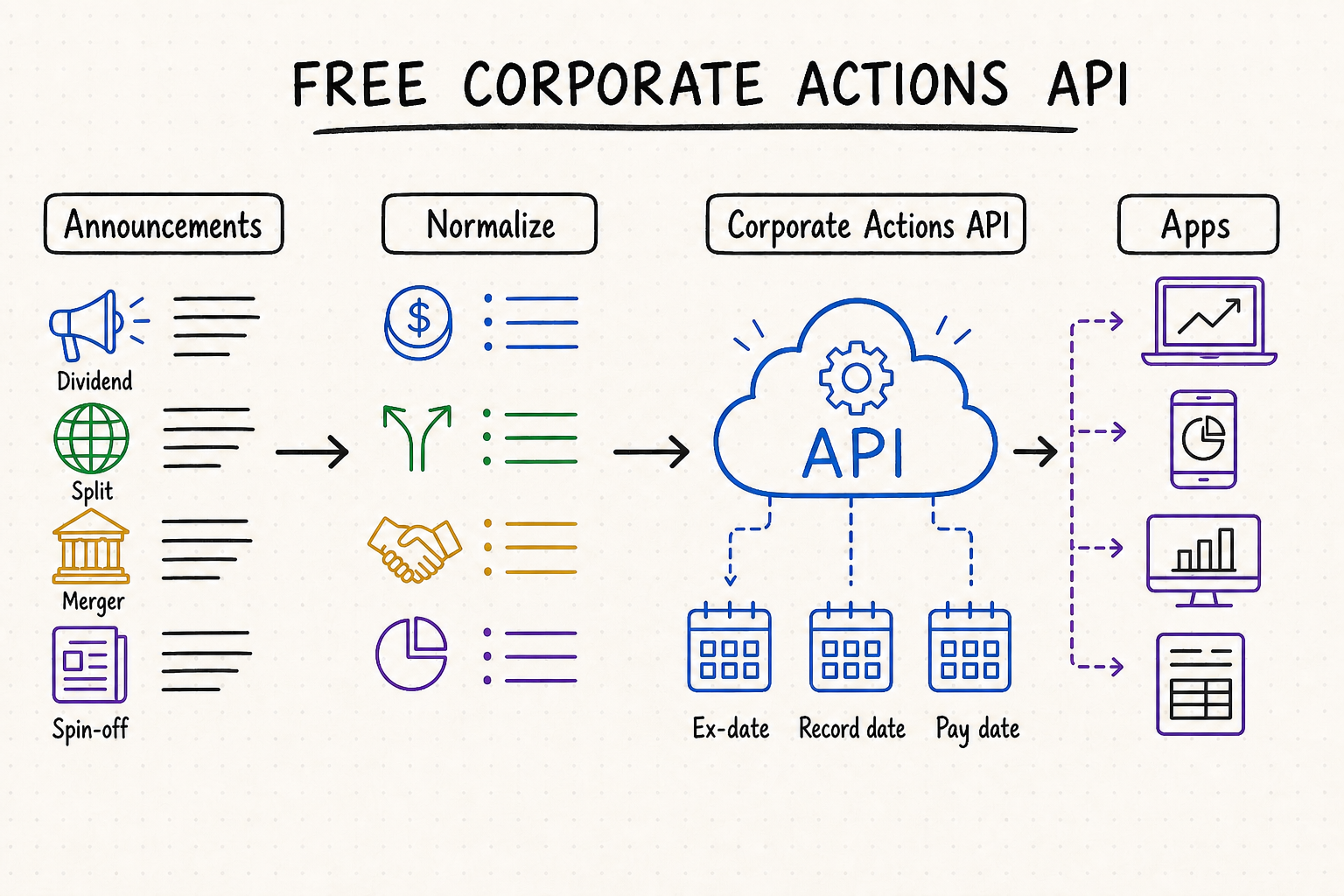
A corporate actions API turns issuer and exchange events into structured records that portfolio systems, research pipelines, event calendars, and price-adjustment processes can consume. The minimum useful record is not simply “dividend” or “split”: it identifies the affected security, action subtype, announcement and effective dates, economic terms, current status, source, and revision time.
For a prototype, a free endpoint that covers cash dividends and stock splits may be sufficient. Production use usually requires broader event coverage, point-in-time identifiers, upcoming and historical records, cancellations and corrections, and license terms that match storage and redistribution. Never infer a missing action only from a price jump: market movements, special distributions, symbol changes, and vendor adjustment conventions can produce similar-looking discontinuities.
A free corporate actions API that returns structured dividends, stock splits, mergers, spin-offs, and reliable event dates.
Check market coverage, history depth, upcoming events, identifiers, revisions, rate limits, and redistribution rights.
Query a known dividend, split, corrected event, and symbol change; then validate terms, dates, identifiers, status, and revision behavior.
QVeris helps agents discover and call suitable financial-data capabilities without claiming to be the underlying exchange source.
What a free corporate actions API should cover
Useful coverage extends beyond ordinary cash dividends and forward splits. Depending on the workflow, it may include stock dividends, reverse splits, mergers, acquisitions, tender offers, spin-offs, rights issues, buybacks, symbol and exchange changes, delistings, liquidations, and bankruptcies. Complex events may affect more than one security, so the schema must represent both the original instrument and any cash, shares, or successor securities received.
Dividend and stock split API fields
For dividends, look for declaration, ex-dividend, record, and payable dates plus amount and currency. For splits, require an effective date and an unambiguous split ratio.
Historical and upcoming corporate actions data
Confirm whether the free tier exposes only history, announced future events, or both. Also check cancellation and correction handling.
Identifiers and global market coverage
Ticker-only data can break after symbol changes. Prefer stable identifiers such as ISIN, CUSIP, or FIGI where your use case and license permit them.
Status, revisions, and event identity
Require a stable event ID plus announced, confirmed, amended, cancelled, and completed states where available. A corrected amount should update the same event lineage rather than arrive as an unexplained duplicate.
Terms for complex and multi-security events
For mergers, spin-offs, rights, and tender offers, capture mandatory or voluntary status, election terms, cash and share consideration, ratio orientation, parent and child identifiers, and any fractional-share treatment.
How to compare free corporate actions API options
| Check | What to record | Why it matters | Free-tier trap |
|---|---|---|---|
| Events | Dividends, splits, mergers, spin-offs, rights, buybacks. | Prevents silent gaps in calendars and adjustments. | Only dividends and splits may be free. |
| Dates | Declaration, ex-date, record, effective, payable. | Different workflows depend on different dates. | One generic date field can be ambiguous. |
| Coverage | Exchanges, assets, history, upcoming events. | A US-equity feed is not a global feed. | Free history may be heavily truncated. |
| Identity | Stable event ID, security ID, old and new ticker, parent and child instruments. | Preserves lineage through renames, mergers, and spin-offs. | Ticker-only records can be joined to the wrong security. |
| Lifecycle | Announcement timestamp, status, source, revision timestamp, cancellation reason. | Separates what was known then from what is known now. | Latest-state-only feeds can leak future knowledge into backtests. |
| Operations | Rate limits, pagination, revisions, license, support. | Determines whether a prototype can reach production. | “Free” may prohibit redistribution. |
Corporate actions API routes to test
The routes below are useful starting points, not interchangeable winners. Verify the current plan, endpoint access, exchange coverage, history, and redistribution rights on the provider's official pages before relying on a free allowance.
| Provider route | Useful coverage | Best starting use | Verify carefully |
|---|---|---|---|
| Alpha Vantage | Documented dividend and split functions that return dated event records for supported equities. | A lightweight calendar, notebook, or prototype that needs common cash-dividend and split history. | Output horizon, symbol coverage, event fields, split-ratio orientation, update timing, and current key entitlement. |
| Massive | Separate stock reference endpoints for dividends and splits with filtering, identifiers, dates, and provider-defined event fields. | Applications already using the same market-data family and wanting structured event history with pagination. | Plan access, adjusted versus cash amount fields, status and correction behavior, pagination, market scope, and licensing. |
| Financial Modeling Prep | Dividend, split, and calendar-style data within a broader company and market-data API family. | A prototype that wants corporate events alongside profiles, statements, prices, or calendars under one schema family. | Current endpoint and plan, historical depth, upcoming-event semantics, source fields, revision handling, and commercial use. |
| Exchange or issuer notices | Primary notices for specific markets or issuers, often containing event terms that normalized feeds simplify. | Verification, exception handling, and complex events such as spin-offs, tenders, rights, and symbol changes. | Document format, language, automation rights, revision notices, identifier mapping, and publication timestamps. |
Choose by event coverage, not provider count. A well-documented dividend and split feed can be the right answer for price-chart adjustment, while a portfolio operations system may need tender elections, merger consideration, spin-off children, rights terms, and cancellations that the same endpoint never attempts to cover.
For an upcoming-event calendar
Prioritize announcement time, expected ex-date or effective date, current status, source, and last revision. Poll by update time rather than repeatedly downloading only the final effective-date range, and show tentative or cancelled events differently from confirmed events.
For historical price adjustment
Focus on ordinary and special cash distributions, forward and reverse splits, exact factor convention, currency, and effective timestamp. Use one provider's documented adjustment methodology end to end; mixing event records from one source with factors from another can create discontinuities.
For a point-in-time backtest
Preserve the first announcement, every revision, cancellation, and processing timestamp. The simulation may use only the state available on that date. A final corrected event loaded backward across history leaks information even if its ex-date is accurate.
For an AI agent
Return the affected security, event subtype, relevant dates, economic terms, status, source, and revision time. The agent should state which date answers the user's question, distinguish announced from completed events, and avoid inventing adjustment math when the tool does not provide a documented factor.
Corporate action examples that expose bad data
Cash dividend: keep the full date chain
An issuer can declare a cash dividend on March 1, the shares can trade ex-dividend on March 14, holders can be checked on the March 15 record date, and cash can be paid on March 29. A calendar may display the ex-date, accounting may need the payable date, and a point-in-time study needs the announcement timestamp. Storing only one generic date makes at least two of those workflows wrong.
4-for-1 split: make the ratio direction explicit
One old share becoming four new shares can appear as 4:1, a factor of 4.0, split_from=1 and split_to=4, or the inverse factor used to adjust historical prices. Store numerator, denominator, and provider meaning explicitly. Applying the share multiplier to prices instead of its inverse creates a sixteen-fold relative error between price and share count.
Special distribution: do not force every payment into ordinary dividends
A return of capital, liquidating distribution, stock dividend, or spin-off can have different tax, entitlement, and adjustment treatment from an ordinary cash dividend. Preserve the source subtype, currency, security consideration, and notes; a normalized “dividend” label should not erase the economic terms.
Symbol change: identity must survive the ticker
When a company changes ticker or exchange, history should remain attached to the same legal instrument where appropriate. Use stable security identifiers and effective dates, retain old and new symbols, and model mergers or spin-offs as relationships between securities rather than rewriting every historical row under today's ticker.
An event record is not an adjustment factor. The event describes what happened and when; a total-return or price-adjustment series applies a documented methodology to those events. Validate the vendor's factor convention, treatment of ordinary versus special dividends, rounding, and effective timestamp before using it to rewrite historical prices.
Test a free corporate actions API with Python
1. Use the provider's documented endpoint
Send a request for one known symbol and a narrow date range. Keep the API key in an environment variable, and never copy an undocumented endpoint into production.
2. Validate corporate action dates and values
HTTP 200 is not enough. Assert event type, symbol or stable identifier, amount or ratio, currency, timezone, and the exact meaning of each returned date.
3. Test pagination, limits, and revisions
Request more than one page, observe rate-limit headers, and determine how corrected or cancelled announcements appear. Save the documentation and license URLs with the test.
4. Normalize without erasing source meaning
Map provider labels into a controlled event taxonomy, but retain the original type, raw payload, source timestamp, and provider event ID. Store dividend amounts and split ratios in explicit fields rather than parsing display text later.
5. Reconcile a moving event window
Poll upcoming actions by announcement or update time, and periodically re-fetch recently effective events. Deduplicate by event lineage, not only by symbol and ex-date, because multiple distributions can share a date.
Use QVeris to connect corporate actions data
QVeris can help an agent discover, inspect, and call relevant financial-data capabilities. Before routing a corporate-action request, inspect supported action types, date filters, identifier inputs, pagination, status fields, and error behavior. Availability, field definitions, revisions, and licensing still come from each underlying provider, so capability discovery does not replace source-level validation.
- Open the QVeris tool details to review a suitable data capability.
- Inspect input fields, output schema, provider terms, and error behavior before calling it.
- Use the QVeris documentation to connect the selected capability to an agent workflow.
FAQ
Yes, some providers offer free plans or limited endpoints. “Free” varies by event coverage, market, history, calls, and redistribution rights, so verify the current terms.
Common events include cash and stock dividends, forward and reverse splits, mergers, acquisitions, spin-offs, rights, buybacks, symbol changes, and delistings.
Some APIs return declared future events, while others expose only completed history. Check status fields and how cancellations or revisions are delivered.
Use the provider’s documented adjustment factors or methodology. Dividend and split adjustments are not interchangeable, and data should not be guessed from price movements.
The ex-date governs when a security begins trading without the entitlement; the record date is when the issuer checks registered holders. Market rules can vary.
Store announcement and revision timestamps, preserve historical event states, and expose only information available at the backtest time. An ex-date alone does not show when the market first knew the terms.