
How to Choose a Free Company Fundamentals API
Evaluate statements, ratios, reporting history, update schedules, rate limits, licensing, and data quality before a free tier becomes a dependency.
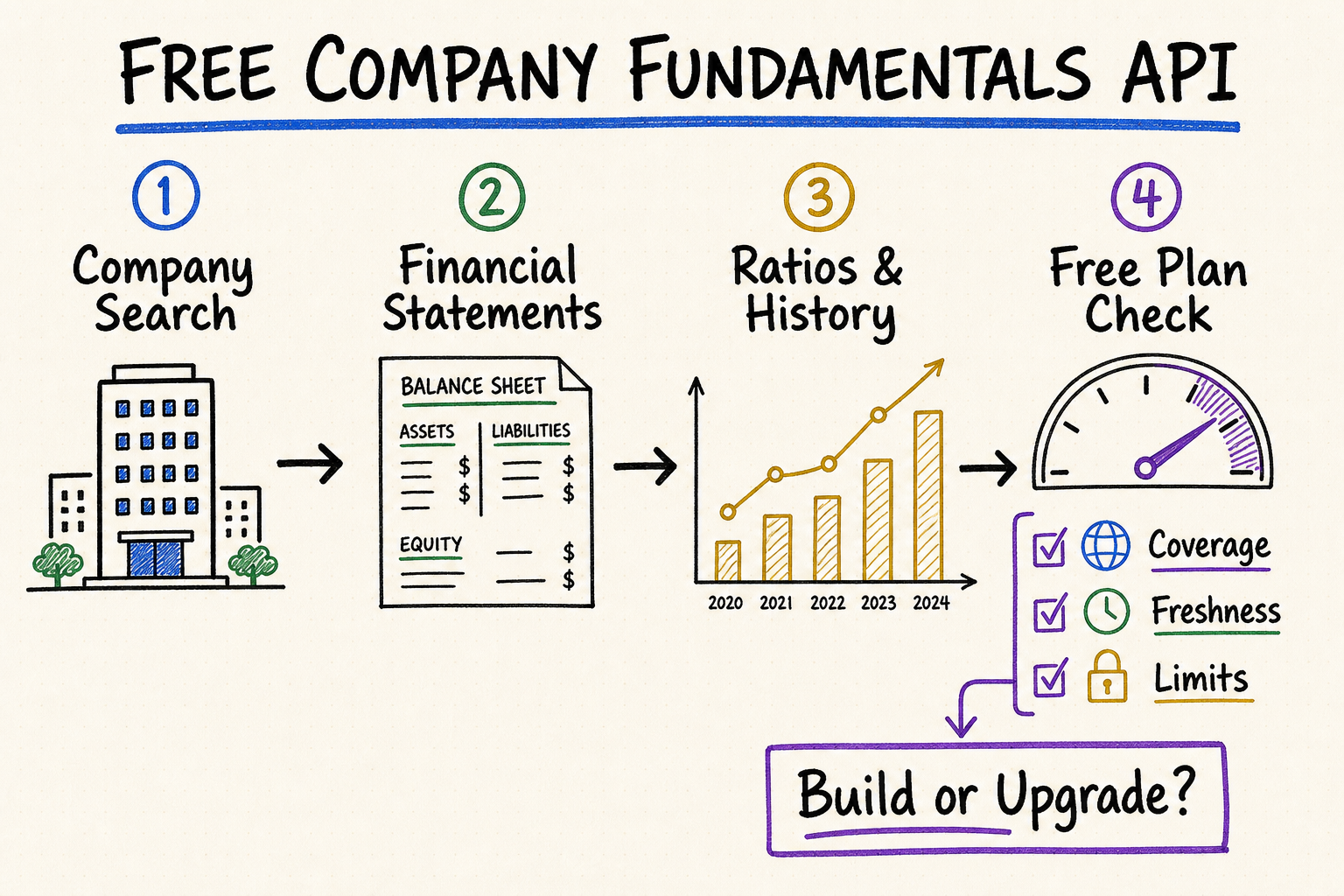
Free company fundamentals API
A company fundamentals API is most useful as a compact, current company snapshot: verified identity, business classification, latest reporting period, headline financials, capital structure, and a small set of clearly defined metrics. It can power company profile pages, symbol search enrichment, watchlists, and the first step of an AI research workflow. It should not be mistaken for a complete historical statement warehouse or a point-in-time backtesting database.
Expect limits on requests, reporting history, exchanges, company universes, endpoints, or commercial usage.
A screener, valuation model, research notebook, and backtest need different statements, periods, and point-in-time guarantees.
Identity, classification, latest fiscal period, market context, and headline metrics should refer to the same company and effective date.
A compact profile still needs source filing dates, market-data timestamps, and clear labels for reported, derived, or estimated fields.
What can a free company fundamentals API cover?
“Company fundamentals” can describe everything from a profile endpoint to a full financial database. For this use case, define the minimum snapshot that lets a user identify a company, understand what it does, see its latest financial scale and profitability, and decide whether deeper research is warranted. Keep optional statement history and filings linked, but do not overload the first response with every available fact.
Require a stable company ID, legal name, exchange-qualified ticker, share class, domicile, website, reporting jurisdiction, status, and a sourced business description. Company name and ticker aliases should not create duplicate profiles.
Sector, industry, country, exchange, employee count, fiscal-year end, and reporting currency help users interpret the numbers. Store the taxonomy name and effective date because classifications can differ across providers and change over time.
Revenue, operating income, net income, assets, debt, cash, operating cash flow, free cash flow, and share count should identify the latest annual or quarterly period. Do not mix a new income statement with an older balance sheet without labeling the mismatch.
Market capitalization, enterprise value, price, dividend yield, and selected multiples require a market-data timestamp and documented denominator period. A live price combined with stale shares or debt can make enterprise value misleading.
The snapshot should link to statements, filings, earnings events, and methodology notes. Users and agents need a path from a headline metric to the reported fact or calculation behind it.
Keep the five dates in a company snapshot separate
| Date or time | Meaning | Common mistake |
|---|---|---|
| Fiscal period end | The annual, quarterly, or year-to-date period represented by the fact | Calling the latest period the publication date |
| Filed or accepted at | When the filing became available through the primary regulator or venue | Allowing a backtest to use a quarter before it was public |
| Provider ingested at | When the API parsed and exposed the filing | Ignoring hours or days of delivery delay |
| Market data as of | The price and market-cap observation used by valuation fields | Combining a current price with an unexplained old share count |
| Retrieved at | When the application fetched this snapshot | Treating retrieval time as evidence that every field is fresh |
Period labels need the same precision. A quarterly income-statement value covers one quarter; a year-to-date value covers the fiscal year through that quarter; a trailing-twelve-month value usually combines the latest four compatible quarters. Annual, quarterly, YTD, and TTM figures must not share one unlabeled revenue field. Balance-sheet facts such as cash and debt are point-in-time values, while revenue and cash flow cover a duration.
The criteria that separate sample fundamentals from dependable data
| Criterion | What to verify | Common free-tier trade-off | Test |
|---|---|---|---|
| Coverage | Companies, exchanges, regions, statements, fields, and history. | Narrow universe or only a few periods. | Query large, small, foreign, and delisted companies. |
| Identity quality | Stable IDs, exchange-qualified tickers, share classes, aliases, and company status. | Duplicate or stale company profiles. | Resolve dual listings, renamed firms, and inactive issuers. |
| Freshness | Filing timestamps, ingestion delay, update schedule, and revisions. | New reports may arrive hours or days late. | Compare new filings and later amendments with a primary source. |
| Snapshot consistency | Effective dates for profile, statement, market, and calculated fields. | Mixed periods presented as one current record. | Print every component date in one sampled profile. |
| Definitions | Reported, standardized, derived, estimated, and sector-specific labels. | Convenient metrics with no methodology. | Trace market cap and one ratio to their inputs. |
| Limits | Per-minute, daily, concurrent, and endpoint quotas. | Low burst capacity or hard daily caps. | Exercise 429 responses and retry headers. |
| Rights | Commercial use, storage, attribution, and redistribution. | Personal or non-commercial use only. | Read both API terms and upstream data rights. |
A safer integration pattern for company fundamentals
Separate required identity and current-context fields from optional history. This keeps the initial response fast and understandable while preserving links to statements, filings, and deeper research.
Map provider-specific company IDs, listings, share classes, and aliases into an internal entity model. Return an ambiguity state when several companies match instead of silently selecting the first ticker result.
Fetch identity, classification, latest financials, capital structure, and market context separately, then label the date and source of each component. Do not imply that asynchronous datasets were updated together.
Store whether each field is reported, standardized, derived, estimated, or provider-specific. Keep source values and documents so a compact profile can still support audit and correction.
Schedule routine updates, but also react to new filings, earnings releases, corporate actions, ticker changes, and status changes. Invalidate only the affected parts of the company card when possible.
Recalculate market capitalization and enterprise value
Assume the security has 100 million eligible shares, a $30.00 price at 16:00, $500 million of debt, and $200 million of cash. Market capitalization is 100m × $30 = $3.0bn. Under a simple definition, enterprise value is $3.0bn + $0.5bn − $0.2bn = $3.3bn. The displayed result should link each input to its date, currency, unit, share class, and source.
Mismatch test: if the 100 million shares predate a 2-for-1 split, or debt and cash come from an older fiscal period than the labeled snapshot, the arithmetic can be correct while the metric is wrong. Reject the calculation or expose the mixed-date state. Also document whether enterprise value includes preferred stock, minority interest, leases, investments, or other provider-specific adjustments.
| Field class | What to retain | Display rule |
|---|---|---|
| Reported | Issuer value, label, unit, period, filing, and source location | Present as filed; do not silently normalize |
| Standardized | Mapped concept, transformation rule, original fact, and taxonomy version | Label the standardized definition and preserve the original |
| Derived | Formula, input IDs, input dates, units, and calculation time | Show methodology and unavailable reasons |
| Estimated | Estimate source, contributing period, contributor count, update time, and basis | Never present as an issuer-reported result |
Use QVeris to discover company fundamentals capabilities
Provider lists go stale and every API describes company fundamentals differently. QVeris helps developers and agents discover profile, filing, market, and financial capabilities, inspect their contracts, and call the appropriate tool for each part of a company snapshot. It simplifies routing, while the application remains responsible for entity resolution, effective dates, field definitions, caching, and the evidence shown to users.
- Search by the capability you need—statements, ratios, company profiles, earnings, segments, or filings—not only by a vendor name.
- Inspect inputs, outputs, authentication, and constraints before wiring a capability into an automated workflow.
FAQ
Yes. Several providers expose profiles, statements, ratios, or filings on a free tier, but most limit requests, history, company coverage, endpoints, or commercial use.
Test income statements, balance sheets, cash flow, annual and quarterly periods, currencies, restatements, missing values, errors, and actual rate-limit behavior.
Start with verified identity, exchange and status, business description, sector, latest fiscal period, headline financials, capital structure, selected metrics, and dates for every component.
It can support an initial screen, but a defensible valuation usually needs full statement history, calculation definitions, estimates, adjustments, and source documents beyond the compact profile.
Expose the effective date and freshness state per field group. Keep the last valid value only when the product labels it clearly; otherwise return unavailable rather than imply that old data is current.
Only with clear labeling and source links. Preserve the issuer or regulatory description separately, and do not let generated text silently replace factual identity or business-classification fields.