
Choose a Free Company Financial Data API
You Can Trust
Evaluate statements, reporting periods, provenance, normalization, quotas, and licensing before company fundamentals become a product dependency.
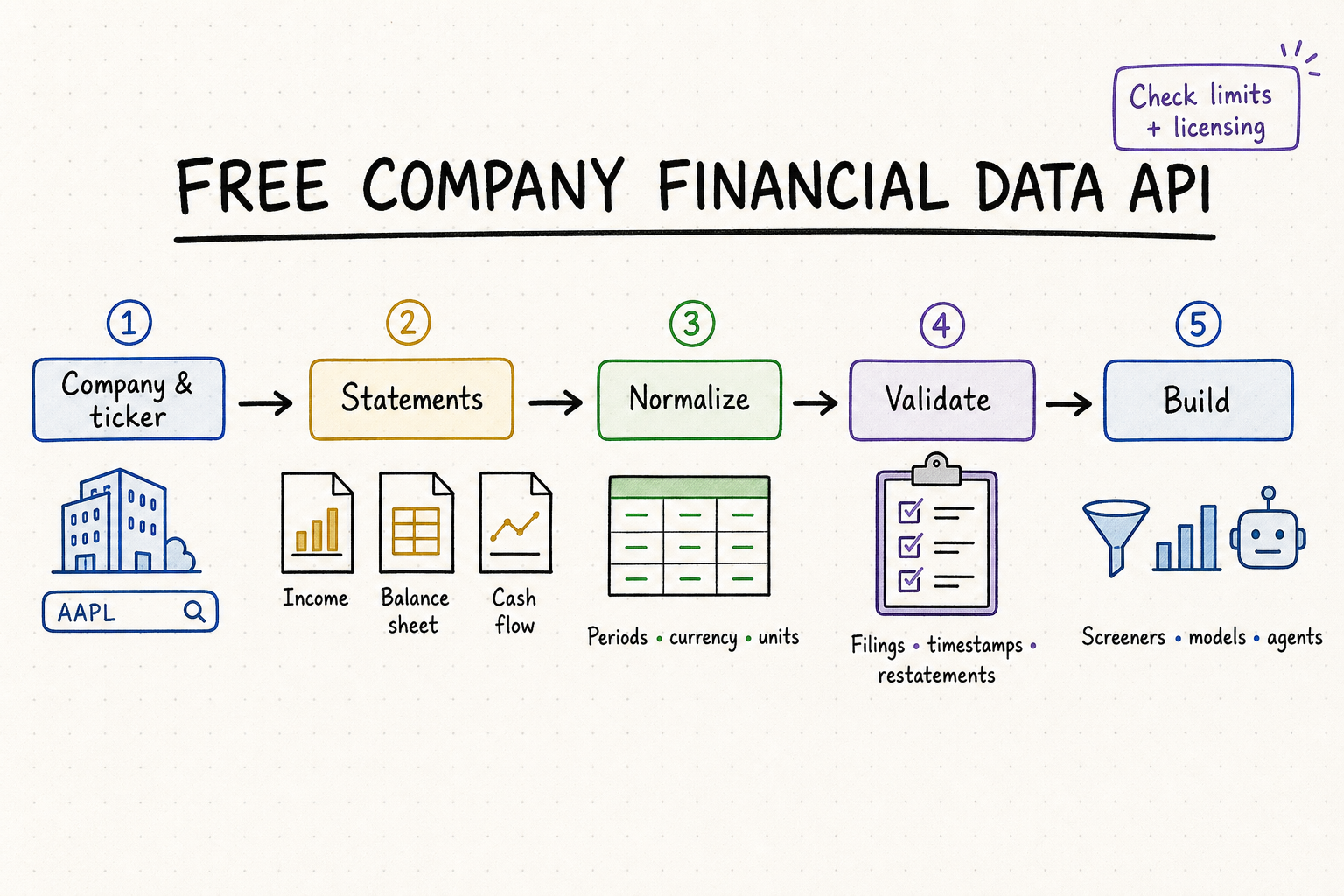
Free company financial data API: the short answer
A company financial data API should let an application reconstruct one issuer's financial story from period to period: what the company reported, when it reported it, what later changed, and how each value connects to the source filing. This is different from building a broad factor dataset. The priority here is a complete, traceable company timeline that supports profiles, research pages, credit reviews, and earnings briefs without mixing fiscal periods or corporate entities.
Expect limits on company coverage, fiscal history, bulk downloads, request volume, normalized fields, or commercial use.
Income, balance sheet, and cash-flow values are meaningful only with periods, currency, units, and filing provenance.
Check accession numbers, timestamps, restatements, missing facts, and fiscal calendars with representative companies.
Connect statements, earnings events, amendments, capital changes, and fiscal-calendar changes in effective-date order.
What should a company financial data API cover?
Company financial data includes identity records, standardized statements, segment disclosures, capital structure, earnings events, selected ratios, and links to regulatory filings. Define the jurisdictions, issuer types, reporting frequency, and fiscal history your company view needs before comparing providers. A useful response should connect these records through stable company IDs and effective dates rather than return unrelated endpoint snapshots.
Confirm the legal issuer, parent and subsidiary relationships, share classes, primary listing, domicile, reporting currency, accounting standard, and consolidated scope. Acquisitions and reorganizations can change which operations belong in a company's historical comparison.
Verify annual and quarterly income, balance-sheet, and cash-flow coverage. Each fact needs a fiscal period, instant or duration type, currency, unit, consolidation scope, source filing, and an indication of whether it is reported or standardized.
Company-level totals can hide the source of change. For deeper profiles, inspect revenue and profit by business segment or geography, customer concentration where disclosed, headcount, production, subscribers, or other issuer-specific operating metrics.
Track basic and diluted shares, debt, cash, preferred securities, minority interest, dividends, repurchases, splits, and issuance. Per-share trends are unreliable when the share-count basis and corporate-action adjustments are unclear.
Check filing dates, acceptance timestamps, accession numbers, earnings release dates, amendments, restatements, and links to source documents. Preserve both the originally reported record and later corrections so the company timeline remains explainable.
Fiscal periods, TTM, and restatements need explicit rules
A financial fact is not just a metric and number. It also has an issuer, accounting concept, start or instant date, end date, fiscal year, fiscal period, currency, unit, consolidation scope, filing, and availability time. Two records labeled “revenue” can be incomparable when one is a single quarter and the other is year to date, or when one represents a continuing operation and the other includes a discontinued business.
Worked example: derive quarters without adding YTD values twice
Assume a company reports Q1 revenue of 100, six-month YTD revenue of 230, nine-month YTD revenue of 360, and full-year revenue of 500. The standalone quarters are Q1 = 100, Q2 = 230 − 100 = 130, Q3 = 360 − 230 = 130, and Q4 = 500 − 360 = 140. Adding 100 + 230 + 360 + 500 would double-count the same periods and produce 1,190—an impossible annual total.
At the next Q1, suppose the new standalone quarter is 110. Trailing-twelve-month revenue can be updated as 500 − 100 + 110 = 510, provided the prior full year and both Q1 values share currency, consolidation scope, and accounting basis. Do not label a provider field TTM until its component periods, adjustment rules, and availability times can be reproduced.
Current view and point-in-time view should preserve different versions
Suppose annual revenue of 500 was filed on February 15 and later restated to 490 on May 1. A current company profile can show 490 with a restatement note and links to both filings. A backtest with a March 1 cutoff must still retrieve 500 because the correction was not yet public. Store filing acceptance time, period, accession, version lineage, and superseded state instead of overwriting the original row.
Company type changes the statement model
Revenue, cost of sales, inventory, deferred revenue, R&D, capital expenditure, and operating segments often drive the model.
Interest income and expense, deposits, loans, credit-loss allowance, capital ratios, and net interest margin need bank-specific concepts.
Premiums, claims, reserves, investment income, combined ratio, and statutory context cannot be forced into a generic industrial template.
Funds from operations, property metrics, partnership structures, or sector-specific non-GAAP measures require definitions and reconciliations.
Choose the source layer by task
| Source layer | Strength | Application responsibility |
|---|---|---|
| SEC filings and Companyfacts | Primary US filing evidence, structured facts, accessions, periods, units, and source traceability. | Resolve concepts, duplicates, dimensions, amended filings, company identity, and filing-time availability. |
| Normalized financial-data provider | Consistent metrics, cross-company access, simpler JSON, ratios, and easier multi-market integration. | Audit mappings, preserve reported values and source links, verify free limits, and test sector-specific coverage. |
| Issuer investor-relations material | Earnings releases, presentations, guidance, operating KPIs, and non-GAAP reconciliations. | Separate management presentation from filed statements and record publication time and document version. |
The criteria that make company financials dependable
| Criterion | What to verify | Common free-tier trade-off | Test |
|---|---|---|---|
| Coverage | Companies, jurisdictions, statements, fields, and history. | Large-cap issuers or short history only. | Query representative, foreign, and delisted issuers. |
| Company model | Stable issuer ID, listings, subsidiaries, reporting currency, and consolidated scope. | One ticker treated as the company. | Follow an issuer through a reorganization or listing change. |
| Provenance | Filing IDs, dates, periods, units, and revisions. | Normalized values without source links. | Trace sampled facts to the original filing. |
| Continuity | Fiscal-year changes, amendments, restatements, acquisitions, and discontinued operations. | Latest values overwrite prior company history. | Rebuild a five-year company timeline and explain every break. |
| Segments | Business and geographic dimensions, segment changes, eliminations, and reconciliation. | Only consolidated totals. | Reconcile segment revenue to the consolidated total. |
| Limits | Per-minute, daily, concurrent, and endpoint quotas. | Low burst capacity or hard daily caps. | Exercise 429 responses and retry headers. |
| Rights | Commercial use, storage, attribution, and redistribution. | Personal or non-commercial use only. | Read both API terms and upstream data rights. |
A safer integration pattern for company financials
Use a stable issuer identifier and verify the requested listing, share class, jurisdiction, and reporting entity. Do not infer company identity from a bare ticker when the result will be shown to users.
Store the source field, filing ID, period, currency, unit, consolidation scope, and retrieval time with each normalized metric for later audits. Retain the original response rather than keeping only transformed columns.
Separate fiscal years, quarters, year-to-date durations, trailing periods, and instant facts. Compare only when currency, units, scope, and periods agree; calendar-quarter labels alone are not enough for off-calendar issuers.
Merge filings, earnings releases, amendments, restatements, dividends, splits, issuance, and fiscal-calendar changes using both event time and data-availability time. This keeps a profile current without erasing its history.
Check statement equations, cash-flow roll-forwards, segment-to-company totals, and share-count changes. Record whether a missing value is not disclosed, not applicable, delayed, mapping-related, or caused by a provider error.
Use QVeris to discover company data capabilities
Provider lists go stale and every API describes itself differently. QVeris helps developers and agents discover, inspect, and call relevant company-data capabilities while keeping inputs and constraints visible. It can simplify capability routing when a workflow needs profiles, statements, filing facts, or corporate events from different tools. The application still owns company identity resolution, period normalization, source retention, and the final explanation shown to the reader.
- Search by the capability you need—statements, ratios, company profiles, filing data points, or historical fundamentals—not only by vendor name.
- Inspect inputs, outputs, authentication, and constraints before wiring a capability into an automated workflow.
- Keep provider adapters and provenance in your application even when discovery and calling are streamlined.
FAQ
Yes. Free sources can expose statements and filings, but company coverage, fiscal history, normalization, quotas, and commercial rights vary.
Test revenue, net income, assets, liabilities, cash flow, fiscal periods, currencies, units, filing IDs, and restatements.
Company financial data usually serves a traceable profile or timeline for one issuer. A fundamental dataset additionally emphasizes cross-company standardization, historical universe membership, and point-in-time panels for screening or backtesting.
Yes. Reported values preserve what the issuer disclosed; standardized values make common comparisons easier. Keeping both lets analysts audit mappings and handle company-specific disclosures.
Store the original filing and each amendment as separate versions with availability timestamps. The current view may show the latest version, but historical research should retrieve the version known at that time.
Not for every product, but they materially improve company research when growth, margins, or risk differ across businesses or regions. Segment totals should reconcile to consolidated disclosures.