
Free Commodity Data API
Coverage, Limits & Examples
Find a usable free commodity data API for prices and fundamentals across metals, energy, and agriculture—then verify history, quotas, units, and licensing.
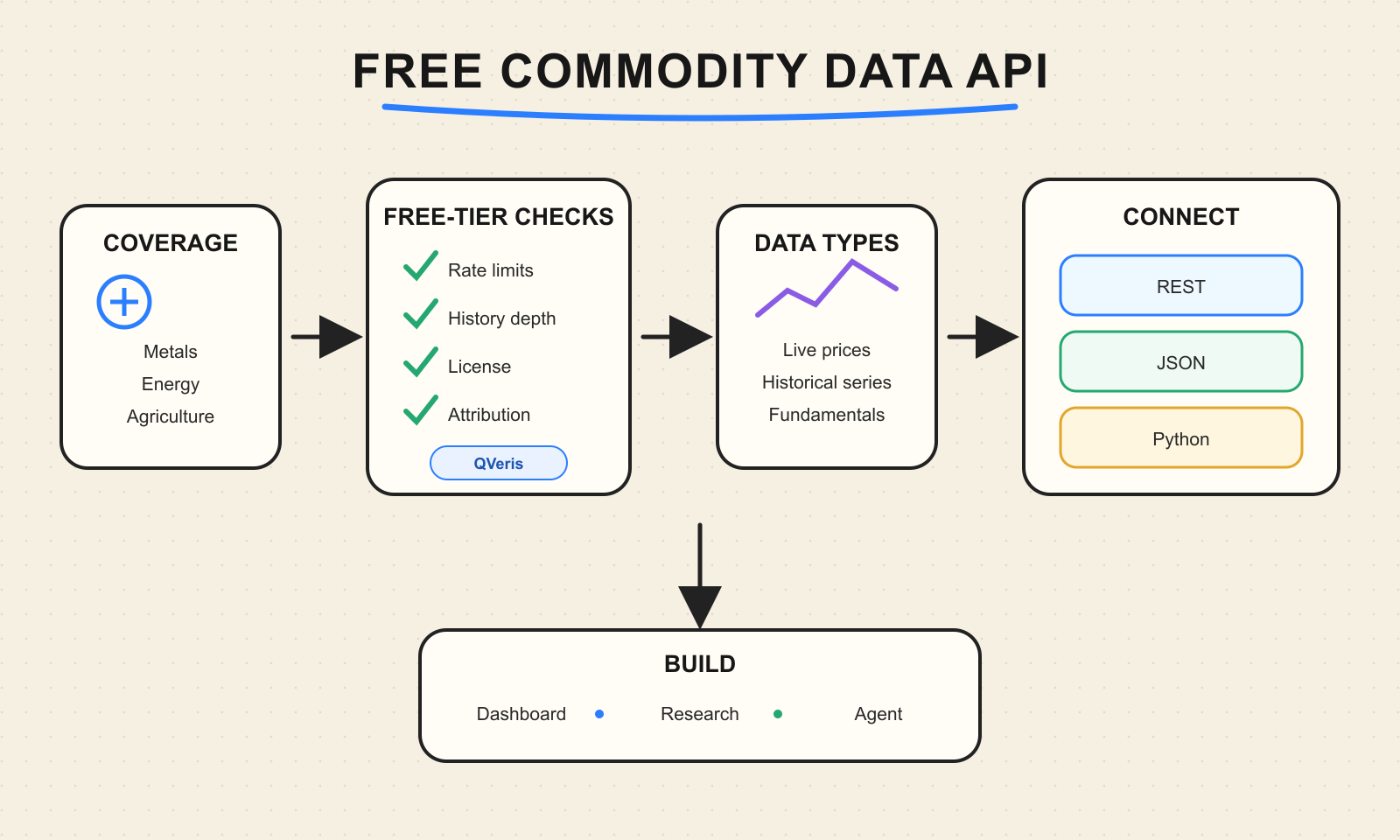
Free commodity data API: what you can actually get
A “free” API may mean a permanent low-volume tier, a trial, delayed quotes, daily observations, or an open public dataset. Choose by the job you need to complete, not by the word free.
- For a dashboard, confirm price symbols, update cadence, currency, unit, and timestamp.
- For research, confirm whether the API includes inventories, production, positioning, crop balances, revisions, and historical depth.
- For production, confirm authentication, rate limits, commercial use, attribution, and redistribution terms.
What should a commodity data API cover?
Real-time commodity prices
Gold, silver, copper, WTI, Brent, and natural gas may be spot benchmarks, futures, or assessed prices. Record exactly what each endpoint represents.
Historical commodity data
For charts and backtests, verify dates, frequency, OHLCV fields, adjustments, continuous-contract rules, revisions, and missing observations.
Commodity fundamentals
Inventory, production, refinery, crop, supply-demand, and CFTC positioning series answer different questions from a price feed and often update weekly or monthly.
The hardest errors are semantic rather than technical. A spot assessment, front-month futures close, cash-settled benchmark, and vendor-built continuous contract may all be labeled “oil price,” yet they have different roll behavior, trading calendars, and licensing. Store contract month, venue, settlement type, unit, currency, and series-construction method as first-class fields.
Continuous-contract example: suppose the expiring crude-oil contract closes at $78 and the next contract closes at $80 on the vendor's roll date. A raw switch from one contract to the other creates an apparent ($80 ÷ $78) - 1 = 2.56% daily gain even if neither contract actually moved by that amount. A difference-adjusted series may add $2 to all pre-roll observations, while a ratio-adjusted series may multiply them by 80 ÷ 78; the two methods preserve different properties and change historical price levels differently. Store both contract closes, the roll trigger, selected contract before and after the roll, adjustment factor, and an unadjusted series. Otherwise a chart or backtest can mistake a stitching decision for market performance.
Where free commodity data comes from
A free endpoint is not a single kind of product. It may expose a government statistical release, an exchange-derived market feed, a vendor-normalized dataset, or a short evaluation tier. The source determines what “latest,” “historical,” and “free” actually mean.
Public statistical APIs
Agencies such as the U.S. EIA publish energy prices, production, inventories, imports, exports, and storage series. These datasets are valuable for research, but publication cadence is usually daily, weekly, or monthly rather than streaming.
Market-data free tiers
Commercial APIs may expose selected spot or futures symbols with delayed updates, shallow history, or a capped request allowance. Confirm whether the free tier is permanent, a trial, or restricted to non-commercial evaluation.
Aggregated economic datasets
Repositories such as FRED make many commodity series easier to query and compare. Always preserve the original series ID, source agency, frequency, unit, seasonal-adjustment flag, and revision behavior.
How to compare free commodity data APIs
| Check | Ask | Why it matters |
|---|---|---|
| Price type | Spot, futures, settlement, index, or assessed price? | Similar labels can represent different markets. |
| Freshness | Real-time, delayed, end-of-day, or periodically updated? | “Latest” does not prove real-time delivery. |
| History | Start date, frequency, revisions, and continuous series? | Backtests need reproducible observations. |
| Units | USD per barrel, ounce, tonne, bushel, or index points? | Wrong unit conversions silently corrupt results. |
| Free tier | Requests, symbols, retention, trial expiry, and attribution? | Free access may not support production. |
Choose the API by use case, not by claim
No free commodity API is best for every workload. A dashboard, research notebook, procurement model, backtest, and production agent each need a different balance of freshness, history, reliability, and licensing.
| Use case | Minimum data requirements | Main risk to test |
|---|---|---|
| Prototype dashboard | Latest value, timestamp, unit, stable symbol, modest quota | A “latest” endpoint may be delayed or update only when the source publishes. |
| Research and analysis | Long history, documented frequency, revisions, downloadable batches | Revised observations can make a result impossible to reproduce. |
| Backtesting | Point-in-time data, OHLCV definitions, contract rolls, missing-value rules | Continuous futures or revised fundamentals can introduce look-ahead bias. |
| Production agent | Schema stability, error contracts, monitoring, commercial rights, fallback | A free tier can change, expire, throttle, or forbid customer-facing display. |
Decision rule: reject an API if you cannot identify the source, timestamp, unit, update policy, quota, and permitted use. A successful HTTP response is not proof that the data is fit for your application.
How to fetch commodity data in Python
The exact URL and field names vary by provider, so treat the following as an integration pattern rather than a live endpoint. It demonstrates the checks that should surround any commodity data API request.
1. Define the commodity and price meaning
Write down the commodity, benchmark or contract, venue, currency, unit, timezone, and required frequency before selecting an endpoint.
2. Test one free JSON request
Start with the provider’s official documentation. Keep the API key outside source code, set a timeout, and capture quota and freshness metadata.
3. Normalize price, unit, and timestamp
Store the raw symbol and source. Convert units explicitly, reject missing timestamps, flag stale values, and preserve revision dates for historical observations.
4. Add rate-limit-safe retries
Use bounded exponential backoff for transient errors, respect 429 responses, cache slow-changing series, and avoid spending a small free quota on unnecessary polling.
5. Validate expiry and roll behavior
For futures, request dates around expiry and compare the named contract with the continuous series. Record the roll trigger, back-adjustment method, and whether volume moves before the vendor rolls.
6. Reconcile against an authoritative release
Check a sample observation against the exchange, benchmark administrator, or public agency. A successful HTTP response does not prove that the unit, contract, or release vintage is correct.
| Response field | Validation | Store with the value |
|---|---|---|
symbol | Match an allowlist; do not infer a benchmark from a display name. | Provider symbol and internal normalized ID |
value | Require a numeric value and define how nulls are handled. | Raw value, normalized value, and conversion formula |
timestamp | Parse timezone explicitly and compare age with the expected cadence. | Observation time, retrieval time, and timezone |
unit | Reject unknown units; distinguish USD from US cents and tonnes from short tons. | Currency, physical unit, quote convention |
source | Require a documented origin and series definition. | Source, endpoint, series ID, and license version |
Move from a free API test to production safely
Cache by publication cadence
Do not poll a weekly inventory series every minute. Cache according to the documented release schedule, preserve the upstream timestamp, and invalidate only when new data should exist.
Separate transport from data quality
Monitor HTTP failures, latency, and rate limits separately from stale timestamps, null values, unit changes, large jumps, and source revisions.
Plan an explicit fallback
Decide whether to serve the last known value, show “data unavailable,” switch sources, or stop an automated action. Never silently substitute a different benchmark.
- Record quota headers and alert before the monthly limit is exhausted.
- Pin expected response fields with contract tests and review provider changelogs.
- Keep API keys server-side, rotate credentials, and avoid exposing them in browser JavaScript.
- Recheck licensing before public display, redistribution, model training, or customer-facing use.
Use QVeris to find commodity data API capabilities
QVeris helps developers and agents discover callable data capabilities and inspect inputs before integration. It does not make licensed exchange data free or guarantee that a provider is suitable for trading.
- Open the QVeris provider details for commodity and financial-data capabilities.
- Inspect symbols, parameters, authentication, output schema, units, and timestamps before an agent calls a provider.
- Keep licensing, accuracy, latency, and suitability checks in your approval process.
1. Discover the capability
Search by the task—latest commodity value, historical series, inventory, production, or positioning—rather than assuming one provider exposes every dataset.
2. Inspect the callable contract
Review required inputs, authentication, symbol conventions, response schema, and error behavior before allowing an agent to call the tool.
3. Add approval boundaries
Require human approval or policy checks when data may trigger trading, purchasing, pricing, or customer-visible output.
FAQ
Is there a free commodity data API?
Yes. Public datasets, permanent free tiers, delayed feeds, and trials exist, but their coverage and usage rights differ.
Which commodities does a free API cover?
Common groups include metals, energy, and agriculture; some APIs also expose inventories, production, crop balances, or trader positioning.
Can I get historical commodity prices by API?
Many APIs return JSON or CSV history, but depth, frequency, revisions, continuous-series construction, and free limits vary.
How do I fetch commodity data in Python?
Use a documented REST endpoint with a timeout, keep keys outside source code, validate timestamps and units, and handle 429 responses.
Does a free commodity API require a credit card?
Some do not, while others only offer a time-limited trial. Confirm signup terms and what happens when the trial ends.
What are free-tier rate limits?
Limits may apply by minute, day, month, symbol, record count, or history depth. Check current provider documentation before integrating.
Is a continuous futures price the same as a tradable contract?
No. It is usually a research series constructed by rolling between expiries. The roll schedule and adjustment method can change returns and may not represent an executable price.
Why do commodity prices differ between APIs?
The feeds may reference different venues, contract months, assessment windows, units, currencies, settlement types, delays, or continuous-series methodology.