
Free Cash Flow Statement API
Data, Formula & Examples
Find, compare, and validate cash flow statement data for screening, valuation, research, and automated financial analysis.
TL;DR
A cash flow statement API should preserve how cash moved through operating, investing, and financing activities and reconcile opening cash to closing cash. Free cash flow is a derived measure built from selected statement fields, not a universally reported line item. A trustworthy integration therefore keeps the reported cash-flow statement intact, documents the chosen free-cash-flow formula, and avoids mixing cumulative and standalone periods.
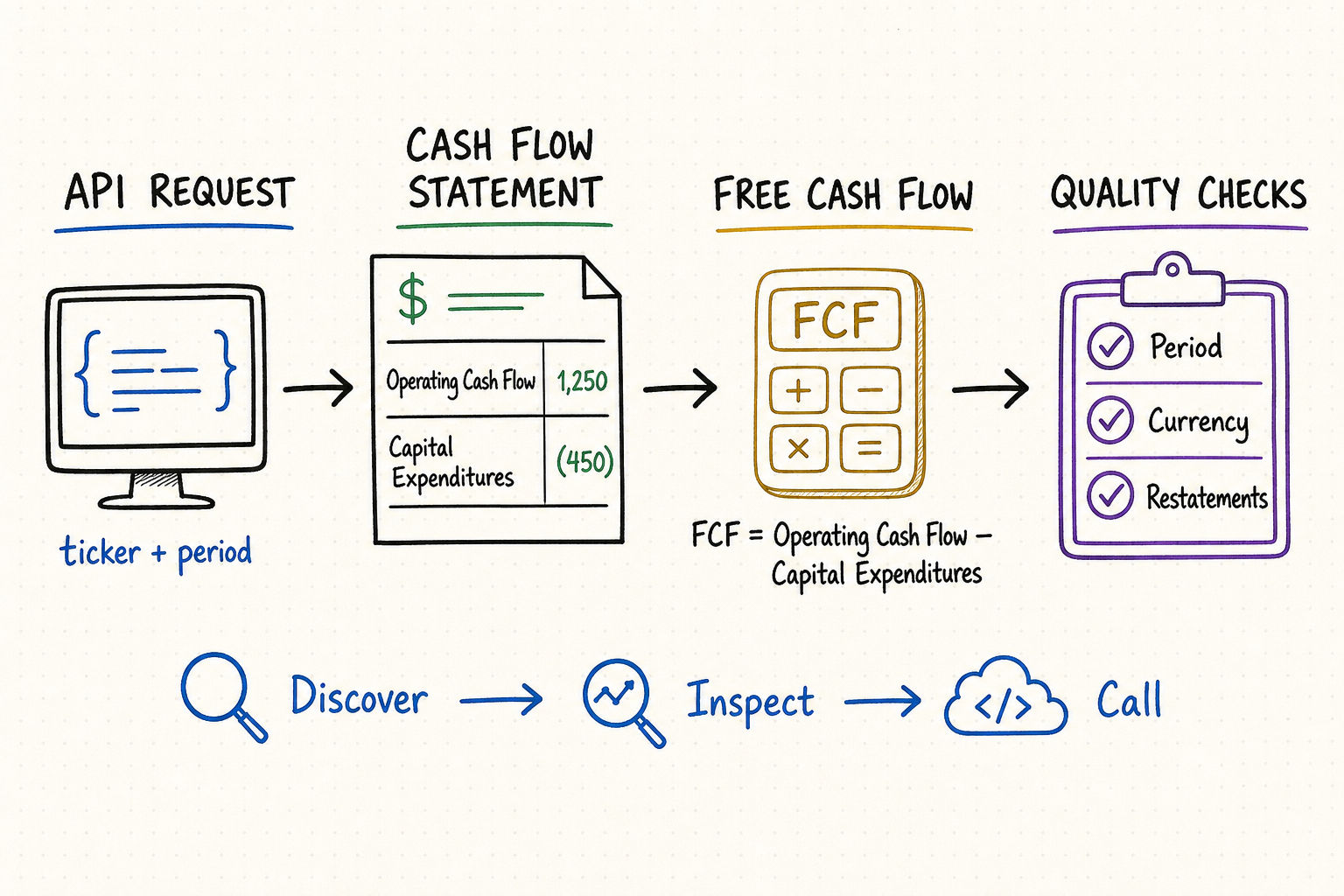
A free cash flow statement API exposes the statement inputs needed to calculate cash generated after capital investment.
For the standard headline measure, subtract capital expenditures from net cash provided by operating activities.
Confirm reporting period, currency, units, filing date, restatements, and the provider's sign convention.
QVeris helps agents discover and inspect financial APIs before committing to an endpoint or provider.
How to calculate free cash flow from API data
Start with the cash flow statement, not a provider's precomputed ratio. The usual company-level formula is free cash flow equals operating cash flow minus capital expenditures. If an API returns capital expenditure as a negative cash outflow, add the signed value instead of subtracting it again. Document the sign convention, included asset purchases, treatment of capitalized software, and whether acquisitions are excluded. Levered free cash flow, unlevered free cash flow, and free cash flow to equity are different measures and should not share one unlabeled field.
Operating cash flow of $1.25 billion and capital expenditures of $450 million produce $800 million of free cash flow.
Sum four non-overlapping quarters from the same statement version. Do not mix fiscal-year results with one of their component quarters.
Many interim filings report cumulative cash flow from the start of the fiscal year. Derive a standalone quarter only by subtracting compatible cumulative periods with the same scope, currency, and filing basis.
Some analysts subtract total purchases of property and equipment; others use net capital expenditure or add proceeds from asset sales. Store the formula version and components so two free-cash-flow series are not compared as if they were identical.
Worked example: reconcile cash before publishing free cash flow
Assume the API uses positive numbers for inflows and negative numbers for outflows. The company begins the period with $300m of cash. It reports $500m of operating cash flow, -$240m of investing cash flow, -$100m of financing cash flow, and a -$10m foreign-exchange effect. Investing cash flow includes -$180m of capital expenditure and a separate -$60m acquisition payment.
| Check | Calculation | Result and meaning |
|---|---|---|
| Closing cash | 300 + 500 - 240 - 100 - 10 = 450 | $450m; this must match the statement total and the balance sheet under the same cash definition. |
| Standard free cash flow | 500 + (-180) = 320 | $320m; because capex is already signed as an outflow, add it to operating cash flow. The acquisition payment remains separate. |
| Net change in cash | 450 - 300 = 150 | $150m; it differs from free cash flow because financing, acquisitions, other investing flows, and FX also move cash. |
A correct FCF number does not prove the statement is complete. Publish the formula components, source period, filing version, currency, units, and reconciliation difference. If closing cash fails to reconcile, hold the derived metric for review instead of returning a polished but unauditable value.
Fields a free cash flow statement API should return
| Field | Meaning | Use | Validation |
|---|---|---|---|
| Operating cash flow | Cash generated by core operations. | The starting value for standard FCF. | Map GAAP and IFRS labels carefully. |
| Capital expenditures | Cash used to acquire or improve long-lived assets. | Subtracted from operating cash flow. | Confirm the provider's sign convention. |
| Investing cash flow | Asset purchases and sales, acquisitions, investments, and disposals. | Separates recurring capital needs from strategic transactions. | Do not classify acquisitions as ordinary capex. |
| Financing cash flow | Debt issuance and repayment, dividends, repurchases, and equity issuance. | Explains how cash generation is distributed or funded. | Separate debt principal from interest classification. |
| Cash reconciliation | Opening cash, net change, FX effect, restricted cash, and closing cash. | Validates statement completeness. | Match the cash definition to the balance sheet. |
| Period metadata | Fiscal period, start date, end date, and filing date. | Prevents overlapping-period errors. | Fiscal calendars vary by issuer. |
| Normalization metadata | Currency, units, source filing, and restatement status. | Supports comparisons and audit trails. | Never infer missing units silently. |
How to evaluate free cash flow API providers
Check exchanges, company types, quarterly depth, delisted securities, and whether historical statements remain available after symbol changes. Confirm whether quarterly values are standalone or cumulative and how trailing periods are built.
Test more than headline operating cash flow. Inspect working-capital adjustments, non-cash charges, capital expenditures, acquisitions, debt, dividends, repurchases, FX effects, and how cash outflows are signed.
Prefer responses that identify the source filing, accession or document link, accepted date, reported currency, normalization status, and amendment version. Recalculate selected totals from reported components.
Measure pagination, backfill time, rate-limit behavior, update delay, caching rights, attribution, redistribution, and commercial use. A formula can be correct while the data license is unsuitable for the product.
From an API response to an auditable free cash flow series
A production integration should preserve the statement before calculating a headline number. The same response may contain annual values, cumulative interim values, restated comparatives, and provider-normalized fields. Separate those records first, then calculate free cash flow only when operating cash flow and capital expenditure share the same issuer, period, currency, units, accounting scope, and source version.
Store the raw payload, request parameters, provider, retrieval time, source filing or document ID, filing acceptance time, amendment status, reported currency, units, and normalization flag. Keep the raw value beside the normalized value so a later mapping correction remains explainable.
Classify each record as annual, standalone quarter, or year-to-date cumulative. Map cash inflows and outflows into an internal convention, but preserve the provider's original sign. A negative capital-expenditure value must not be subtracted twice, and a nine-month cumulative value must not be labelled as the third quarter.
Calculate the selected free-cash-flow formula from compatible components and attach the formula version. Independently reconcile opening cash, operating, investing, financing, foreign-exchange effects, and other defined adjustments to closing cash. Also compare closing cash with the balance sheet under the same cash and restricted-cash definition.
Use an industrial company, a bank, a capital-intensive issuer, a company with acquisitions, an off-calendar fiscal year, and a filing later amended. Verify reported totals, standalone-quarter derivation, formula output, null handling, restatement behavior, and source links. Record expected results and tolerances so future provider or parser changes can be detected automatically.
Use QVeris to discover financial data APIs
QVeris gives agents a discovery layer for finding and inspecting cash-flow, filing, and financial-statement capabilities. An agent can compare period parameters, schemas, and invocation requirements before making a call instead of hardcoding the first endpoint found. The application still owns period construction, sign normalization, formula choice, cash reconciliation, and the evidence attached to a free-cash-flow conclusion.
- Search for cash flow statement capabilities by intent, not only by a provider's product name.
- Inspect input parameters and response fields before wiring an endpoint into production code.
- Keep provider-specific transformations behind a stable internal financial statement model.
FAQ
Not always. Many APIs calculate it from reported operating cash flow and capital expenditures, so definitions can differ.
Some providers offer a free plan, but coverage, request frequency limits, history, and update speed vary. Verify the current terms.
Cash flow adjusts accrual earnings for non-cash items and working-capital changes, then separately records investing and financing cash movements. The difference is expected and often analytically useful.
Reconcile opening cash plus operating, investing, financing, and FX effects to closing cash using the same definition of cash and restricted cash as the balance sheet.
Usually not in the standard operating-cash-flow-minus-capex measure. Keep business acquisitions separate and document any broader formula used for owner earnings or acquisition-adjusted cash flow.
Yes. Heavy investment, working-capital builds, or timing can produce negative free cash flow. Review the components and persistence rather than treating the sign alone as a verdict.