
Free Business News API
Selection & Integration Guide
Find a free business news API that matches your sources, filters, freshness, usage rights, and production limits—then test it before you build.
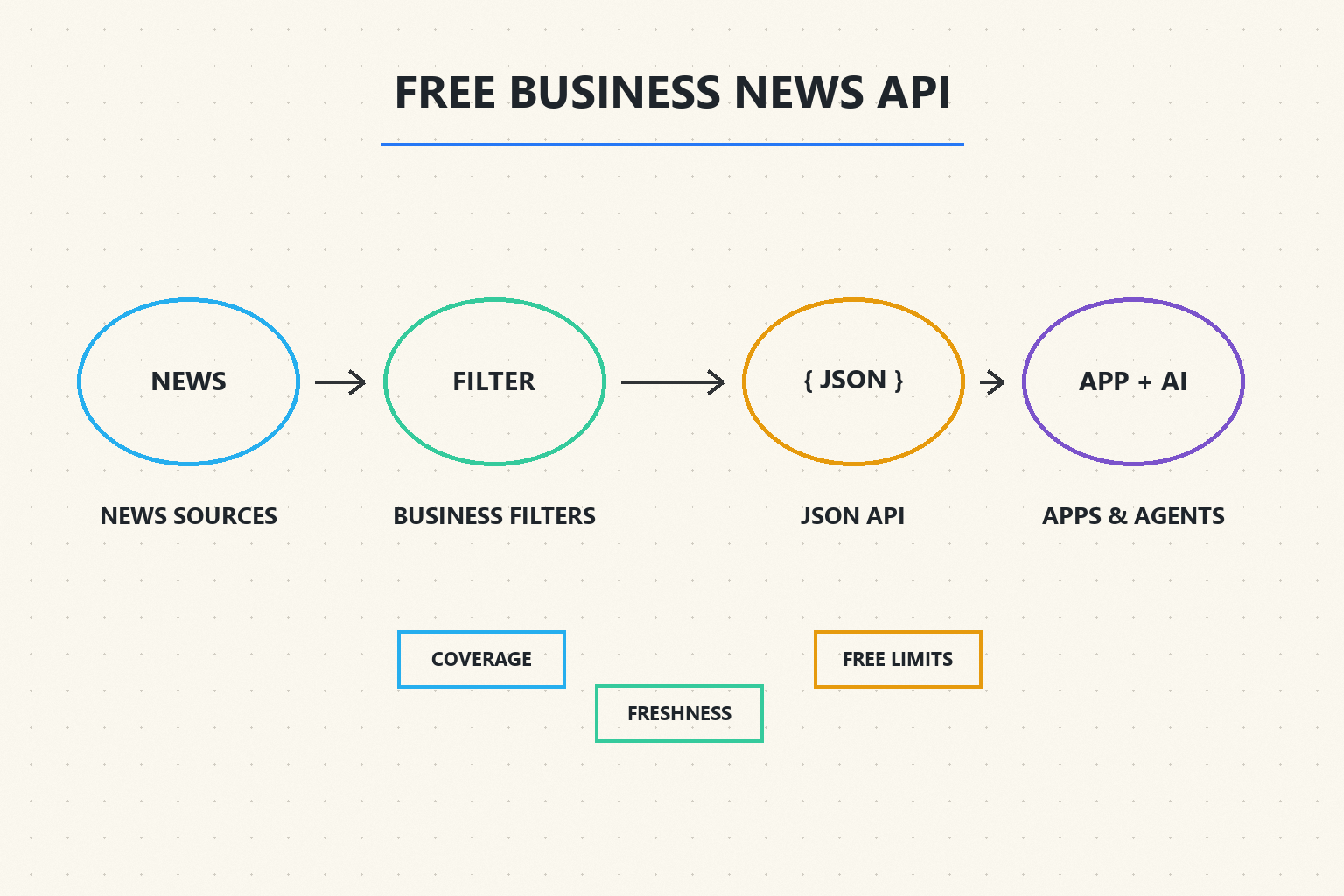
TL;DR
A usable free tier, relevant business sources, predictable JSON, practical filters, and terms that allow the intended project.
Free may mean no key, a trial, or a recurring quota. Check request limits, delay, history, attribution, and commercial-use rules.
Run the same company, topic, language, and date queries against candidates; inspect relevance, duplicates, timestamps, and missing fields.
QVeris helps agents discover and call external capabilities; each provider’s current data rights and limits still apply.
Define the free business news API requirements first
Start by defining whether the product needs a public headline feed, company monitoring, market and industry coverage, economic-policy reporting, or evidence for an agent. Then confirm the access model, returned fields, source and language coverage, freshness, and usage rights. A broad “business” category is useful only when it matches the product's actual decision window and display requirements.
Coverage and relevance
Decide whether “business” means broad corporate headlines, company-specific news, financial markets, industries, economic policy, or a regional feed. A general news category may not support ticker-level monitoring.
Freshness, history, and full text
Record timestamp semantics, update cadence, archive window, pagination rules, and whether the API returns metadata, a summary, or licensed article text. Test “real-time” rather than assuming it.
Free tier and usage rights
Check calls per minute and month, allowed environments, caching, attribution, redistribution, commercial use, and upgrade behavior. The free plan must fit both your test volume and legal use case.
Article identity, syndication, and corrections
A single announcement may appear under a wire service, several publisher URLs, and rewritten headlines. Prefer a provider article ID and canonical URL, but retain publisher, original source, publication time, update time, and language. If the API exposes corrections, retractions, or updated versions, decide whether your application replaces the old record, links the versions, or alerts a reviewer.
Primary evidence versus reporting
Press releases, regulatory filings, exchange notices, central-bank statements, and company investor-relations posts are primary evidence; publisher articles interpret or contextualize them. A useful feed identifies the source type and preserves a link to the original material when available. For research or agent-generated answers, keep the reporting article and the primary document as separate records so citations do not imply that commentary is an official disclosure.
Entity, event, and language semantics
Company names, tickers, products, executives, industries, countries, and event types should be distinct fields rather than one keyword list. Verify how aliases, renamed companies, dual listings, ambiguous tickers, and translated names are resolved. If the provider translates headlines or summaries, retain the original language and text, translation status, and model or method; otherwise an English query may hide that the underlying evidence was published in another language.
Match the feed to the product surface
A public headline widget needs display rights, attribution, images, stable URLs, and aggressive duplicate control. A company-monitoring alert needs low publication-to-API delay, exchange-aware entity matching, event classification, and correction updates. A research assistant needs longer history, primary-source links, full query replay, and enough context to explain why evidence was selected. A model-training or archive workflow adds retention and redistribution requirements. Score providers against the intended surface instead of treating one broad “business news” endpoint as equally suitable for all four.
How to compare free business news API options
| Criterion | Verify | Why it matters |
|---|---|---|
| Sources | Publishers, countries, languages, categories | Relevance and geographic blind spots |
| Filters | Company, ticker, topic, source, language, date | Less noisy post-processing |
| Response | Stable IDs, URLs, timestamps, summaries, images | Deduplication and display |
| Free limits | Quota, throttling, delay, history, CORS, key | Demo versus sustainable integration |
| Rights | Attribution, caching, commercial use, redistribution | Technically and legally usable |
Business news APIs to test first
The services below represent different retrieval models. Confirm current pricing, free-plan restrictions, source rights, history, and production use on each official site; a development key does not automatically authorize a public or commercial news product.
| Provider | Good starting point | Best fit | Verify carefully |
|---|---|---|---|
| NewsAPI | Broad publisher discovery through top-headline and article-search endpoints with source, keyword, language, and date-style filters. | Evaluating a general business-news feed or quickly testing source and query coverage. | Development versus production rights, article-content fields, result delay, archive depth, source list, attribution, and redistribution. |
| GNews | General news search and top-headline retrieval with language, country, topic, time, and pagination controls. | Regional or multilingual business-news prototypes that need a simple REST response. | Exact business-topic coverage, number of accessible articles, historical limits, content truncation, images, attribution, and commercial display. |
| Marketaux | Financial news enriched with companies and entities, symbol filters, industries, countries, languages, and sentiment-related fields. | Ticker-level company monitoring, entity-aware filtering, and financial-news research. | Entity-link precision, duplicate stories, pagination cost, source mix, historical depth, text storage, and plan-specific limits. |
| Alpha Vantage | A News & Sentiment function focused on market topics and ticker-related articles within a broader financial-data API family. | Scheduled company or market briefs that want news metadata and sentiment alongside other financial endpoints. | Ticker relevance, topic filters, sort order, time range, result limit, source coverage, endpoint access, and whether sentiment is item- or ticker-specific. |
Do not compare only article counts. A smaller feed with stable IDs, relevant company matching, correction delivery, and usable rights can be more valuable than a larger feed dominated by syndicated duplicates or content that cannot be displayed.
Business news API acceptance examples
One wire story can appear as twenty articles
A company announcement may be distributed by a wire service, republished by regional outlets, copied into finance portals, and summarized under rewritten headlines. Counting every URL as independent evidence inflates source diversity, article volume, and sentiment confidence. Build a duplicate cluster from provider IDs, canonical URLs, original source, normalized headline, publication time, named entities, and text similarity. Keep every permitted record, but choose one representative item and report both raw count and independent-story count.
“Apple” is not always Apple Inc.
A keyword query for Apple can retrieve fruit prices, an orchard company, a music label, or an article that mentions an iPhone only in passing. Test exact ticker filters separately from full-text keywords. Require company entity ID, exchange-aware ticker, relevance score, matched text span, and article focus when available. Include negative examples in the benchmark; a feed that returns nothing for an ambiguous query can be safer than one that confidently links the wrong issuer.
Prioritize display rights, attribution, stable article URLs, publisher identity, image rights, correction handling, and duplicate control. Do not expose provider-only snippets or images merely because the JSON contains them.
Prioritize publication-to-API latency, entity precision, event classification, source quality, and update or retraction delivery. Define a quiet-period baseline so ordinary mentions do not trigger the same alert as earnings, litigation, or an acquisition.
Require longer history, query replay, primary-source links, article timestamps, source type, duplicate clusters, and enough licensed context to explain selection. Preserve conflicting coverage instead of collapsing it into one summary.
Return article ID, headline, publisher, original source when known, publication and ingestion times, entities, relevance, language, correction state, and citation URL. The agent should separate reported claims from primary evidence and state when coverage is incomplete.
Integrate a free business news API step by step
Include a large company, a smaller company, an industry topic, two languages, a date boundary, and an intentionally empty query.
Store credentials server-side, set a timeout, and log the status code, response time, rate-limit headers, and raw response during evaluation.
Map provider fields into your article model. Prefer stable IDs; otherwise combine canonical URL, normalized title, source, and publication time.
Handle 429, malformed items, missing timestamps, empty pages, and outages. Cache only where provider terms allow it.
Store the complete permitted result set before applying your own relevance, freshness, source-quality, or event-impact ranking. Keep the ranking version and feature values so a reviewer can explain why one article appeared above another. Do not let a sentiment score silently become a relevance score.
Replay known queries on a schedule and track publisher coverage, latency percentiles, duplicate groups, retractions, schema changes, and missing fields. Alert when a major source disappears or a cursor starts skipping records; a 200 response can still contain a degraded feed.
Use measurable acceptance criteria. For a fixed query set, record relevant articles found, irrelevant results, duplicate-cluster rate, median and 95th-percentile publication-to-API delay, missing-field rate, paging consistency, correction delivery, and source concentration. Include known events that should be found and negative queries that should stay empty. Review false positives by cause—ambiguous entity, stale article, broad category, translation, or syndication—because each needs a different fix. A provider with more headlines is not automatically better if most are duplicates, arrive after the decision window, come from one narrow source group, or cannot be legally displayed. Save the dated scorecard and raw samples so plan or coverage changes can be measured against the original approval evidence.
Use QVeris to discover business news capabilities
QVeris can help an AI agent discover, inspect, and call relevant external capabilities instead of hard-coding every provider path. It does not change a provider’s coverage, licensing, quota, or freshness.
- Explore the QVeris provider details for news and financial data capabilities.
- Inspect the capability definition and inputs before an agent calls it.
- Keep provider limits, attribution, and validation in application policy.
FAQ
Yes. Some providers offer a free tier or no-key endpoint, but coverage, limits, licensing, article content, and production rights differ.
Some APIs do. Confirm whether matching uses named entities, exact tickers, full-text keywords, or provider tags.
Only when the terms permit your use case and quota, attribution, redistribution, and reliability fit production.
Test representative queries and compare sources, freshness, deduplication, filters, fields, limits, rights, and failures.