
Choose a Reliable
Free Balance Sheet API
Evaluate coverage, accounting fields, history, limits, and reporting dates before a free endpoint becomes part of your analysis.
TL;DR
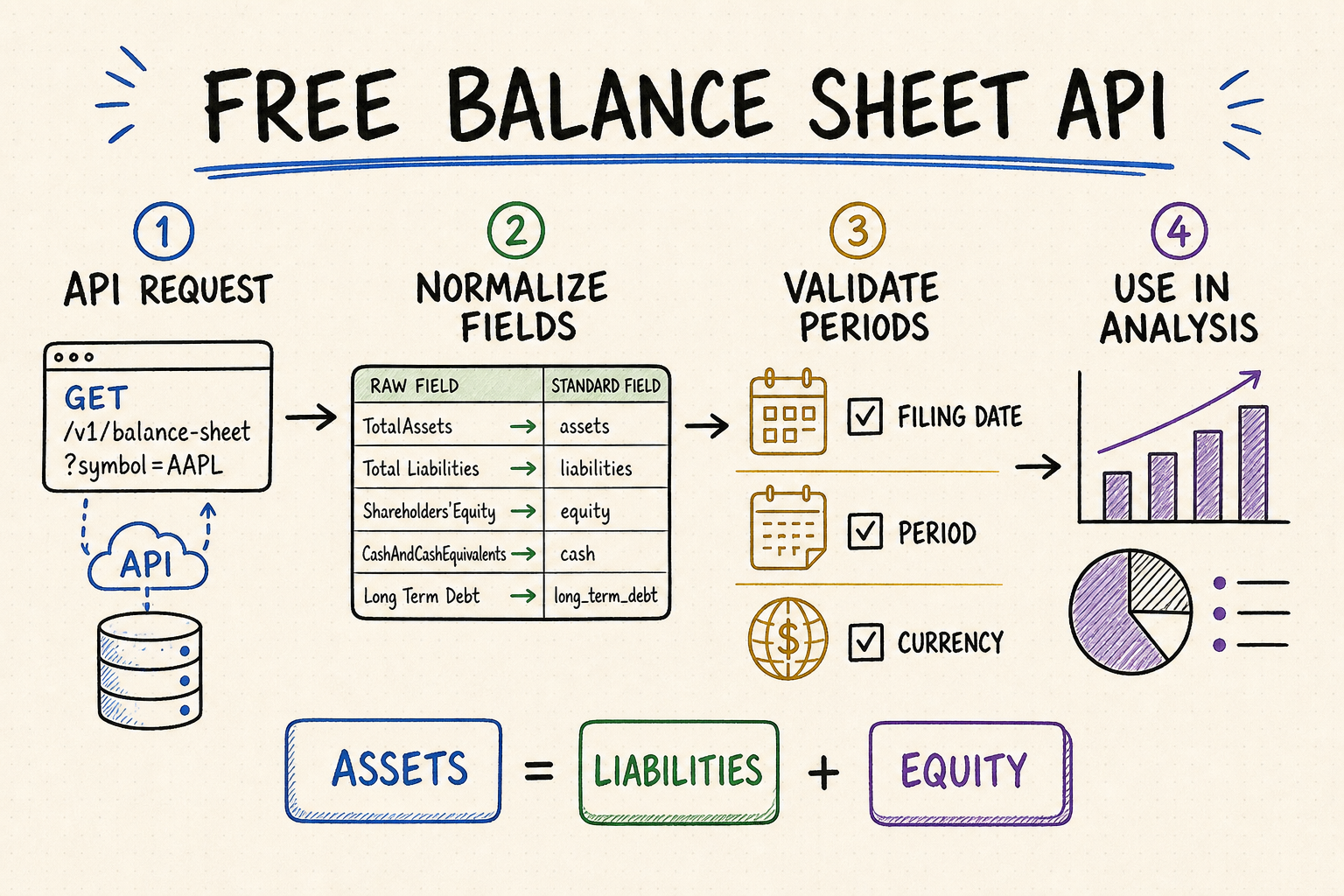
A balance sheet API returns a company's financial position at a specific date, not activity over a period. Reliable data preserves the reporting entity, period end, currency, unit, consolidation scope, filing version, and current versus non-current classifications. It should let you test whether assets equal liabilities plus equity and explain changes in liquidity, debt, working capital, and book value without mixing dates.
A free endpoint can suit prototypes, screening, education, and light research, but not every production workload.
Confirm annual and quarterly statements, consolidated values, currency, filing dates, and restatement behavior.
Request frequency limits matter, but history depth, symbol coverage, latency, and licensing can be tighter constraints.
Map provider fields to a stable schema and test the accounting equation across companies and reporting periods.
How to evaluate a free balance sheet API
“Free” describes price, not fitness. Begin with the exchanges and company types you need, then verify whether the API returns standardized statements or filing-native facts. Standardized data is easier to compare; filing-native data preserves detail but requires more accounting logic. Because a balance sheet is an instant snapshot, even a small mismatch between period end, filing version, or consolidation scope can invalidate a ratio or liquidity comparison.
Check active and delisted companies, primary listings, ADRs, funds, and foreign issuers. Prefer stable legal-entity IDs over tickers, and verify whether the statement covers the parent, consolidated group, guarantor, regulated subsidiary, or another reporting entity.
Count available annual and quarterly period ends rather than accepting a vague “historical data” claim. Distinguish the balance-sheet date, filing date, regulatory acceptance time, provider availability time, and any later amendment.
Confirm current and non-current presentation, currency, units, accounting standard, consolidation scope, and whether leases, restricted cash, held-for-sale assets, deferred taxes, and non-controlling interests retain their reported treatment.
Acquisitions, disposals, spin-offs, foreign-exchange translation, reclassifications, and restatements can create breaks. Preserve comparative values as reported in each filing and do not assume every change represents operating movement.
Differentiate not disclosed, not applicable, mapping failure, delayed data, and true zero. Financial institutions and funds use balance-sheet structures that differ from industrial companies; a generic schema should not erase sector-specific assets and obligations.
Before calculating liquidity, leverage, or book-value ratios, verify that total assets equal total liabilities plus equity within a documented tolerance. Reconcile cash to the cash-flow statement, retained earnings to prior periods, and debt totals to current and non-current components. A ratio calculated from a balanced-looking but semantically mixed statement is still unreliable.
Store the statement exactly as it was available at each research cutoff, including filing version, provider retrieval time, currency, units, and normalization rules. Later amendments and provider remappings should create a new version rather than overwrite the evidence used by an earlier screen, backtest, credit model, or AI-generated brief.
Fields and reporting periods that matter
| Category | Typical fields | Analysis use | Validation focus |
|---|---|---|---|
| Assets | Cash, receivables, inventory, investments, property, goodwill, and other assets. | Liquidity and asset quality. | Current/non-current split. |
| Liabilities | Payables, short-term borrowings, long-term debt, leases, and deferred items. | Leverage and obligations. | Maturity classification. |
| Equity | Common stock, paid-in capital, retained earnings, treasury stock, and OCI. | Book value and capital structure. | Minority interest treatment. |
| Working capital | Receivables, inventory, payables, accrued liabilities, contract assets, and contract liabilities. | Short-term operating funding. | Operating versus financing classification. |
| Debt and liquidity | Cash, restricted cash, revolvers, current debt, long-term debt, leases, and maturities. | Liquidity runway and refinancing risk. | Net-debt definition and current portion. |
| Accounting checks | Assets, liabilities, equity, subtotals, and comparative presentation. | Detect mapping, scaling, and sign errors. | Run the accounting equation and subtotal checks. |
| Period metadata | Fiscal year, quarter, period end, filing date, currency, and form type. | Point-in-time alignment. | Restatements and late filings. |
Build an auditable balance sheet API workflow
Do not flatten the first successful response directly into an analysis table. A provider may return company-normalized fields, filing-native concepts, comparative periods, and later amendments through the same endpoint. Preserve the source record first, then create a validated statement version whose entity, instant date, currency, units, and consolidation scope are explicit.
Save request parameters, raw payload, provider, retrieval time, filing URL or accession, acceptance time, form type, amendment status, and taxonomy version. Keep source facts beside normalized fields so a later mapping change does not erase the originally reported meaning.
Map the legal reporting entity separately from its ticker and share class. Require one instant date, reporting currency, unit scale, accounting standard, and consolidation scope for each statement. Reject ambiguous records rather than joining values merely because they share a fiscal-quarter label.
Test assets against liabilities plus equity within a documented tolerance, then recalculate major subtotals. Reconcile cash with the cash-flow statement, retained earnings with prior periods and earnings movements, and debt with current and long-term components. Keep any unexplained difference visible instead of inserting a balancing value.
Create a new immutable version when a filing is amended or a provider remaps a concept. Track missing required fields, reconciliation differences, unexpected unit changes, stale filings, classification drift, and coverage by company type. Research outputs should retain the exact statement version used.
Use QVeris to compare callable data options
Providers label coverage, quotas, and balance-sheet endpoints differently. QVeris helps teams discover and inspect callable statement, filing, company-fact, and debt-data capabilities before committing integration time. It can streamline access, but the application still owns reporting-entity resolution, period-end alignment, accounting classifications, reconciliation, and the license decision.
- Search by the actual task—balance sheets, filings, company fundamentals, or statement history—not only by vendor category.
- Inspect input parameters and returned fields before writing an adapter, then compare alternatives against the same test set.
- Keep validation and licensing decisions in your application; discovery does not replace accounting review or legal approval.
FAQ
It can be, but price does not prove accuracy. Compare sampled values with source filings, test amendments, and monitor reconciliation failures.
At minimum, require total assets, total liabilities, equity, currency, period end, filing date, fiscal period, and a stable company identifier.
Free plans vary widely. Count complete annual and quarterly periods for your target companies and verify whether older records use the same taxonomy.
Common causes include unit scaling, sign conventions, missing non-controlling interest, incomplete custom concepts, mixed filing versions, or a provider mapping error. Inspect source facts before adding a balancing plug.
Yes, but define whether you mean current assets minus current liabilities or operating working capital that excludes cash and financing items. Preserve the components and period end with the result.
Separate short-term borrowings, current maturities, long-term debt, leases, and other financing obligations. Record cash and restricted cash separately before calculating net debt.
Not through a generic balance-sheet template alone. Banks require sector-specific fields for loans, deposits, securities, capital, and allowances, with different liquidity and leverage interpretation.