
Free 8-K API
for SEC Filing Data
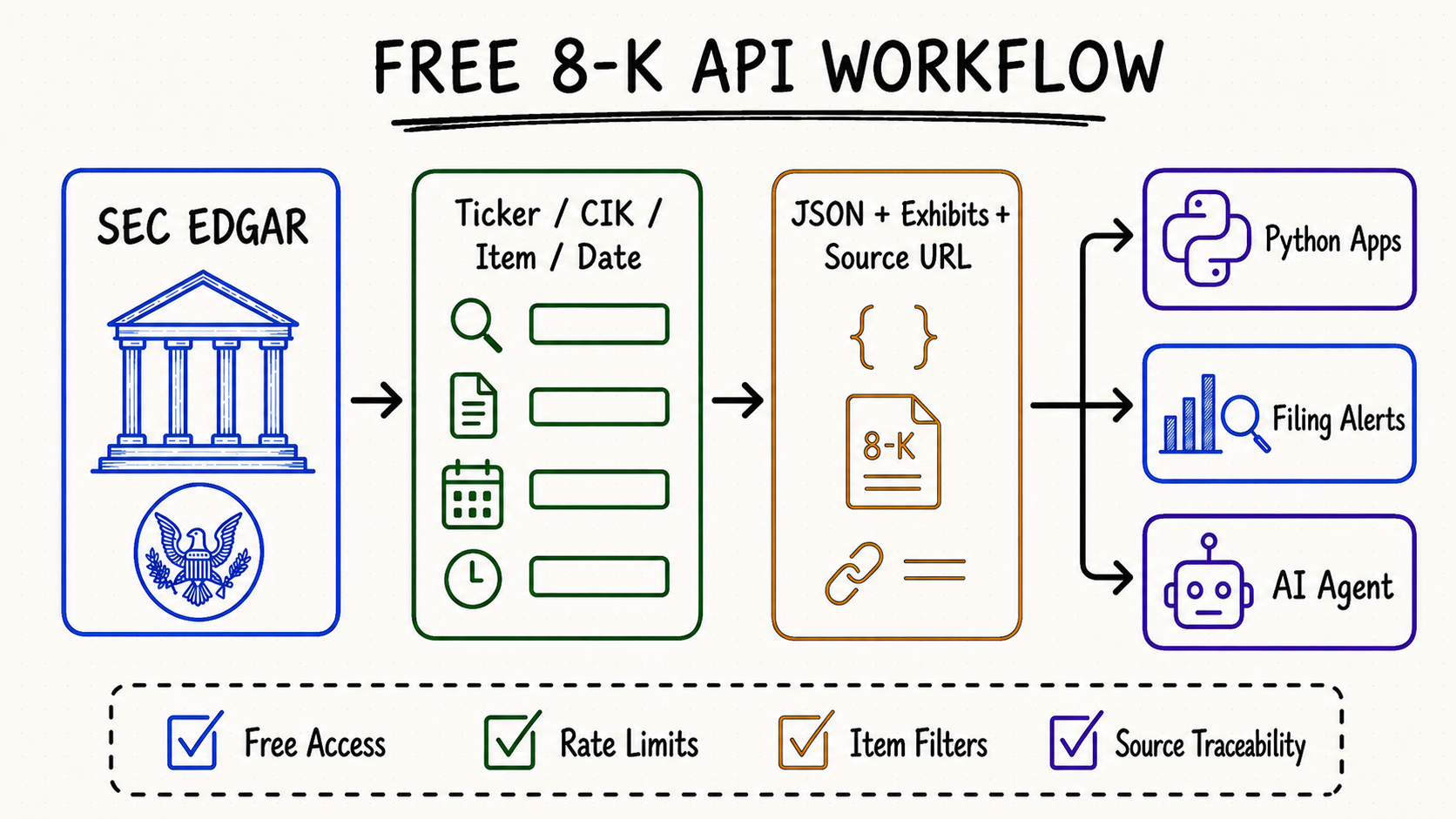
Build a free 8-K event feed that detects new SEC current reports, preserves every reported Item, follows material exhibits, and issues correction-aware alerts with source evidence.
TL;DR
Event feed, not headline feed
An 8-K can report several Items and attach the document that contains the real detail. Capture the filing package instead of reducing it to one generated headline.
Time has three meanings
Keep event or report date, SEC filing date, and accepted timestamp separately. Monitoring and point-in-time research normally depend on acceptance time.
Accession is the filing key
Deduplicate by accession number, not ticker and date. Link an 8-K/A to the original as a new disclosure version rather than overwriting it.
Evidence completes the alert
Return CIK, form, Items, primary document, exhibits, official URLs, retrieval time, and parser version so the event can be verified.
How to use a free 8-K API for SEC filings
An 8-K API primarily supports event monitoring. Poll or stream new accessions across the issuer universe, parse the item numbers and acceptance timestamp, fetch linked exhibits, and classify the event without guessing from the headline alone. The workflow must distinguish filing arrival from the underlying event date and treat 8-K/A as a new disclosure version rather than a duplicate.
Item codes are the first structured clue, not the final interpretation. Item 1.01 can identify a material agreement; Item 2.01 a completed acquisition or disposition; Item 2.02 results of operations; Item 5.02 leadership and compensation events; Item 7.01 Regulation FD disclosure; Item 8.01 other events; and Item 9.01 financial statements and exhibits. One accession can contain several Items, while an EX-99.1 exhibit may contain the earnings release or presentation users actually need.
1. Detect new accessions with low duplication risk
Use accession number as the immutable event key and retain SEC acceptance time. A ticker-only poll can miss renamed issuers and produce duplicate notifications.
2. Parse item codes before assigning event meaning
Items distinguish earnings, agreements, acquisitions, officer changes, impairments, and other disclosures. Preserve every reported item because one 8-K can contain multiple events.
3. Retrieve and classify exhibits
Material detail often lives in an earnings release, agreement, or presentation filed as an exhibit. Save exhibit type, filename, URL, and its relationship to the parent filing.
4. Build correction-aware alerts
Send an initial alert from stable filing metadata, then enrich it after parsing. When an amendment arrives, link it to the original and emit a correction instead of a second unrelated event.
5. Separate detection from enrichment latency
Measure when EDGAR accepted the accession, when the feed observed it, and when documents and exhibits finished parsing. Label preliminary and enriched states explicitly instead of presenting incomplete evidence as final.
6. Preserve multi-event structure
Model filing, Item, exhibit, and derived event as related records. Alerts created from several Items should share one accession, while no single category should hide other material disclosures in the filing.
Free SEC filing API fields and capabilities
| Layer | Main job | Best for | Boundary |
|---|---|---|---|
| Form type | 8-K or 8-K/A. | Separating original filings from amendments. | Do not infer event meaning from form type alone. |
| CIK / ticker | Issuer lookup key. | Company-specific 8-K search. | Ticker may be absent or change. |
| Accession / URL | Unique filing reference and source document. | Deduplication and audit trails. | Document parsing may be separate. |
| Extracted 8-K items | Item number, event category, exhibits, acceptance time, and filing text. | Structured event monitoring and research. | Coverage varies by provider and plan. |
| Accepted timestamp | When EDGAR accepted the filing. | Ordering alerts and point-in-time research. | It is not necessarily the underlying event date. |
| Item list | All reported Item numbers and captions. | Routing to earnings, M&A, governance, financing, or risk workflows. | One filing can contain several Items; captions do not replace source text. |
| Exhibit relationship | Sequence, exhibit type, filename, description, URL, and parent accession. | Retrieving releases, agreements, presentations, and schedules. | The primary 8-K may only summarize the exhibit. |
8-K filings API example and validation checklist
Model the response as a filing package, not a flattened headline. This provider-neutral JSON uses placeholders, but it captures the relationships a production alert needs to preserve.
{
  "issuer": {"cik": "CIK_PLACEHOLDER", "ticker": "TICKER_PLACEHOLDER"},
  "filing": {
    "accession_number": "ACCESSION_PLACEHOLDER",
    "form": "8-K",
    "accepted_at": "YYYY-MM-DDThh:mm:ss-04:00",
    "report_date": "YYYY-MM-DD",
    "items": ["2.02", "9.01"],
    "filing_index_url": "SEC_FILING_INDEX_URL",
    "primary_document_url": "SEC_PRIMARY_DOCUMENT_URL",
    "amends_accession": null
  },
  "exhibits": [
    {
      "sequence": 1,
      "type": "EX-99.1",
      "description": "Earnings release",
      "source_url": "SEC_EXHIBIT_URL",
      "retrieval_status": "complete"
    }
  ],
  "processing": {
    "state": "enriched",
    "retrieved_at": "YYYY-MM-DDThh:mm:ssZ",
    "parser_version": "PARSER_VERSION"
  }
}
The accession remains the parent key. Items and exhibits are child records, so a multi-Item filing is stored once and can generate several evidence-linked alerts. If an 8-K/A arrives, give it its own accession and populate amends_accession; never overwrite the original package or reuse its acceptance time.
Define the event universe
Choose issuers, exact forms, Item filters, and a time window. Decide whether 8-K/A enters the same stream and whether every Item triggers an alert or only configured categories. Use CIK for issuer identity and ticker as display metadata.
Checkpoint with an overlap window
Persist the last accepted timestamp, re-read a small overlap after each run, paginate to completion, and deduplicate by accession. This protects against delayed availability, reordered responses, and partial failures.
Validate the filing package
Require CIK, accession, exact form, accepted time, report date, primary document, Item list, and official filing-index URL. Enumerate exhibits and verify links before marking the event complete.
Classify with evidence
Use Item codes and exhibit types as deterministic signals, then extract entities, amounts, dates, and summaries from source text. Store rule or model version, confidence, source location, and parent accession; route low-confidence results to review.
Test alert correctness
Replay a multi-Item filing, an earnings-release exhibit, an 8-K/A, a renamed issuer, an after-hours acceptance, and a temporary fetch failure. Measure detection delay, duplicate rate, missing-exhibit rate, and correction linkage.
How QVeris helps discover an 8-K filing API
QVeris can help an agent discover and inspect capabilities for current-report discovery, Item extraction, exhibit retrieval, or filing alerts. Before calling a tool, the agent should state the issuer universe, exact forms, Item categories, time window, desired latency, amendment policy, and evidence fields. It should not turn a preliminary filing record into a definitive event summary before linked exhibits are available. Provider rights, quota, freshness, and usage terms still apply.
- Open the QVeris tool details for issuer lookup, SEC filing search, or structured filing extraction.
- Inspect required parameters and returned fields before connecting the capability to an agent workflow.
- Keep the SEC source URL and provider attribution in every research output.
FAQ
Is there an official free SEC 8-K API?
SEC EDGAR exposes public filing metadata and archived documents without an API key. Filter submissions for 8-K and 8-K/A, follow current access guidance, and retrieve the filing index plus exhibits when the event requires more than metadata.
Which fields are essential for an 8-K event feed?
Keep CIK, accession, form, accepted timestamp, filing and report dates, every Item, primary document, filing-index URL, exhibit sequence and type, retrieval state, and amendment relationship. Derived categories should retain evidence and classifier version.
Can one 8-K represent multiple events?
Yes. A filing can report several Items and exhibits. Model the filing once, attach multiple Item and document records, and let alerts share the accession rather than duplicating it as unrelated events.
Why are exhibits important?
The primary 8-K may summarize an earnings release, agreement, presentation, or financial schedule filed as an exhibit. Ignoring the exhibit list can miss the figures or terms users actually need.
How should 8-K/A affect alerts?
Store it as a separate accession, link it to the original disclosure, identify what changed, and emit a correction or update. Do not silently overwrite history or create an unrelated duplicate.
How can I reduce missed or duplicate alerts?
Checkpoint on accepted time, replay an overlap window, paginate fully, deduplicate by accession, separate preliminary from enriched status, and retry missing exhibits independently.