
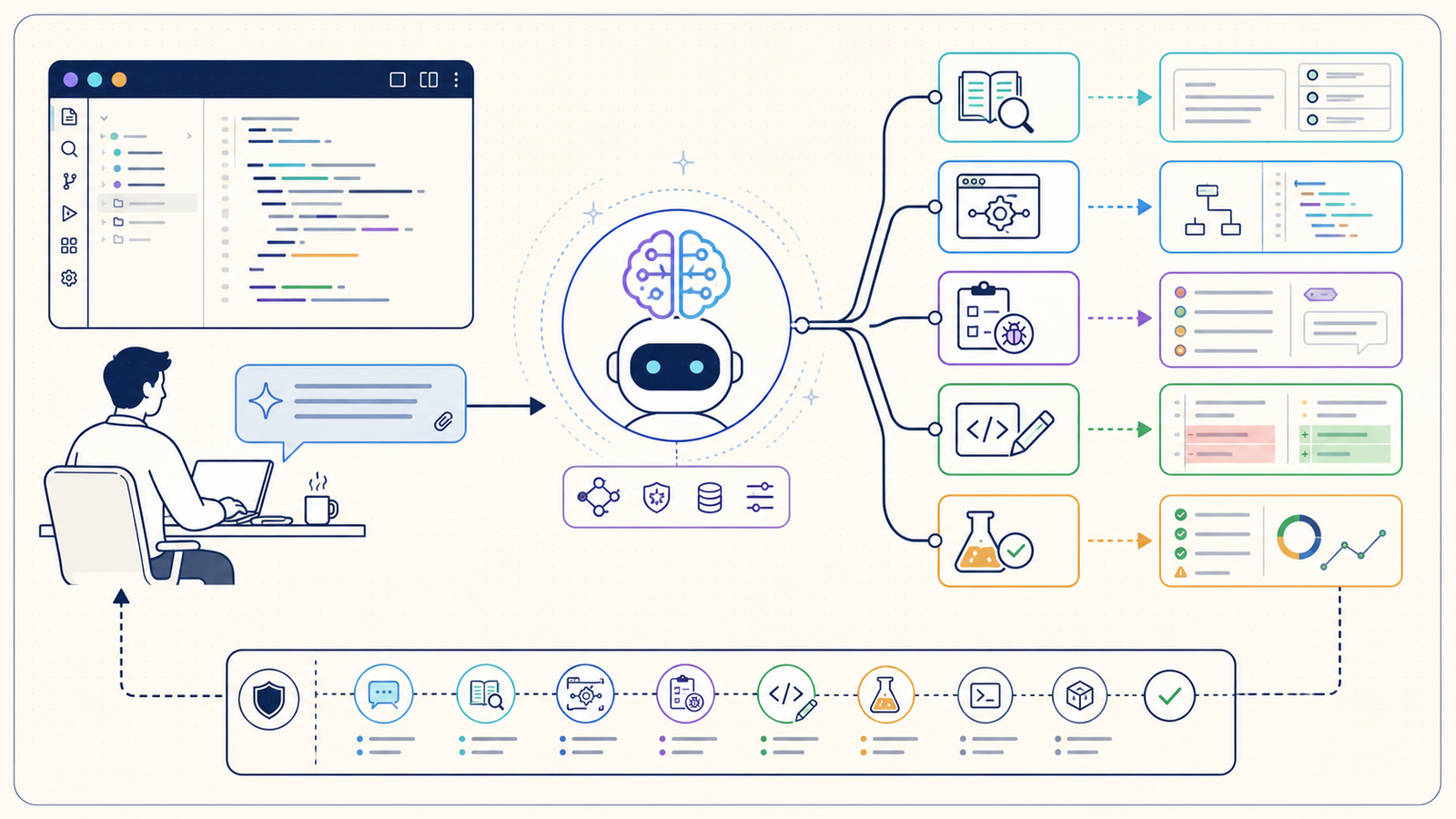
From Coding Assistant to Developer Automation Agent
OpenCode helps developers execute coding agent workflows in terminal or code environments. But a truly useful developer automation agent cannot rely solely on model context or local files — it needs to call real external capabilities to query APIs, retrieve documentation, analyze public references, check service status, process files, send notifications, or organize structured results.
Common tasks include API documentation lookup, error and exception research, issue triage, PR preparation, changelog drafting, dependency research, monitoring and status lookup, structured task summaries, and workflow handoff notes.
QVeris gives the OpenCode agent a unified capability layer to discover, inspect, and call these capabilities — instead of requiring the developer to write wrappers for every API, documentation source, or tool.
Why Developer Automation Agents Are Hard to Build with Hardcoded Tools
Three core challenges that make developer automation agent development slow and brittle.
Developer Context Is Spread Across Tools
Code, docs, tickets, logs, APIs, packages, monitoring systems, and public references often live in different places — each requiring its own integration.
Agents Need Tool Schemas Before Action
A useful developer automation agent needs to know required inputs, response format, provider behavior, and cost signals before calling a capability — not after a failed attempt.
Manual Tool Wiring Slows Down Iteration
Hardcoding every docs search, API lookup, monitoring call, or notification provider creates maintenance overhead and slows agent development.
How the OpenCode + QVeris Developer Automation Workflow Works
Built on OpenCode coding agent environment and the QVeris capability routing layer
Describe the developer task in OpenCode
Ask the OpenCode agent to investigate an issue, research an API, summarize a workflow, or automate a development task.
Discover relevant capabilities
The agent uses QVeris to find capabilities for documentation search, API lookup, web research, file processing, monitoring, or notifications.
Inspect schema and cost signals
Before execution, QVeris lets the agent inspect required inputs, output format, parameters, provider information, and billing signals.
Call selected capabilities
The agent calls selected capabilities and receives structured results that downstream code can consume directly.
Turn results into developer actions
OpenCode can use the returned output to create a task summary, debugging plan, issue triage note, implementation checklist, or workflow handoff.
What You Can Automate in OpenCode with QVeris
Six concrete developer automation scenarios powered by OpenCode + QVeris capabilities.
API Documentation Lookup
Let the agent find and structure relevant API information before generating integration code or implementation notes.
Issue Triage Assistant
Analyze an issue description, gather context, classify the problem, and return suggested next steps for a developer.
Error Research Workflow
Research error messages, logs, public references, and relevant documentation to generate a structured debugging plan.
Dependency Research Agent
Look up package information, compatibility notes, usage examples, or migration context before changing dependencies.
Release Note and Changelog Helper
Collect structured context from commits, docs, or project notes and turn it into a draft release summary.
Developer Workflow Handoff
Summarize findings, open questions, implementation steps, and recommended follow-up actions for another developer or team.
Example Structured Output for a Developer Automation Agent
Illustrative example of structured output from QVeris capabilities. This is not data from a real repository or private issue.
This is an illustrative example. It does not represent real repository data, private issues, customer engineering projects, or guaranteed debugging outcomes. Developers should review, test, and validate all changes.
OpenCode Alone vs Hardcoded Tools vs OpenCode + QVeris
| Requirement | OpenCode alone | Hardcoded tools | OpenCode + QVeris |
|---|---|---|---|
| Access to external developer tools | Limited to model context, local files, or user-provided inputs | Possible, but each tool or API requires custom setup | ✓Agent can discover and call relevant developer capabilities through one layer |
| Tool discovery | No unified capability discovery by default | Developers manually choose and wire providers | ✓Discover relevant capabilities based on the development task |
| Schema understanding | No provider schema by default | Developer reads and maintains provider docs | ✓Inspect schema, parameters, and cost signals before calling |
| Workflow speed | Good for local coding assistance | Slower due to integration overhead | ✓Faster developer automation with reusable capability calls |
| Visibility | No external capability usage history | Usage spread across multiple dashboards | ✓Usage can be reviewed through QVeris usage history and credits ledger |
Who Should Use This Workflow?
AI Coding Agent Builders
Developers building coding agents that need external tools, docs, APIs, and structured task execution beyond local context.
Platform Engineering Teams
Teams automating internal developer workflows such as issue triage, docs lookup, debugging support, or handoff summaries.
Startup Developers
Small teams that want to prototype developer workflows faster without wiring every provider manually from scratch.
Agent Framework Developers
Builders who want OpenCode agents to call real capabilities instead of relying only on model context or local files.
A Practical Pattern for Developer Automation Agents
A conceptual workflow pattern — not an installation tutorial. Adapt this to your own OpenCode agent workflow.
Developer defines the automation task
The developer describes the automation goal in OpenCode — issue triage, API research, error investigation, or workflow summarization.
Agent discovers relevant QVeris capabilities
The agent queries QVeris for capabilities matching the task type, required data, and output structure.
Agent inspects schemas, parameters, and costs
Before execution, the agent inspects required inputs, output formats, provider metadata, and billing signals.
Agent calls selected capabilities
The agent executes selected developer or research capabilities with inspected parameters and receives structured responses.
Agent structures results into actions
OpenCode transforms the structured output into a task list, debugging plan, triage notes, or implementation checklist.
Developer reviews and applies the output
The developer reviews the structured automation output, verifies assumptions, and applies the recommended actions.
developer_task = {
  "goal": "triage an integration issue",
  "inputs": ["error_message", "api_context", "expected_behavior"],
  "steps": ["discover", "inspect", "call", "summarize", "review"]
}
This is a conceptual pattern for illustration. It does not represent working code or a specific QVeris API endpoint. Adapt based on your actual project setup.
Continue Exploring QVeris
All Tools Directory
Browse the complete catalog of AI agent tools, platforms, and developer capabilities.
Best MCP Tools
Discover top MCP platforms for connecting agents to developer tools and services.
Web Research Agent in Claude Desktop
Explore web research, source discovery, and structured brief scenarios.
Stock Research Agent in Cursor
Explore financial research — stock screening and market analysis.
Frequently Asked Questions
Can I build a developer automation agent in OpenCode with QVeris?
Is this an OpenCode integration page?
What developer workflows can I automate?
Do I need to hardcode every developer tool integration?
Why does schema inspection matter for developer automation agents?
Does QVeris replace OpenCode?
Is the example output based on a real repository?
Can this guarantee a bug fix?
Build Your Developer Automation Agent in OpenCode
Use QVeris to give your OpenCode workflow access to real-world capabilities for API lookup, documentation research, issue triage, and developer automation.