
Choose the Best Options Data API
for Your Workflow
Compare coverage, delay, rate limits, licensing, Greeks, IV, and historical depth before choosing a provider.
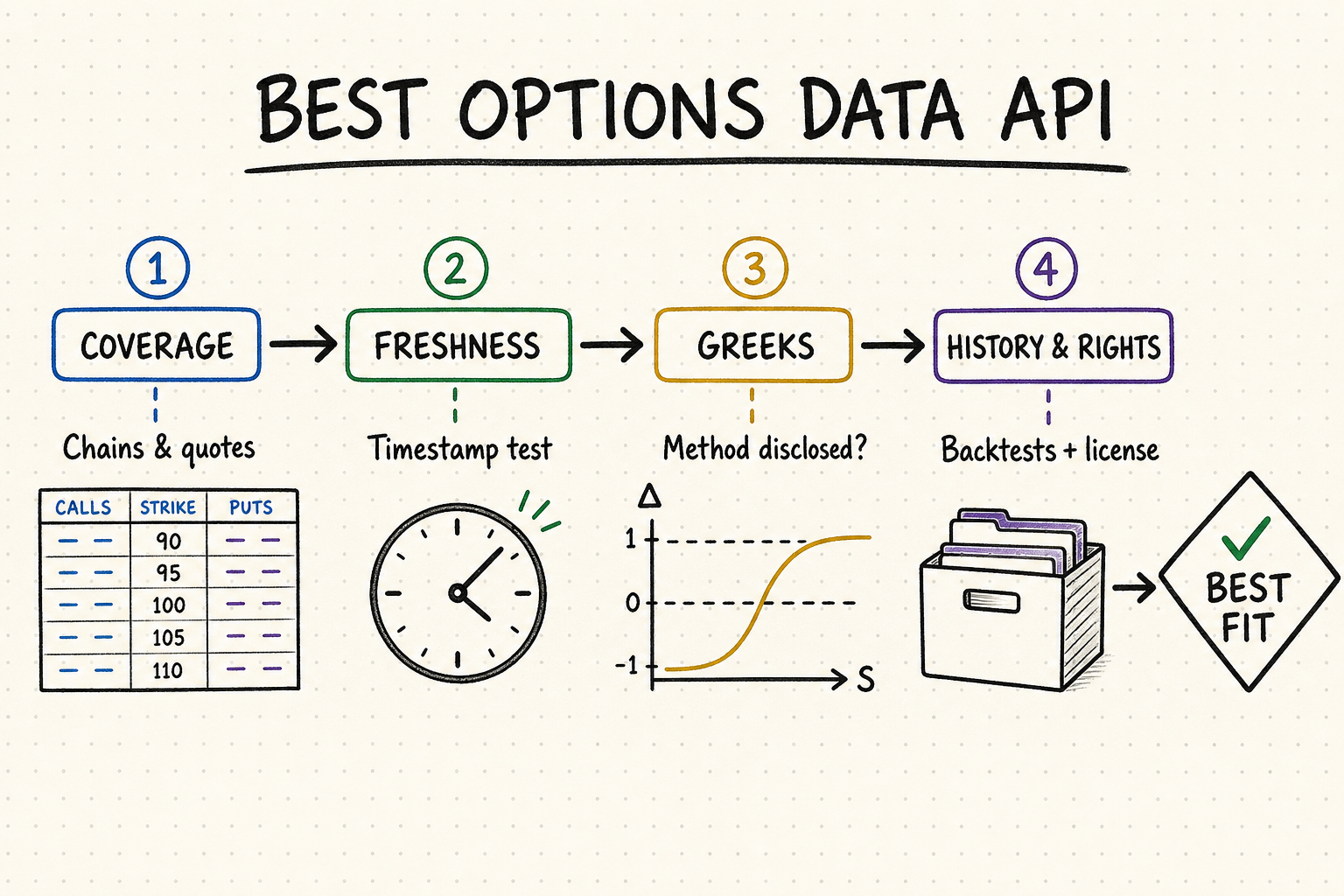
TL;DR
The strongest provider is the one that matches your contracts, latency, history, analytics, and usage rights.
Contract coverage, quote delay, historical depth, Greeks, implied volatility, and request quotas differ sharply.
Exchange entitlements and redistribution rights can matter more than the advertised API subscription price.
Define the exact fields and latency you need, then validate one complete chain response before integration.
For a trading interface, prioritize entitlement-correct live quotes, resilient streaming, and contract lookup. For screening, prioritize complete chain snapshots, consistent Greeks, and predictable bulk limits. For backtesting, prioritize expired contracts, point-in-time history, adjustments, and reproducible downloads. A provider can be excellent for one of these workloads and unsuitable for the others, so the “best” API should be selected against a written acceptance test rather than a generic feature count.
What the best options data APIs should include
Options data is not one dataset. A useful evaluation separates reference data, chain snapshots, market quotes, calculated analytics, and historical records. A provider may offer one category free while charging for another.
Underlying symbol, expiration, strike, call or put, contract identifier, exchange, and exercise style form the base schema.
Bid, ask, midpoint, last trade, volume, and open interest may be real-time, delayed, end-of-day, or absent.
Delta, gamma, theta, vega, rho, and IV may be vendor-calculated; confirm methodology and timestamp semantics.
Check whether history contains expired contracts, quotes rather than only trades, corporate-action adjustments, and point-in-time records. Ask how late corrections and vendor backfills are versioned.
Compare REST snapshots, WebSocket streams, pagination, snapshot sequence numbers, status messages, quota headers, and retry guidance. A usable feed must reveal gaps and reconnect state instead of silently resuming with missing updates.
Separate the API subscription from exchange fees and user entitlements. Confirm whether data may be cached, displayed to customers, used by an automated agent, stored for backtests, or redistributed in derived products.
Compare options data API provider types
| Provider type | Typical access | Best for | Watch for |
|---|---|---|---|
| Broker API | Current chains and account-linked market data. | Trading apps and personal workflows. | Account, entitlement, and redistribution limits. |
| Market data vendor | Commercial chains, quotes, analytics, and history. | Production research, screening, and backtesting. | Exchange fees, retention, and redistribution rights. |
| Exchange or regulator | Reference files, delayed summaries, or reports. | Validation and official definitions. | Often not a developer-ready full chain API. |
| Community library | Convenient wrappers around public endpoints. | Exploration, education, and notebooks. | Unofficial endpoints and breaking changes. |
Compare total production cost, not the first monthly price shown. Include exchange entitlements, professional-user status, separate historical packages, WebSocket connections, bulk-download fees, overages, retention, support, and the engineering cost of normalizing identifiers or filling coverage gaps. A lower-priced endpoint can become the expensive choice if every chain requires hundreds of calls or if its license forces a second feed for customer-facing output.
Which options data API fits each production workload?
A useful shortlist starts with the job the data must perform. The providers below are not interchangeable: one emphasizes consolidated market events, another supplies modeled volatility analytics, another delivers research files, and broker-linked APIs combine data with an account workflow. Treat this as a candidate map, then verify the current plan, entitlement, retention, and redistribution terms directly with each provider.
| Candidate | Strongest fit | What official documentation confirms | Validate before choosing |
|---|---|---|---|
| Polygon.io | Live monitoring, intraday research, complete U.S. options market events, and applications that need REST, WebSocket, or flat-file delivery. | Its options documentation describes real-time and historical reference, quote, trade, aggregate, and snapshot data sourced through OPRA from all U.S. options exchanges. | Confirm the plan's recency, history depth, connection limits, professional status, exchange entitlements, and customer-display rights. |
| ORATS | Volatility research, Greeks, surface analysis, end-of-day studies, and one-minute historical strategy testing. | ORATS documents live, delayed, historical end-of-day data back to 2007 and one-minute history back to August 2020, enriched with modeled indicators and smoothed values. | Reconcile its calculated IV and Greeks with your methodology; confirm exact delay, live-data agreements, symbol coverage, timestamp meaning, and point-in-time reproducibility. |
| Cboe DataShop | Historical market-microstructure research, auditable trade files, NBBO-at-trade analysis, and large offline studies. | Cboe's Option Trades product includes trade price and size, execution exchange, NBBO at trade time, and underlying bid/ask; its historical coverage is listed from January 2012. | Do not assume a downloadable research dataset behaves like a low-latency application API. Check delivery schedule, file size, corrections, index licensing, and intraday availability. |
| Alpaca or Tradier | Broker-linked trading tools, paper workflows, account-aware market access, and teams that prefer one integration for data and orders. | Alpaca documents option chains, snapshots, historical endpoints, and WebSocket feeds with separate indicative and OPRA sources. Tradier documents real-time options data for brokerage accounts and delayed sandbox data. | Separate convenience from completeness. Check whether the account requirement, indicative feed, available history, Greeks cadence, sandbox differences, and redistribution terms match the deployed product. |
A practical elimination test before procurement
Build a fixed contract universe containing a liquid weekly option, an illiquid far-dated contract, an adjusted contract after a corporate action, and an index option if the product needs one. During the open, midday, and a volatile interval, collect a complete chain plus incremental updates. Record missing contracts, crossed or one-sided quotes, stale age, event-to-arrival latency, pagination time, reconnect gaps, correction behavior, and the percentage of rows with usable IV and Greeks. Repeat the same requests for a prior date and verify that a rerun produces the same point-in-time result or a documented new version.
If required symbols, expirations, fields, or rights are missing, a high score elsewhere cannot rescue the provider. Treat these requirements as pass-or-fail gates.
A reasonable production score can weight completeness and rights at 25% each, latency and recovery at 15% each, historical reproducibility at 10%, and annual total cost plus support at 10%. Change the weights to match the product, but preserve the raw evidence.
Before replacing an existing source, operate both feeds against the same requests for several representative sessions. Compare contract identity, timestamps, gaps, calculated fields, and downstream decisions before cutting over.
Best options data API selection checklist
Test liquid, illiquid, weekly, long-dated, index, and multi-listed contracts that resemble your workload.
Record source timestamps, arrival times, stale-quote frequency, and behavior around the open. “Real-time” can depend on exchange entitlements and account status.
Confirm stable option identifiers, underlying IDs, exchange, multiplier, exercise style, settlement, adjusted deliverables, null semantics, and whether the same contract resolves consistently across snapshot, quote, and historical endpoints.
Compare implied volatility and Greeks on a fixed contract set. Request the pricing model, rates, dividend treatment, underlying reference price, calculation timestamp, and behavior when quotes are crossed, stale, or one-sided.
Fetch several complete chains at the open and during a volatile session. Measure pagination, concurrent limits, stream reconnects, missing sequence handling, retry behavior, and whether rate-limit errors expose a safe reset time.
Test the exact deployment: internal research, personal app, automated trading, customer display, or redistribution. “API access” does not automatically grant every downstream use.
Use weighted acceptance criteria for required contracts, completeness, p95 latency, uptime, historical reproducibility, support, rights, and annual cost. Keep failed test cases beside the final score.
Use QVeris to discover options data capabilities
QVeris helps developers and agents discover callable options-data capabilities, inspect required inputs and response shapes, and compare provider boundaries before routing a request. It can reduce discovery and integration work; the application still owns entitlement checks, contract normalization, latency testing, calculated-field validation, fallback behavior, and the final provider decision.
- Search by capability such as options chains, quotes, Greeks, implied volatility, or historical data.
- Inspect required parameters and response shape before writing integration code.
- Keep provider-specific limits and licensing in your own production acceptance checklist.
FAQ
There is no universal winner. Choose by coverage, measured latency, history, analytics methodology, licensing, reliability, and production cost.
Use them only after validation. Calculations and timestamps vary, so verify model inputs, the risk-free rate, dividend assumptions, and update frequency.
A broker API can fit account-linked trading and personal tools. An independent vendor often fits multi-broker products, commercial display, deeper history, or broader analytics. Compare rights and coverage, not the label.
It should identify the source venue, applicable entitlement, event timestamp, delivery timestamp, delay policy, and session. A real-time endpoint can still deliver stale individual contracts in an inactive chain.
Use streaming when the application must react continuously to quote or trade updates. REST snapshots are often simpler for occasional screening. Many systems use a snapshot to initialize state and a stream to maintain it.
Model calls per complete chain, concurrent users, stream connections, history, storage, exchange fees, overages, redistribution rights, support, and fallback data. Convert the result into annual cost for the expected workload.