
Best Free Options Data API
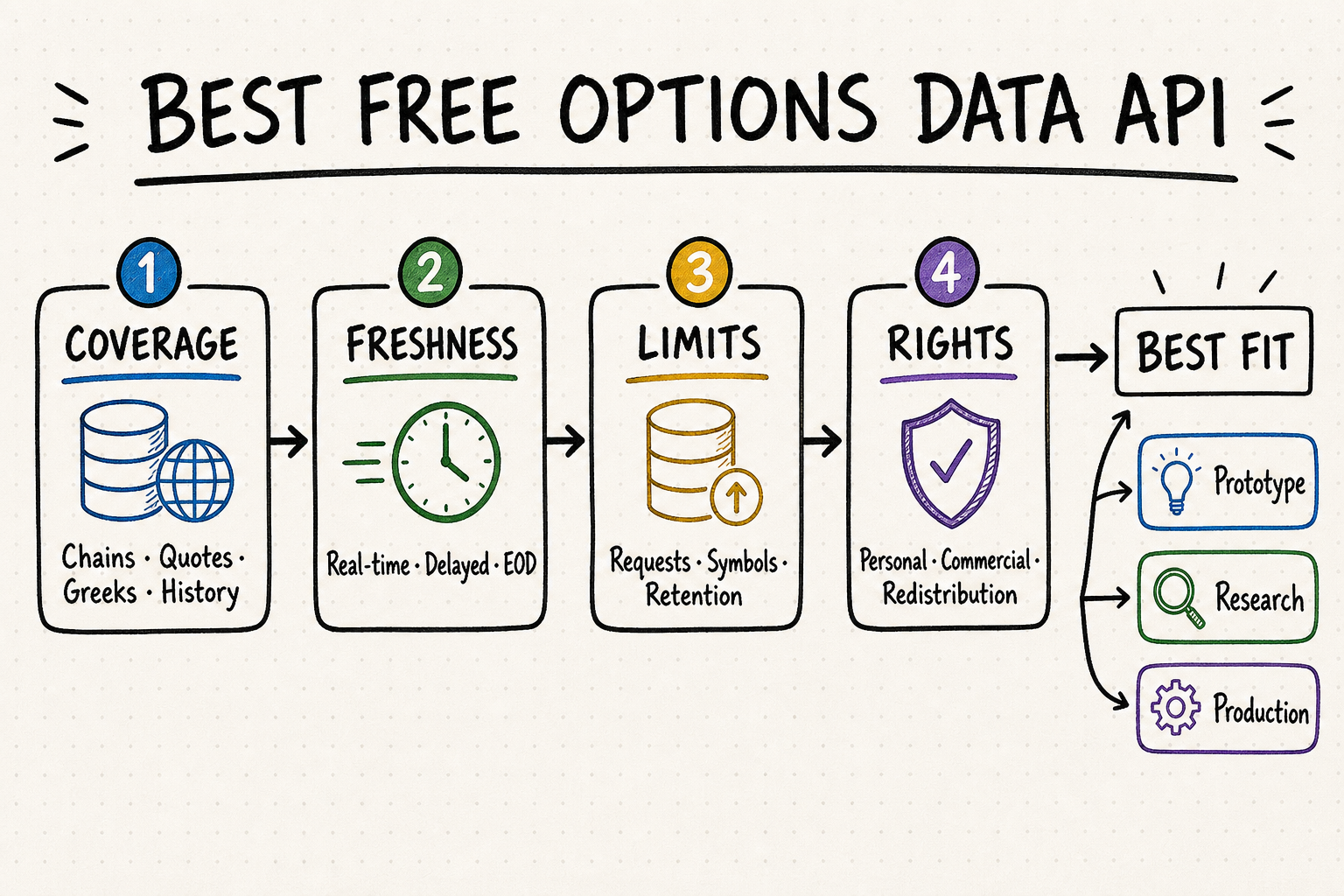
Compare free choices by chains, quotes, Greeks, historical depth, data freshness, request limits, and usable licensing—not by “free” alone.
TL;DR
Choose a documented REST API with filtered chains and predictable JSON, even if quotes are delayed.
An account-linked broker API can suit personal trading tools when entitlements and usage terms fit.
Prioritize reproducible historical snapshots, corporate-action handling, and stable contract identifiers.
The winner is the service that meets your required fields, freshness, volume, and rights at the same time.
For learning and schema validation, delayed chains with clear documentation may be the best free choice. For a personal broker-linked dashboard, account entitlements can make a broker API more useful than a public endpoint. For historical research, “free” is valuable only if expired contracts and observation times remain reproducible. No-cost access should be judged by the complete usable workflow, including sign-up, entitlement, quota, retention, and permitted output—not by a zero-dollar headline.
What a free options data API can include
Underlying symbol, expiration, strike, call or put, contract identifier, exchange, and exercise style form the base schema.
Bid, ask, midpoint, last trade, volume, and open interest may be real-time, delayed, end-of-day, or absent.
Free endpoints may calculate delta, gamma, theta, vega, rho, and IV only for current chains or selected contracts. Record the model inputs, timestamp, underlying reference price, rate, dividend treatment, and null policy.
Check weekly, monthly, LEAPS, index, adjusted, and expired contracts. Preserve listing date, last trade date, settlement type, multiplier, deliverable, and a stable identifier through symbol changes.
Separate current-chain lookup from historical quote, trade, chain-snapshot, open-interest, and analytics access. A free “history” endpoint may expose only settlements or a short rolling window.
Require remaining quota, reset time, endpoint weight, pagination, maximum contracts, delay class, attribution, and error details. These fields determine whether the free plan can be automated safely.
Best free options data API choices by use case
| Source type | Typical free access | Best for | Watch for |
|---|---|---|---|
| Documented free-tier vendor | Filtered chains, delayed quotes, IV, Greeks, and limited history. | Fast prototypes and learning a stable schema. | A full chain may consume many credits; freshness can be a day behind. |
| Broker API | Account-linked chains and market data under user entitlements. | Personal dashboards, alerts, and trading workflows. | Authentication, account requirements, and redistribution restrictions. |
| Exchange or educational source | Definitions, calendars, statistics, delayed summaries, or downloads. | Validation, market context, and official reference material. | Usually not a complete developer-ready chain and quote API. |
| Unofficial wrapper | Convenient access to public or reverse-engineered endpoints. | Disposable experiments and classroom notebooks. | Schema changes, blocking, unclear rights, and no service guarantee. |
Shortlist by disqualifiers first. Remove any option that lacks a required contract type, violates the intended license, cannot return a complete chain within quota, or cannot meet the maximum acceptable delay. Then run the same workload through the remaining candidates and compare chain completeness, source-time age, calls or credits consumed, response stability, error handling, and the engineering needed to normalize it. This produces a defensible “best free” choice for the actual project rather than a universal ranking.
Actual free options API candidates—and the boundary of each
A concrete shortlist is more useful than a generic provider ranking, but the word “free” describes different access models. One service offers an indicative feed at no cost, another offers delayed sandbox data and reserves real-time quotes for brokerage accounts, while a third advertises a free API key but marks its options endpoints as premium. Treat these as different products rather than rows in one interchangeable price table.
| Candidate | What official documentation currently confirms | Good starting use | Do not assume |
|---|---|---|---|
| Alpaca Basic | The zero-cost Basic plan includes an indicative options feed. Alpaca describes it as a derivative of OPRA rather than actual OPRA quotes; indicative trades are delayed. Its historical options documentation currently states availability beginning in February 2024. | Learning the schema, testing contract discovery, building non-execution prototypes, and measuring chain retrieval. | Do not treat indicative quotes as executable consolidated quotes or infer that the free plan includes unrestricted historical OPRA access. |
| Tradier Sandbox | Tradier documents delayed equity and options data in its sandbox. Real-time US stock and options data is available to Tradier Brokerage account holders; the documentation currently lists Greeks as hourly for brokerage access and unavailable in sandbox. | Testing authentication, option symbology, expiration discovery, chain parsing, and order-workflow integration before using account-entitled data. | Do not describe sandbox results as real time or assume that opening an API project alone grants live consolidated options data. |
| Alpha Vantage | The documentation describes real-time US options and full historical chains with Greeks and IV, but currently labels both real-time and historical options functions as premium. A free API key therefore does not by itself make these options endpoints free. | Evaluating documented response shape and comparing the paid upgrade path when long history is required. | Do not include it in a “completely free historical options API” list without stating the premium endpoint requirement. |
| Exchange and educational sources | Cboe, OCC, and OIC publish authoritative product rules, calendars, statistics, and education that help validate contract and settlement behavior. | Reference validation, settlement logic, product eligibility, and test-case design. | Do not assume an educational or statistics page is a free, production-ready full-chain quote API. |
A 30-minute shortlist test
Create the allowed account or sandbox token, call one documented chain endpoint, and record the feed name, entitlement, source timestamp, HTTP headers, and returned fields. An authorization error is a result, not a setup inconvenience to ignore.
Use a liquid underlying and an expiration with many strikes. Count expected and returned calls and puts, inspect zero bids, wide spreads, contract IDs, multipliers, and the oldest versus newest quote timestamp.
Try a historical date, a second page or large symbol batch, a Greeks request, and a quote outside the latest free window. Record whether failure is caused by entitlement, history, quota, or missing data.
Accept the candidate only if its actual feed can support the intended display, research, or broker workflow. Otherwise classify it as a schema sandbox, reference source, paid-upgrade candidate, or unsuitable option instead of calling it “best.”
Free options data API selection checklist
Test liquid, illiquid, weekly, long-dated, index, and multi-listed contracts that resemble your workload.
Record source timestamps and arrival times. “Real-time” can depend on exchange entitlements and account status.
Count contracts returned, pagination, retries, and refresh frequency. A chain endpoint can consume quota per contract rather than per HTTP call.
Personal access does not automatically permit a public dashboard, client delivery, caching, derived products, or redistribution.
Document whether access needs an account, funded balance, brokerage approval, exchange agreement, professional-status declaration, payment card, or manual review. Free pricing does not mean anonymous access.
For a fixed underlying and expiration, compare expected and returned calls, puts, and strikes; flag duplicates, missing wings, stale quotes, inconsistent multipliers, and mixed timestamps.
Compare Greeks and IV for liquid, illiquid, zero-bid, crossed, deep in-the-money, and far out-of-the-money contracts. Missing or unstable model inputs can make a free calculated field misleading.
Calculate when symbols, refresh rate, history, users, or commercial rights exceed the free tier. Record the paid path and an alternative provider before the prototype becomes operationally dependent.
Use QVeris to discover options data capabilities
QVeris helps developers and agents discover callable options-data capabilities, inspect inputs and outputs, and compare documented provider boundaries before routing a request. It can reduce discovery work; the application still owns entitlement checks, free-tier monitoring, contract normalization, chain completeness, analytics validation, license compliance, and the upgrade or fallback decision.
FAQ
Unrestricted real-time exchange data is uncommon. Free access often requires an account, carries delays, or has tight quotas and usage terms.
Some do, but calculations and timestamps vary. Verify the model inputs, risk-free rate, dividend assumptions, and update frequency.
Common offers include delayed current chains, limited underlyings, small request quotas, end-of-day values, short history, sample files, or broker-entitled access. The exact combination matters more than the word “free.”
The API may have no separate subscription, but access can require an account, exchange agreements, market-data fees, funded status, or nonprofessional eligibility. Include all prerequisites in the cost.
It depends on pagination, expiration filters, contracts per response, and whether quotes and Greeks use separate endpoints. Measure a complete representative chain rather than treating one HTTP request as one unit of work.
Upgrade or switch when required coverage, freshness, history, reliability, users, legal rights, or support exceeds the free contract. Make the threshold measurable before launch.