
Task fit
Prefer an API that returns the smallest authoritative object needed for the decision. A broad endpoint that dumps pages of text creates more ambiguity than capability.
Compare APIs for Gemini across research, multimodal data, and tool calling, with access and failure checks.
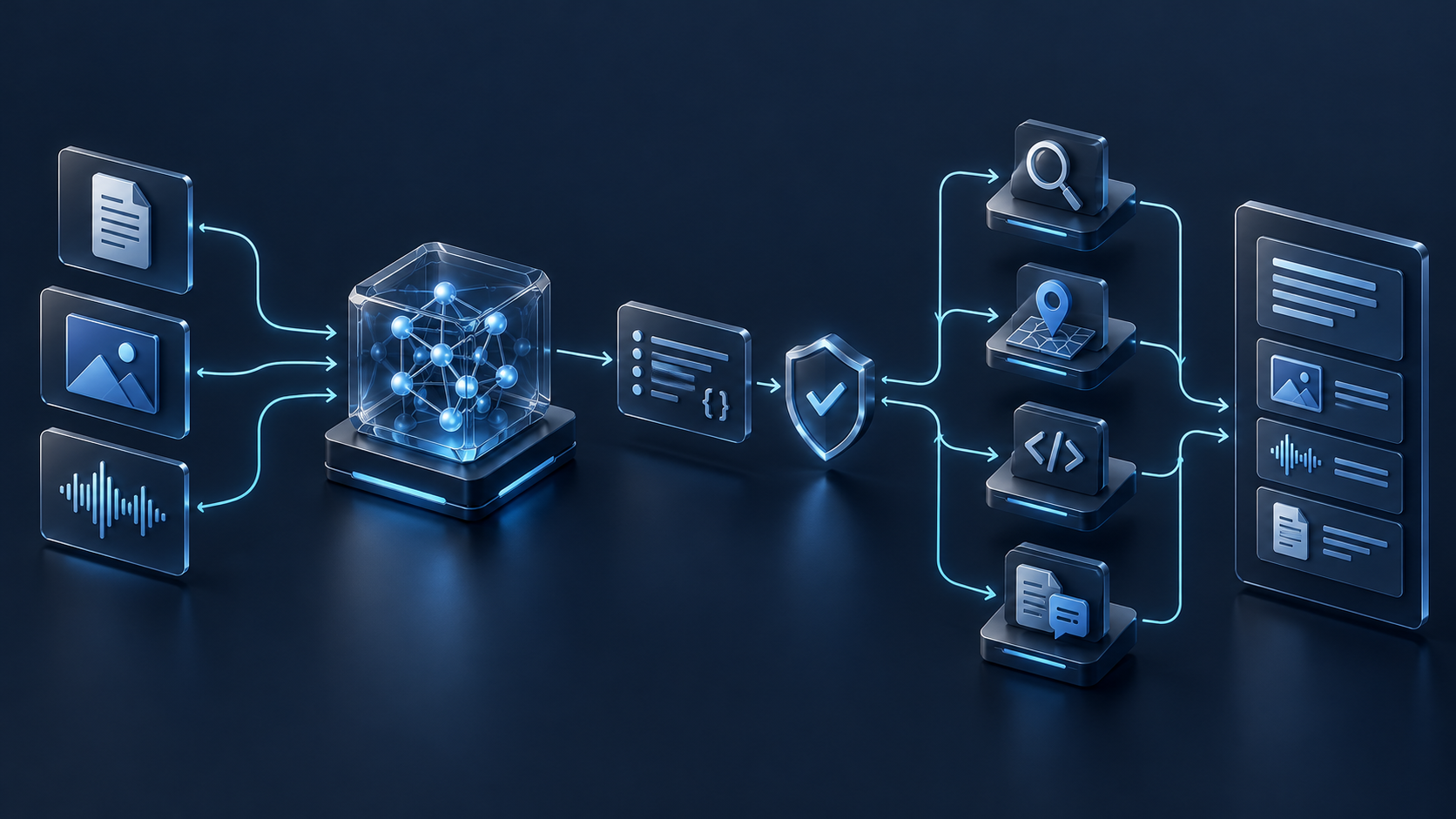
Gemini supports function calling: your application describes functions, Gemini selects a function and arguments, and your code executes it. Google’s official guide is explicit that execution remains your responsibility. That boundary is the foundation of a reliable stack—not an implementation detail.
Prefer an API that returns the smallest authoritative object needed for the decision. A broad endpoint that dumps pages of text creates more ambiguity than capability.
Authentication, allowlists, scopes, budgets, idempotency, confirmation, and audit logs must live outside the model. Treat generated arguments as untrusted input.
Return source IDs, timestamps, status, and compact fields. The final answer should distinguish provider facts from Gemini’s interpretation.
This is a use-case shortlist, not a universal ranking. Availability, pricing, quotas, data residency, and terms can change; verify the linked official documentation before production use.
| API | Best Gemini job | Why it fits | Main control |
|---|---|---|---|
| Google Search / Maps tools | Current information and location-aware answers | Managed tools can ground responses without building every connector yourself. | Citations, geography, freshness |
| GitHub REST API | Issue triage, PR context, checks, release workflows | Structured repository objects map cleanly to engineering decisions. | Pin repository and SHA; use fine-grained scopes |
| Slack Web APISlack provider details | Channel search, summaries, approval handoffs | Turns team communication into retrievable events and controlled messages. | Channel allowlist; preview before posting |
| Notion APINotion provider details | Knowledge retrieval and structured page updates | Useful when the source of truth is databases and pages rather than chat. | Limit shared pages and editable properties |
| Stripe APIStripe provider details | Billing lookup, payment support, approved commerce actions | Strong object model, test environments, request IDs, and idempotency patterns. | Never let model text set amount or recipient unchecked |
| Twilio API | SMS, voice, status notifications, support workflows | Makes the final mile of a workflow programmable across channels. | Consent, recipient allowlist, templates, rate limits |
A useful Gemini tool contract is smaller than the provider API. Wrap only the operations the workflow needs, normalize their responses, and keep provider authorization in application code.
Use managed Gemini tools for current web information, place discovery, directions, and geographic context. Google executes these built-in tools inside the model request, shortening the integration path. Preserve citations, place IDs, timestamps, and geographic assumptions; do not treat a search snippet as final evidence.
GitHub is a strong first integration for software delivery because issues, commits, pull requests, reviews, and checks are structured objects. Pin every analysis to a repository and SHA. Start with retrieval and triage; generate comments or changes as drafts before submission.
Slack works best as an event and handoff layer: retrieve a bounded thread, summarize an incident channel, or draft a message carrying evidence from another API. Search and posting need separate tools. Require a visible preview and channel allowlist before sending.
Notion fits workflows whose source of truth is a curated database or page hierarchy. Preserve page IDs and last-edited times so Gemini can flag stale context. For writes, constrain the destination database and editable properties instead of accepting arbitrary page content.
Stripe is appropriate for explaining billing state, retrieving payment objects, or preparing a tightly controlled action. Separate lookup from mutation. Resolve customer, currency, amount, and entitlement from trusted application state—not free-form model output.
Twilio provides delivery for SMS, voice, and messaging workflows. Gemini can select a template and fill bounded variables; the application must resolve the recipient, check consent and quiet hours, enforce rate limits, and record the provider message ID.
Name the action precisely, describe when it should and should not be used, keep required parameters minimal, and use enums for bounded choices.
Gemini selects the function and emits structured arguments. It has proposed an action; it has not authorized or completed one.
Validate types and business rules, resolve identity server-side, enforce resource and spending limits, and require approval for consequential writes.
Attach request IDs and idempotency keys where supported. Timeouts do not prove failure: inspect remote state before retrying.
Send Gemini status, stable IDs, timestamps, source URLs, and only the fields needed to explain the result. Store the full audit event outside the prompt.
The following are implementation patterns, not measured customer outcomes. Each starts with a bounded read, preserves provider evidence, and places consequential writes behind a separate control.
Success evidence: all claims resolve to a PR, check, review, or commit URL.
Success evidence: external statements cite sources; internal claims cite page IDs.
Success evidence: Stripe object and request IDs plus Twilio message SID.
Gemini chooses the right provider but the wrong operation. Split reads from writes, use intent-specific names, remove unused parameters, and test deliberately ambiguous requests.
Do not return entire channels, repositories, or page trees. Filter server-side, paginate intentionally, cap text fields, and expose a stable ID for follow-up retrieval.
A timeout is an unknown state, not proof of failure. Query by request or idempotency key, reconcile remote state, and retry only when the operation is absent or safely repeatable.
Issue bodies, web pages, and messages can contain prompt injection. Label retrieved content as data, strip active markup, keep policy in a separate trusted layer, and block tool-scope escalation.
Documentation proves an API can perform an operation. A fixed evaluation set proves whether the Gemini workflow selects it correctly, remains inside policy, and recovers from realistic failures.
Record the manual steps, trusted sources, required evidence, permissions, latency, and final human decision.
Run normal, missing, stale, paginated, unauthorized, rate-limited, and malformed responses.
Inject hostile text, force a timeout, rotate credentials, and request forbidden resources. Verify safe stops and clear logs.
Require preview, approval, idempotency, and reconciliation. Expand only when failure cases are understood.
Best when Google already offers the grounding capability and its supported behavior matches your task. You trade some low-level control for a shorter integration path.
Best for a stable, application-owned provider with strict performance, schema, or compliance requirements. Your team owns authentication, retries, normalization, and monitoring.
Best when the same model-facing tools should be reusable across compatible clients. MCP standardizes discovery and invocation, but it does not replace provider authorization or business policy.
Best when the workflow starts from a required capability and may span changing providers. Use the QVeris tool directory to inspect available capabilities, then test non-sensitive inputs in the Playground before wiring production credentials.
Gemini can select a declared function and produce its arguments, but your application is responsible for executing custom functions and returning results. Managed built-in tools are different: Google can handle their execution inside the model request.
Choose the API that supports your highest-value, low-risk read task. Search grounding, issue lookup, or internal knowledge retrieval are usually safer pilots than payments, messaging, deletion, or account changes.
No. Expose a small task-specific tool set. Broad catalogs make tool selection harder and expand the attack surface. Add capabilities only after evaluation shows a real need.
Use provider-supported idempotency keys or stable request IDs, then query remote state before retrying. Stripe, for example, documents idempotent requests for safe retries. If the provider cannot reconcile state safely, require manual resolution.
No. MCP standardizes how model-facing tools are described and invoked. You still need provider authorization, input validation, least privilege, approval, rate limits, logging, and incident controls.
Describe the capability, inspect matching tools and parameters, then test with non-sensitive data. Keep production credentials and consequential writes outside the pilot until the failure cases are understood.
Gemini API documentation and capability checks.