
OpenRouter
Model routing for compatibility and fallback checks.
Compare AI infrastructure companies across compute, data, model serving, and observability to decide what to build or buy.
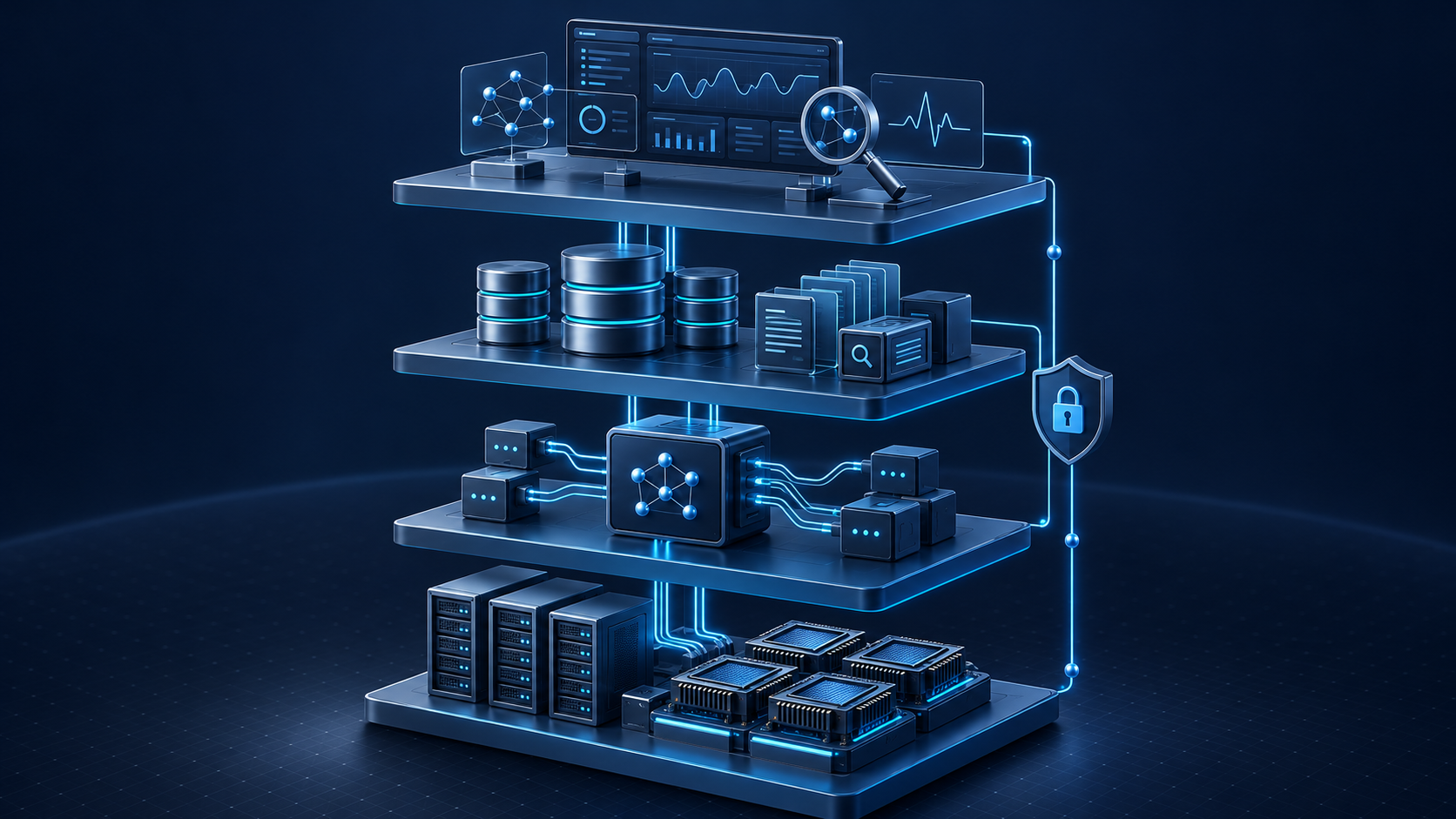
AI infrastructure companies sell the foundational capabilities other teams use to build and operate AI products. The market begins with chips, servers, networking, data centers, and cloud capacity; continues through foundation models and inference; then adds data platforms, retrieval, orchestration, evaluation, observability, security, and agent runtimes. A company may span several layers, but buyers should still evaluate each dependency by the specific job it performs.
Availability, accelerator fit, networking, utilization, scheduling, energy, region, and price determine whether training or inference can run economically.
Quality varies by task, language, modality, context, tool use, safety policy, latency, and update cadence. A leaderboard cannot represent the full workload.
Storage and retrieval are valuable only when freshness, lineage, access control, deletion, and relevance survive the path into the model.
Evaluation, tracing, routing, policy, incident response, and cost controls determine whether a promising prototype can serve real users.
The examples below are representative suppliers, not a universal ranking or investment list. Product boundaries and availability change quickly, so shortlist companies only after defining the workload and checking current official documentation.
| Layer | What companies provide | Representative suppliers | Primary evaluation |
|---|---|---|---|
| Accelerators and systems | GPUs, interconnect, drivers, scheduling, partitioning, and validated enterprise stacks. | NVIDIA and cloud silicon vendors. | Workload fit, availability, utilization, network, software support. |
| AI cloud | Managed capacity, clusters, networking, storage, deployment, and enterprise controls. | AWS, Google Cloud, Microsoft Azure, CoreWeave. | Regions, quotas, provisioning time, reliability, security, total cost. |
| Models and APIs | Foundation models, embeddings, multimodal input, tool use, safety, and managed inference. | Anthropic, OpenAI, hyperscalers, open-model hosts. | Task quality, latency distribution, throughput, privacy, price, deprecation. |
| Inference platforms | Optimized serving, open models, fine-tuning, batching, routing, and dedicated endpoints. | Together AI, Fireworks AI, cloud and model providers. | Tokens per second, queueing, cold starts, model fidelity, isolation. |
| Data and AI platforms | Lakehouse or warehouse, governance, pipelines, model development, search, and AI functions. | Databricks, Snowflake, major clouds. | Lineage, access control, freshness, workload isolation, compute economics. |
| Retrieval | Vector and hybrid search, metadata filters, reranking, connectors, and index operations. | Pinecone, Weaviate, database and cloud vendors. | Recall, precision, filtering, freshness, multitenancy, deletion. |
| Evaluation and observability | Traces, datasets, experiments, evaluators, production monitoring, and debugging. | LangSmith, Arize Phoenix, cloud platforms. | Trace completeness, custom evals, privacy, alert quality, exportability. |
A company can be excellent and still be wrong for your system. Convert requirements into a test set and an operating model before watching demos. Use representative prompts, documents, tool calls, traffic bursts, failure cases, and data classifications. Measure distributions and edge cases rather than one favorable average.
| Dimension | Measure | Evidence to request |
|---|---|---|
| Quality | Task success, groundedness, retrieval relevance, tool accuracy, regression rate. | Your evaluation set, failure examples, repeat runs, version comparison. |
| Performance | Time to first token, end-to-end latency, throughput, queueing, cold start. | P50/P95/P99 under normal and peak load. |
| Reliability | Availability, regional failure, retries, idempotency, recovery, degradation. | SLA wording, incident history, status APIs, tested failover. |
| Security | Identity, tenant isolation, encryption, retention, training policy, audit. | Architecture, control reports, data flow, deletion proof, access logs. |
| Economics | Unit cost, idle cost, storage, egress, observability, support, failed calls. | A bill modeled from your traffic and retention profile. |
| Portability | API semantics, model behavior, data formats, evals, exports, operational skills. | Exit plan, export test, substitute benchmark, migration estimate. |
Score the system, not the brochure: record the provider version, region, quota, configuration, dataset, test date, and raw results. Re-run the same scorecard before a major upgrade or contract renewal.
Buy where a provider creates scale, expertise, and operational leverage that would be expensive to reproduce. Build where your proprietary data, domain policy, workflow, or evaluation method creates durable differentiation. Keep an abstraction only when it protects a real switching need; a lowest-common-denominator wrapper can hide valuable provider capabilities and add its own failure modes.
Assign an owner for compute, model access, data, retrieval, prompts, evaluations, observability, policy, and incident response. “The vendor owns AI” is not an operating model.
Carry request IDs, model and version, retrieval sources, tool calls, latency, token usage, cost, policy decisions, and final outcome through one trace.
Specify what happens when a model, vector index, external tool, region, or evaluator fails. A safe partial answer may be better than invisible fallback with different semantics.
Run a small but real portability exercise before signing a critical contract. Export data, replay evaluations, switch credentials, and measure behavior—not just API compatibility.
QVeris is a capability routing layer for agents, not a substitute for compute, model hosting, or core data infrastructure. This broad market-map topic has no single exact Tool or Provider destination, so the page uses QVeris Docs and the Build a persistent research report. In a production agent, QVeris can help discover, inspect, and call external capabilities while preserving provider and execution evidence.
A core product that helps other teams train, serve, connect data to, evaluate, secure, observe, or operate AI systems belongs in the infrastructure stack.
Often yes when they provide developer APIs, enterprise deployment, safety controls, and operational guarantees used as a production dependency.
Not necessarily. Consolidation can simplify identity and procurement, but it also concentrates failure, pricing, roadmap, and switching risk.
Benchmark the smallest representative workload, prefer managed commodity layers, retain your evaluation assets, and avoid contracts whose minimums exceed validated demand.
Data governance, identity, regions, auditability, contractual controls, recovery, procurement viability, and integration with existing platforms matter alongside quality and cost.
Continuously monitor production, and rerun the formal scorecard before major model versions, architecture changes, capacity commitments, or renewals.
NVIDIA AI Enterprise
AWS Bedrock
Google Cloud Vertex AI
Microsoft Foundry
Databricks AI and ML
Arize Phoenix
QVeris Docs
Build a persistent research report
Model routing for compatibility and fallback checks.