
Choose a Reliable
0DTE Options Data API
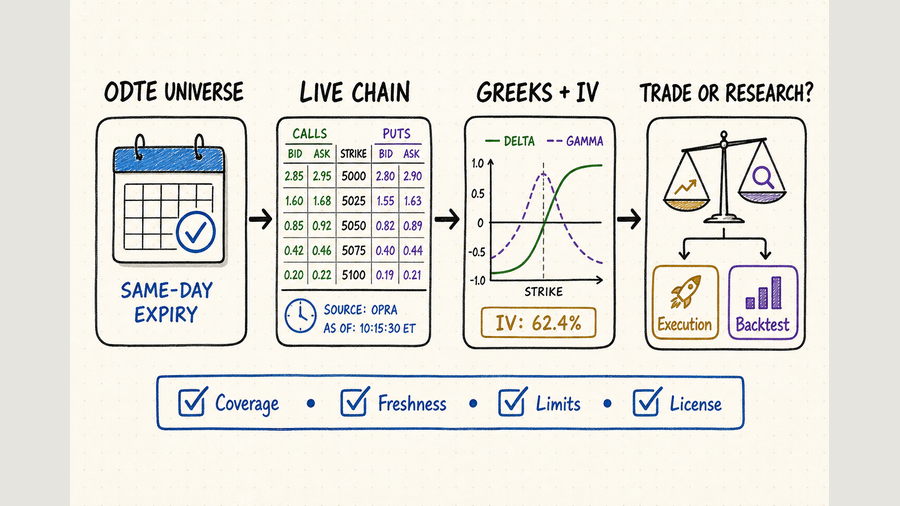
Evaluate same-day chains, source timestamps, Greeks, intraday history, throughput, and licensing before an API reaches research or execution.
TL;DR
A useful 0DTE options data API must identify contracts expiring today and deliver internally consistent quotes, trades, Greeks, IV, and source timestamps fast enough for the intended workflow.
A current-looking chain can still mix delayed quotes, stale open interest, vendor-calculated analytics, and incomplete strikes. Validate every field rather than trusting a “real-time” label.
For monitoring and education, periodic full-chain snapshots may be sufficient. For alerts, market making, or execution, use a synchronized snapshot plus streaming updates, explicit sequence or recovery behavior, and measured end-to-end latency. For historical research, require quote-level records that can reconstruct the chain as it appeared before the decision. The correct feed depends less on the “0DTE” label than on whether it preserves timing, contract state, and executable market context during the final hours.
What a 0DTE options data API must provide
Zero-days-to-expiration is a contract state, not a separate asset class. The API must resolve the trading calendar before returning today’s contracts. For index products, confirm settlement style, last trading time, and holiday handling.
Require a stable identifier, call/put, strike, expiration, exercise style, multiplier, and exchange. Test deep in- and out-of-the-money strikes, not only contracts near spot.
Bid, ask, sizes, trades, volume, and quote condition need source timestamps and a clear time zone. Open interest is normally daily, not a live intraday field.
Determine whether rapidly changing Greeks and IV are exchange-supplied or modeled, which price drives the model, and how zero bids or crossed markets are handled.
Resolve the exchange calendar, early closes, last trading time, AM- versus PM-settlement, cash versus physical settlement, and any product-specific cutoff. A contract can stop trading before the calendar date used in a simple expiry filter.
A chain assembled contract by contract may mix several market moments. Preserve snapshot time, per-contract event time, underlying reference time, sequence information, and completeness so spreads and surface calculations do not combine stale wings with a fresh at-the-money quote.
Include bid and ask sizes, quote conditions, trade conditions, exchange, halt status, and spread. Last price alone can come from an old trade and should not be treated as an executable 0DTE value.
Confirm event or snapshot frequency, retention length, correction policy, and whether expired same-day contracts remain queryable after the session. A live feed without replay cannot independently support a historical 0DTE study.
Match the feed to the 0DTE workload
| Workload | Minimum useful data | Critical test | Main risk |
|---|---|---|---|
| Chain monitor | Snapshots, quotes, Greeks, IV. | Refresh a full chain under quota. | Mixed-time snapshots. |
| Live execution | Streaming quotes and trades. | Measure p95 and recovery. | Polling misses changes. |
| Intraday research | Timestamped history. | Reconstruct one instant. | Incomplete strikes. |
| Backtesting | Historical quotes and trades. | Prevent look-ahead. | Snapshots miss execution. |
Translate the workload into a capacity budget. Count the underlyings, expirations, strikes, refreshes per minute, analytics fields, and simultaneous users; then include discovery calls, reconnect snapshots, retries, and bursts around the open or final hour. This reveals whether a nominally generous request limit can refresh a complete chain before its earliest quote becomes stale.
How to validate a 0DTE API
Capture contract lists, source and arrival timestamps, underlying prices, and a comparison feed near the open, midday, and the final hour.
Count calls for discovery, quotes, and analytics. Then test 429 handling, retry headers, caching, and concurrent connections.
Confirm entitlements, retention, derived-data rights, and redistribution. Record uptime, correction policy, schema versioning, and missing-field behavior.
Use regular sessions, early closes, holidays, expiration mornings, and products with different settlement conventions. Verify that “expires today” follows the venue’s trading date and last tradable moment.
For each capture, compare the newest and oldest source timestamps, expected versus returned strikes, duplicate IDs, crossed markets, zero bids, and the underlying-price timestamp. Set a maximum acceptable skew.
Disconnect the client, drop messages, rotate credentials, and trigger a rate limit. Confirm how the feed signals a gap, whether sequence recovery is possible, and when a fresh snapshot is mandatory.
Replay decisions using only information available before each timestamp. Apply quote-age, size, spread, slippage, and no-fill rules; keep model-generated Greeks separate from observed exchange events.
Worked chain-coherence example. At 15:59:59.500 ET, an application receives an underlying value stamped 15:59:59.200, a same-strike call quote of $2.10 × $2.30 stamped 15:59:59.120, and a put quote of $1.85 × $2.05 stamped 15:59:55.200. The apparent midpoint cost of the straddle is $4.15, but its two legs are almost four seconds apart—material during the final minutes of a 0DTE session. Keep the per-contract source times, calculate the chain’s oldest-to-newest skew, and reject or flag combinations above the workload’s tolerance rather than treating the arrival time as proof of synchronization.
Use QVeris to discover 0DTE data capabilities
QVeris helps developers and AI agents find callable option-chain, quote, trade, Greeks, IV, and historical capabilities, then inspect inputs, outputs, and provider boundaries before routing a request. The application still owns trading-calendar logic, synchronized state, latency and gap testing, contract normalization, execution assumptions, and compliance with the provider’s market-data rights.
- Search for option chain, quote, Greeks, implied volatility, trade, and historical-data capabilities.
FAQ
Usually, but product calendars and settlement conventions matter. Filter using the exchange trading date and contract metadata, not a naive difference between UTC dates.
Only for coarse research when snapshots are historically timestamped and complete. Execution-sensitive testing usually needs historical quotes or events, spread assumptions, and protection against look-ahead bias.
Usually not. Open interest is generally calculated and published on a daily cycle, so label its as-of date separately from intraday volume, quotes, and trades.
REST can support occasional chain monitoring. Execution-sensitive workflows normally need streaming updates, plus a REST snapshot for initialization and recovery. Test both against the same source timestamps.
They may use different underlying prices, rates, dividends, time-to-expiry conventions, pricing models, smoothing, or quote filters. Store the calculation time and methodology before comparing values.
Use contemporaneous bid and ask, available size, quote age, spread, latency, slippage, and a no-fill outcome. Filling every order at midpoint materially overstates many same-day strategies.